

Nearby amenities are defined as the local services, facilities, and retail or leisure spaces within walking or short driving distance of a property, and they directly influence what buyers will pay. Research confirms that local amenities raise property value through classic supply and demand: desirable surroundings attract more buyers, which increases competition and pushes prices upward. Understanding how nearby amenities affect value is no longer optional for serious buyers or investors. Schools, transport links, retail centres, and even digital services like Amazon Fresh all feed into a property's true market worth. This guide uses 2026 research to show you exactly what to look for and how to act on it.
Which nearby amenities most strongly affect UK property values?
Not all amenities carry equal weight. The local amenities impact on property value depends heavily on the type of facility and how well it serves daily life.
Quality schools sit at the top of the hierarchy. Ofsted-rated Outstanding schools consistently attract families willing to pay a premium to secure a place in the catchment area. Transport hubs, particularly well-connected rail stations, follow closely. Retail centres, GP surgeries, pharmacies, and leisure facilities round out the core group that buyers and investors should assess first.

A 2026 study using social media data found that catering spaces have the highest impact on resident life satisfaction at 36.36%, followed by entertainment at 24.93%, personal care at 18.41%, retail at 13.09%, and sports at 7.21%. This ranking matters because it tells you where buyers feel the benefit most acutely in their daily lives, and therefore where they are most willing to pay a premium.
Emerging digital amenities are also entering the picture. E-grocery services like Amazon Fresh now function as intangible amenities, increasing neighbourhood appeal by saving residents time and reducing physical shopping trips. Their presence mirrors the convenience traditionally associated with physical retail, and their influence on buyer desirability is growing.
| Amenity Type | Typical Value Impact | Notes |
|---|---|---|
| Outstanding-rated schools | High | Catchment areas command consistent premiums |
| Rail and tube stations | High | Value depends on walkability and retail integration |
| Catering and restaurants | High | Highest life satisfaction impact at 36.36% |
| Retail centres | Moderate | Brand profile matters as much as presence |
| GP surgeries and pharmacies | Moderate | Particularly valued by families and older buyers |
| Sports and leisure facilities | Lower | Positive but smallest satisfaction impact at 7.21% |
| Digital services (e.g. Amazon Fresh) | Emerging | Growing influence on desirability in urban areas |
Pro Tip: When assessing a property, do not just note which amenities exist. Check their quality ratings, opening hours, and how recently they opened. A new GP surgery or a recently refurbished leisure centre carries more weight than a dated facility that may close.
How does proximity to amenities influence pricing premiums?
Proximity creates value, but only up to a point. The relationship between distance and price is not linear.
Homes within half a mile of a high-quality retail node can command a 2%–5% pricing premium. On a £500,000 property, that translates to £10,000–£25,000 added to the asking price simply because of what is nearby. That figure is significant enough to justify serious due diligence before making an offer.
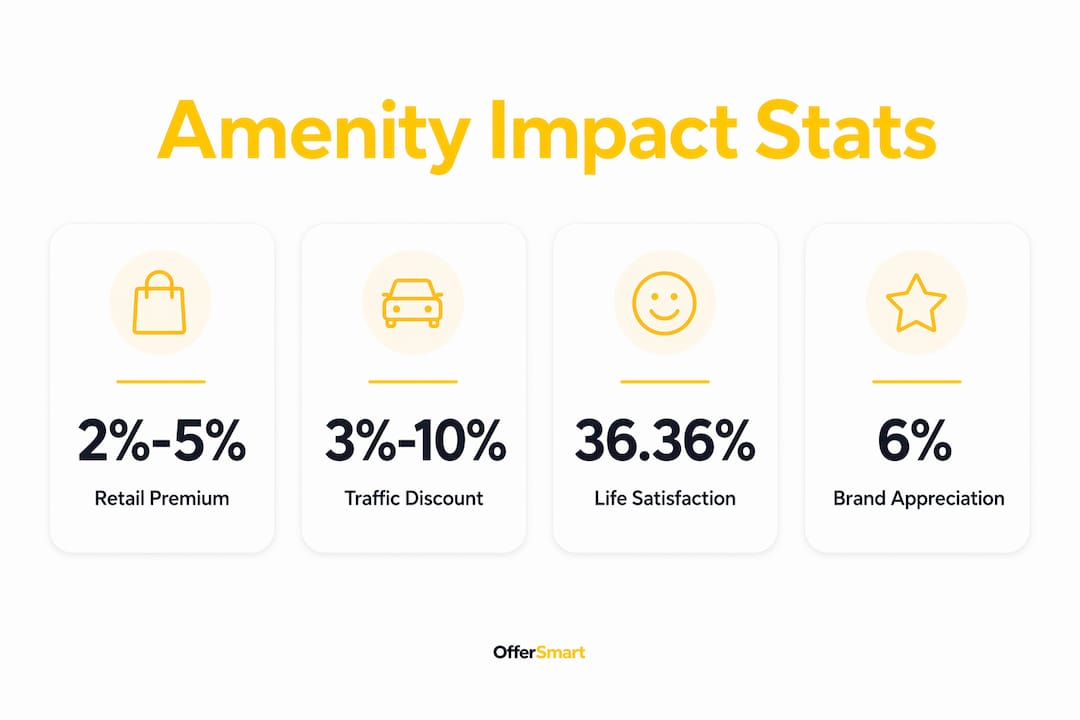
The reverse is equally true. Homes immediately adjacent to high-traffic commercial hubs often trade at a 3%–10% discount due to noise, traffic, and general nuisance. A flat above a busy supermarket or a terrace backing onto a loading bay will reflect that in its price, and rightly so.
Walkability amplifies the positive effect. A December 2025 UK study found that greater diversity of local amenities is strongly associated with reduced daily car use, with an odds ratio of 0.77. Buyers in walkable, multi-functional neighbourhoods are not just buying convenience. They are buying a lifestyle that reduces commuting stress and daily costs.
Key proximity factors to evaluate before making an offer:
- Distance to amenity: The 0.5-mile radius is the sweet spot for positive value impact. Beyond one mile, the premium fades considerably.
- Traffic and noise levels: A restaurant cluster 400 metres away adds value. The same cluster directly outside your front door may not.
- Walkability score: Check whether amenities are accessible on foot without crossing major roads or navigating poor infrastructure.
- Future planning permissions: A quiet green space today could become a retail park tomorrow. Check the local authority planning portal before committing.
- Amenity mix: A single supermarket adds less value than a cluster of catering, retail, and leisure options within the same area.
Pro Tip: Use Google Street View alongside a planning portal search to assess both the current amenity environment and any approved developments within 500 metres of a property you are considering.
How does amenity quality and brand presence shape buyer perception?
Presence alone does not determine value. The brand and quality of a local amenity can shift a neighbourhood's entire price trajectory.
The most striking evidence comes from grocery retail. Neighbourhoods gaining a Trader Joe's saw home price appreciation 6% above the national average over three years. Neighbourhoods where a Walmart opened saw 4% underperformance over the same period. The stores themselves did not build or demolish homes. What changed was the demographic signal each brand sent about the neighbourhood's direction of travel.
The same principle applies across the UK. Consider the difference between a neighbourhood anchored by a Waitrose or Marks and Spencer Food Hall versus one served only by a discount retailer. Both provide groceries. Only one signals the kind of community identity that attracts higher-income buyers and sustains price growth.
Here is how quality and brand presence translate into practical value signals:
- Retail brand profile: Premium or specialist retailers attract a demographic that supports higher property prices. Their presence signals investment confidence in the area.
- Dining and leisure quality: Independent restaurants, wine bars, and well-maintained parks signal a neighbourhood with active community investment. Generic chains in poor condition signal the opposite.
- Community identity: Amenities that reflect a coherent neighbourhood character, such as a farmers' market, an independent bookshop, or a well-funded arts centre, create a lifestyle narrative that buyers pay for.
- Neighbourhood marketing: Sellers who track local amenity improvements and present them as part of a lifestyle story consistently achieve stronger sale prices. Buyers respond to evidence of a neighbourhood improving, not just one that is already established.
The intangible dimension matters too. Market perception and demographic targeting by retailers deeply shape neighbourhood value trajectories. A single new opening can reframe how buyers perceive an entire postcode.
What are the practical implications for UK buyers and investors?
Understanding the importance of neighbourhood facilities is one thing. Translating that understanding into smarter purchase decisions is another.
For buyers, the first step is building what practitioners call a neighbourhood file. This is a running record of local openings, closures, planning applications, and infrastructure upgrades within a one-mile radius of any property you are seriously considering. Maintaining a neighbourhood file helps you identify whether an area is improving or declining, which directly affects whether today's asking price is fair value or a premium you will struggle to recover.
For investors, the calculus extends further. Walkable neighbourhoods with diverse amenities attract both buyers and tenants, which supports rental yields and long-term capital appreciation simultaneously. A property in a neighbourhood with a strong amenity mix will typically outperform an equivalent property in an amenity-poor location over a five-year horizon.
Practical steps to apply this knowledge before making an offer:
- Map the amenity radius: Identify every significant facility within 0.5 miles and 1 mile. Note quality, brand, and condition, not just category.
- Check infrastructure pipelines: Review Transport for London, Network Rail, or local authority transport plans for any planned station upgrades or new bus routes. Transit stations raise property values only when integrated with walkability and retail. A poorly designed station can blunt potential gains entirely.
- Assess saturation risk: Too many rentals or overbuilt commercial spaces in one area can degrade desirability over time. Check vacancy rates on local high streets before committing.
- Factor amenities into your offer price: Use comparable sales data from streets with similar amenity profiles, not just similar property types. A three-bedroom semi in a walkable village centre is not directly comparable to the same house on the edge of a retail park.
- Use a property insight tool: Offersmart analyses nearby lifestyle factors, including pubs, parks, restaurants, and schools, alongside comparable sales data, so you can see how location affects home price before you make an offer. Read more about how house prices are determined to build a fuller picture.
Key takeaways
Nearby amenities are a measurable, data-backed driver of UK property values, and buyers who ignore them risk overpaying or missing growth opportunities.
| Point | Details |
|---|---|
| Proximity creates premiums | Homes within 0.5 miles of quality retail can command a 2%–5% price premium. |
| Too close carries a discount | Properties adjacent to high-traffic hubs often trade at a 3%–10% discount due to nuisance. |
| Quality outweighs presence | Amenity brand and condition shape buyer perception and neighbourhood price trajectories. |
| Walkability multiplies value | Diverse, walkable amenity clusters reduce car dependency and attract higher-paying buyers. |
| Investors need a neighbourhood file | Tracking local openings and infrastructure plans reveals whether an area is appreciating or declining. |
Why buyers still underestimate amenities in 2026
Most buyers I speak with focus almost entirely on the property itself: the number of bedrooms, the condition of the kitchen, the size of the garden. Amenities get a passing mention at best. That is a significant oversight, and one that costs people money.
What I have observed over years of analysing UK property decisions is that the amenity picture around a home is often more predictive of five-year value growth than the property's current condition. You can renovate a kitchen. You cannot renovate a neighbourhood. When a Waitrose opens in a previously underserved area, or a new Overground station is confirmed, the price movement happens fast and it does not reverse.
The subtler point that most buyers miss is the digital amenity shift. Services like Amazon Fresh and rapid grocery delivery are beginning to function like physical retail in terms of buyer desirability. A flat in a postcode with same-day delivery infrastructure and strong broadband provision is genuinely more convenient than one without, and convenience is what buyers pay for.
My honest advice: treat amenity analysis as a non-negotiable part of your due diligence. Build your neighbourhood file before you make an offer. Check planning portals. Look at what retailers are opening nearby, not just what is already there. The local property data approach to offer pricing exists precisely because the market rewards buyers who do this work and penalises those who do not.
— Rhys
See the full amenity picture before you offer
Understanding how location affects home price is only useful if you can act on it quickly. Offersmart gives you a complete local picture the moment you enter a property address or paste a listing link.
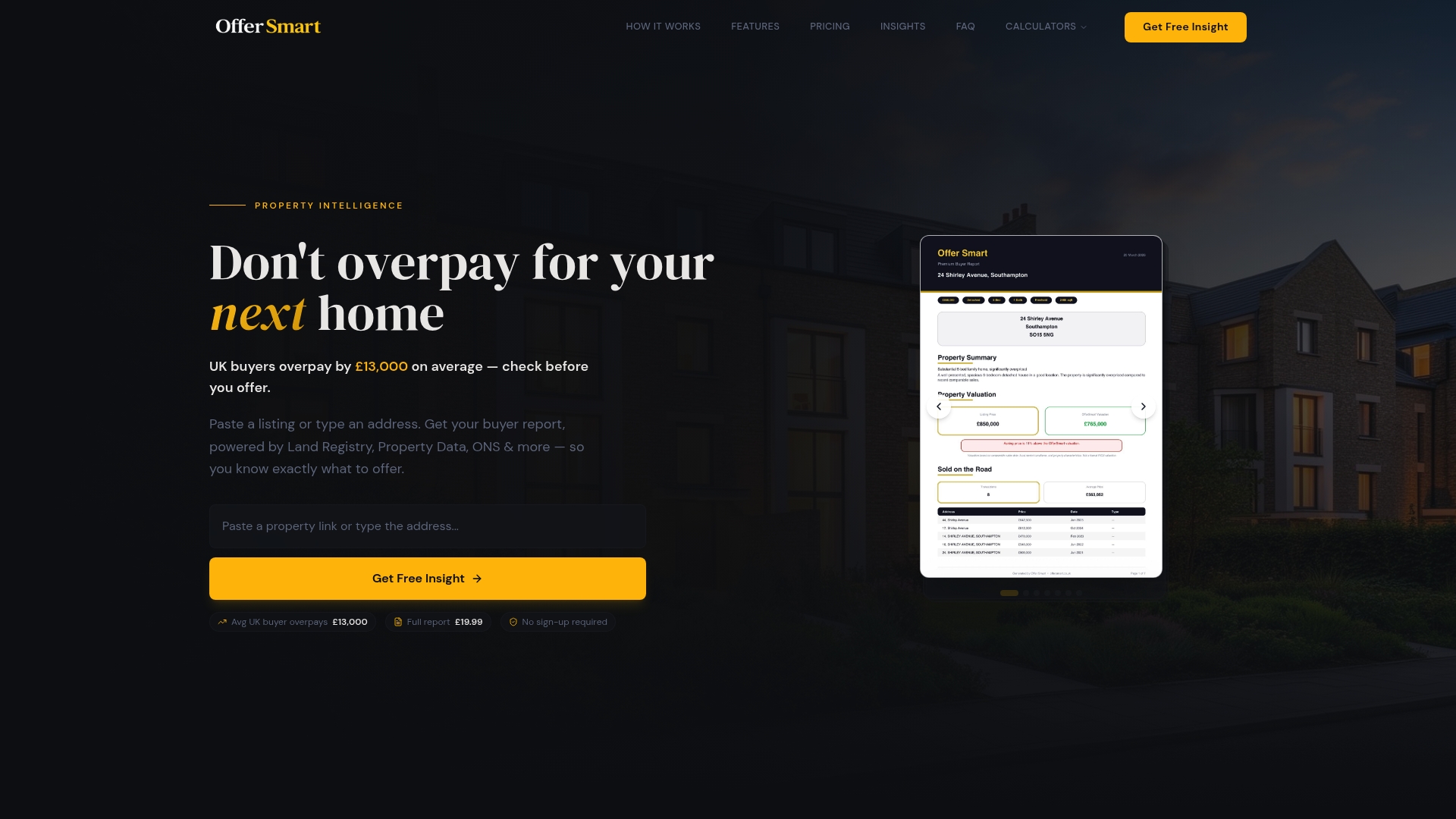
Offersmart analyses nearby lifestyle factors including restaurants, parks, pubs, and schools alongside comparable sales data and crime and flood risk. For investors, it calculates rental value, estimated ROI, and a five-year value forecast. The built-in mortgage calculator helps you stress-test affordability against the true market value, not the asking price. Stop guessing what a property is worth. Let the data tell you.
FAQ
Do amenities always increase property value?
Not always. Homes immediately adjacent to high-traffic commercial areas often trade at a 3%–10% discount due to noise and congestion. The positive effect is strongest within a 0.5-mile radius where convenience is high but nuisance is low.
Which amenity type has the biggest impact on resident satisfaction?
Catering spaces such as restaurants and cafés have the highest impact on life satisfaction at 36.36%, according to a 2026 study. Entertainment venues follow at 24.93%, making dining and leisure the most influential amenity categories.
How much can a nearby school add to a property's value?
Outstanding-rated schools consistently attract premiums in their catchment areas, though the exact figure varies by location and demand. Families competing for limited school places drive up prices for homes within the catchment boundary.
Does the brand of a local retailer affect property prices?
Yes. Neighbourhoods where a premium grocer opened saw home prices appreciate 6% above the national average over three years, compared to 4% underperformance near discount retailers. Brand signals demographic direction, which buyers price in.
How can i factor amenities into my offer price?
Compare recent sales from streets with a similar amenity profile, not just similar property types. Use a tool like Offersmart to analyse local lifestyle factors and comparable sales data together, so your offer reflects true market value rather than the asking price.