

Despite rising inventory and falling prices in many regions, first-time buyer share sits near a 40-year low. That single fact tells you something important: property market trends are far more layered than any headline suggests. If you rely only on price direction to guide your buying decisions, you are working with an incomplete picture. This article breaks down what property market trends actually are, what forces drive them, and how you can use that knowledge to make smarter, more confident decisions, whether you are buying your first home or adding to an investment portfolio.
Table of Contents
- What are property market trends?
- Key factors driving property market trends
- How to interpret and use market data
- Applying property market trends to your buying strategy
- Why most people misunderstand property market trends
- Ready to buy smart with the latest market insights?
- Frequently asked questions
Key Takeaways
| Point | Details |
|---|---|
| Trends mean more than price | Property market trends encompass prices, inventory, buyer types, and demand, not just price changes. |
| Check multiple data sources | Rely on primary data like MLS and recent market studies, not just high-level headlines or summaries. |
| Apply trends to your plan | Use current trend signals to guide when and how you make your home-buying decisions. |
| Watch for market shocks | Unexpected events can shift the market fast, so stay flexible and updated. |
What are property market trends?
A property market trend is a measurable, sustained pattern across one or more real estate indicators over a defined period. Most people think of trends as simply prices going up or down. In reality, a trend captures a much wider set of signals, including how many homes are available, how quickly they sell, who is buying, and what share of the market different buyer groups hold.
To identify a trend, analysts compare current market data against historical benchmarks. If the median days on market drops from 45 to 22 over six months, that signals rising demand. If active listings increase by 20% year over year, that points toward a cooling market or a shift in seller behavior. Neither data point alone tells the full story, but together they form a trend.
Big market participants shape trends significantly. Investors accounted for 30% of single-family home purchases in recent years, which directly compresses the inventory available to first-time buyers. Understanding obstacles for first-time homebuyers means recognizing that investor demand is itself a trend driver, not a background factor.
Key metrics that make up a property market trend:
- Median sale price and price per square foot
- Active listings and months of supply
- Days on market (DOM)
- Sale-to-list price ratio
- Buyer demographics and age distribution
- Investor purchase share
- Mortgage application volume
- New construction starts
Here is a quick reference for how different trend signals translate into market conditions:
| Metric | Rising value signals | Falling value signals |
|---|---|---|
| Active listings | Buyer-friendly market | Seller-friendly market |
| Days on market | Cooling demand | Strong demand |
| Sale-to-list ratio | Seller leverage | Buyer leverage |
| Investor share | Tighter supply for buyers | More options for buyers |
| Mortgage applications | Growing buyer pool | Shrinking buyer pool |
Experts explaining recent market shifts consistently point to the combination of these metrics rather than any single figure. When you train yourself to read multiple indicators at once, your understanding of where a market is heading becomes far more accurate.
Key factors driving property market trends
With a basic understanding of trends established, the next step is identifying what actually causes them to shift. In 2026, several forces are interacting in ways that make the market particularly complex to read.
Interest rates and mortgage availability remain the most powerful lever. When borrowing costs rise, purchasing power falls, and demand contracts. When rates ease, more buyers enter the market, pushing prices and competition upward. The relationship is not always immediate, though. Buyers who locked in rates earlier may hold off on selling, which keeps supply tight even when demand softens.

Inventory levels determine how competitive you need to be. Low supply means multiple offers, waived contingencies, and prices above asking. Higher inventory gives you time, options, and negotiation leverage. Right now, volatile market factors including post-pandemic supply chain effects and shifting construction costs are creating uneven inventory patterns across different regions.
Demographics are reshaping who is buying. The average first-time buyer age has reached 40, and their market share sits at a historic low. This reflects years of affordability pressure, student debt, and delayed household formation. As this demographic finally enters the market in larger numbers, demand patterns will shift again.
National versus local data is a distinction that trips up many buyers. National averages can mask what is happening in your target neighborhood. A city may show flat median prices while one zip code sees 15% appreciation and another drops 8%.
Some analysts expect a spring buying rebound in 2026, while others point to continued affordability constraints as a ceiling on growth. Both views have merit, which is exactly why you should not rely on a single forecast.
Comparison of market outlooks for 2026:
| Perspective | Supporting evidence | Risk factors |
|---|---|---|
| Cautious optimism | Rising inventory, stabilizing rates | Affordability still stretched |
| Continued caution | High buyer age, low first-time share | Rate sensitivity remains high |
Pro Tip: Always pull local market data before drawing conclusions from national headlines. A national trend may be moving in one direction while your target area moves in the opposite direction.
Understanding housing costs for first-time buyers at the local level gives you a far more reliable foundation for your decision-making than any broad market summary.
How to interpret and use market data
Understanding the drivers is one thing, but knowing how to actually use the data is another. Here is a practical framework for making sense of what you are seeing.
-
Identify your primary data sources. Start with MLS (Multiple Listing Service) data, which provides the most granular and current information on listings, sales, and price history. Supplement with reports from reputable organizations that track reading MLS data and comparable sales trends.
-
Compare across time periods. A single month's data means very little. Compare the current quarter to the same quarter last year, and look at rolling 12-month averages to filter out seasonal noise.
-
Track volume alongside price. A rising median price on low transaction volume can be misleading. High volume combined with rising prices is a far stronger signal of genuine demand.
-
Monitor days on market closely. This metric often moves before prices do. When DOM starts falling, competition is building. When it rises, the market is softening, even if prices have not yet responded.
-
Watch for non-linear changes. Edge cases and outlier events can break predictive models. Pandemic-era disruptions showed clearly that hybrid approaches combining multiple data types outperform single-variable forecasts.
"Prioritize primary data like MLS over aggregates when assessing local market conditions."
Common mistakes buyers make include over-relying on national price indexes, ignoring shifts in buyer mix, and treating a single data point as a trend. A property that sold for 10% above asking last month does not confirm a sellers' market if overall DOM is rising and listings are accumulating.
Pro Tip: Cross-reference at least two independent data sources before drawing a conclusion. If both point in the same direction, your confidence in that signal should increase substantially.
The goal is not to predict the future with certainty. It is to reduce the range of uncertainty so that your decisions are grounded in evidence rather than assumption.
Applying property market trends to your buying strategy
With a solid foundation in interpreting market data, you are ready to use these trends to shape your buying plan. Trend knowledge only creates value when it translates into action.
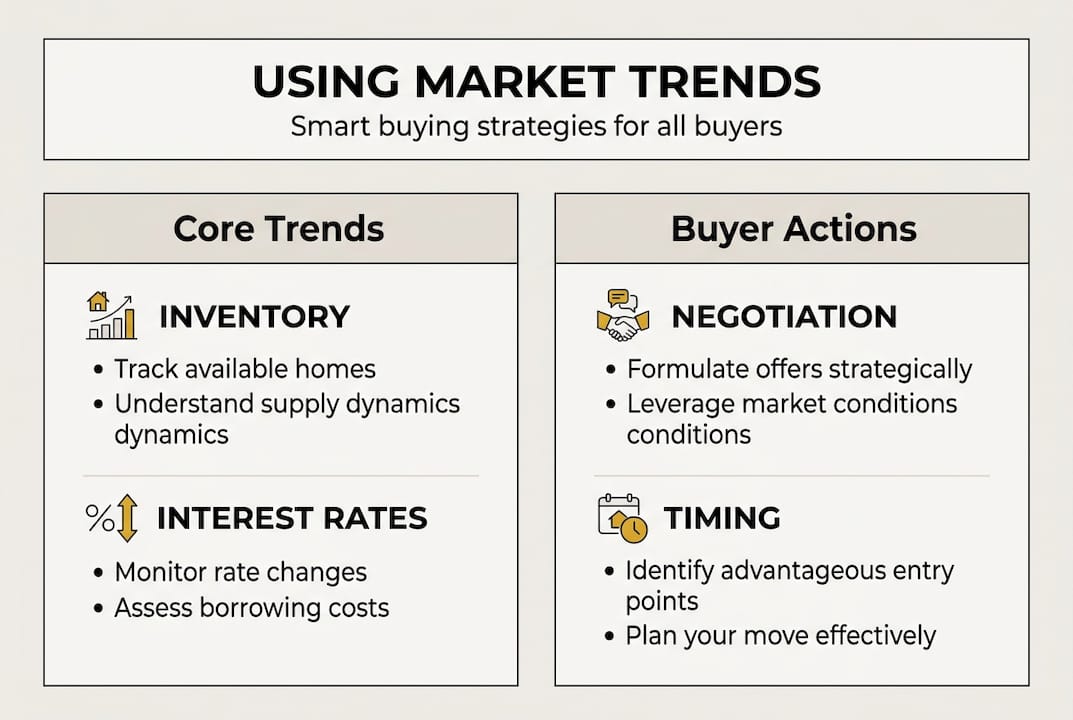
In a buyers' market (rising inventory, longer DOM, price reductions), you have room to negotiate. You can request contingencies, ask for seller concessions, and take time to compare options. Offering below asking price with supporting comparable evidence is a reasonable strategy.
In a sellers' market (low inventory, fast sales, multiple offers), speed and certainty matter more than price alone. Sellers favor clean offers with fewer conditions. Having your financing pre-approved and your comparable data ready allows you to move quickly and confidently.
For investors, the analysis shifts toward yield and long-term appreciation potential rather than emotional fit. Investors examine rent-to-price ratios, vacancy rates, and neighborhood growth indicators. It is worth noting that investors captured a significant share of single-family purchases recently, which means competition for income-producing properties remains intense.
First-time buyers face both improved inventory conditions and persistent affordability challenges in 2026. That combination means opportunity exists, but only for buyers who are prepared.
Before making your offer, work through this checklist:
- Pull comparable sales from the past 90 days within a half-mile radius
- Check the property's DOM relative to the local average
- Review the sale-to-list ratio for recent nearby transactions
- Assess inventory levels in the specific price band you are targeting
- Confirm your financing is pre-approved and your budget accounts for running costs
- Evaluate risk factors including flood zone status, crime data, and school ratings
- Determine your walk-away price before entering any negotiation
Using making competitive offers as a framework means combining trend data with property-specific evidence to arrive at a number you can defend and feel confident about.
Why most people misunderstand property market trends
Here is an uncomfortable truth we have observed repeatedly: most buyers, and even some experienced investors, reduce property market trends to a single question: are prices going up or down? That oversimplification causes real financial harm.
Prices are a lagging indicator. By the time a price trend is visible in published data, the underlying market forces that caused it have already been in motion for months. Buyers who wait for price confirmation are often acting on yesterday's market.
What matters more is the combination of leading indicators, things like DOM, inventory change, and buyer mix, that signal where the market is heading before prices reflect it. Non-linear changes, pandemic disruptions, and nuanced data patterns matter far more than a glance at a price chart.
We have also seen the damage done by dramatic "hot market" or "crash incoming" narratives. Both tend to be oversimplified. Real markets are regional, segmented by price band, and driven by forces that interact in ways no single headline can capture.
The smartest buyers we see are those who check all trend layers, not just the top-line number. They look at housing cost pitfalls, local supply dynamics, and demographic shifts before forming a view. That approach will not make you perfectly right every time, but it will keep you from being badly wrong.
Ready to buy smart with the latest market insights?
Understanding property market trends is a powerful first step. Putting that knowledge to work on a specific property is where it gets real.

Offer Smart tools give you instant access to comparable local sales, area risk data, rental yield estimates, and a 5-year value forecast, all in one place. Simply enter a property address or paste a listing link, and you get a clear, evidence-based picture of what you should realistically offer. Whether you are a first-time buyer trying to avoid overpaying or an investor assessing long-term ROI, Offer Smart turns market data into a decision you can act on with confidence.
Frequently asked questions
What factors influence property market trends the most?
Interest rates, inventory, and demographics are the primary drivers of property market trends, as each directly affects buyer demand, available supply, and purchasing power.
How do I find reliable property market data?
MLS listings and primary sources are more accurate than aggregated summaries, so start there before consulting broader market reports.
Why are property prices not the only trend to watch?
Market shocks and non-price factors such as buyer mix, inventory shifts, and economic disruptions can change the market's direction before prices move, making them critical signals to monitor.
Are 2026 trends favorable for first-time buyers?
Affordability remains a challenge despite more listings coming to market, making 2026 a mixed environment where preparation and data-driven strategy matter more than ever.