

Many buyers assume the asking price is what they're expected to pay. That assumption can cost thousands. In UK property buying, the offer price is the amount you propose to pay for a property, submitted through the estate agent as part of a negotiation process. It is not the same as the asking price, and it is certainly not fixed. Understanding this distinction gives you real negotiating power, protects your budget, and puts you in control of one of the biggest financial decisions you will ever make. This article covers definitions, key differences, how to set your offer strategically, and what the law actually says.
Table of Contents
- What does offer price really mean?
- How offer price compares to asking price, guide price, and actual sale price
- How to set your offer price wisely
- Legal and negotiation realities of submitting an offer
- The unseen risks and smarter paths: What most buyers miss about offer price
- Take the stress out of your next offer with Offer Smart
- Frequently asked questions
Key Takeaways
| Point | Details |
|---|---|
| Offer price defined | Your offer price is the amount you propose to pay, not what the seller asks. |
| Term differences matter | The offer, asking, guide, and sale prices each serve unique roles in buying a home. |
| Do your research | Base your offer on recently sold comparable properties and your budget, not just on the asking price. |
| Negotiation is normal | Offers often lead to counteroffers and discussions before anything is legally binding. |
| Legal status | An accepted offer is not binding in the UK until contracts are formally exchanged. |
What does offer price really mean?
The offer price is your proposed purchase amount. It is the figure you put forward to the seller, usually communicated through the estate agent, after you have viewed a property and decided you want to buy it. Think of it as the opening position in a negotiation rather than a final answer.
According to Rightmove's buyer guidance, the offer price is the amount you propose to pay for a property. The estate agent acts as the intermediary, passing your offer to the seller and relaying any response back to you. You are not speaking directly with the seller in most cases, which means clarity and documentation matter enormously.
Before you submit any figure, it pays to understand what to check before making an offer on a property. Rushing in with a number before you have done your research is one of the most common and costly mistakes buyers make.
Here is what the offer price process typically looks like in practice:
- You view a property and decide to proceed
- You research comparable sold prices in the area
- You calculate your maximum budget, including all associated costs
- You submit a figure to the estate agent verbally or in writing
- The seller accepts, rejects, or counter-offers
- Negotiation continues until both parties agree or walk away
One critical point that many first-time buyers miss: your offer is not legally binding at this stage. Neither party is committed until contracts are formally exchanged, which happens much later in the process. This means a seller can accept your offer today and accept a higher offer from someone else tomorrow, a practice known as gazumping.
| Stage | What happens | Is it binding? |
|---|---|---|
| Offer submitted | Buyer proposes a price via agent | No |
| Offer accepted | Seller verbally agrees | No |
| Solicitors instructed | Legal process begins | No |
| Exchange of contracts | Both parties sign and swap contracts | Yes |
| Completion | Money transfers, keys handed over | Yes |
Understanding this table alone will save you from making assumptions that lead to expensive surprises.
How offer price compares to asking price, guide price, and actual sale price
With the offer price defined, it is crucial to understand how it fits alongside the other pricing terms you will encounter throughout your property search.
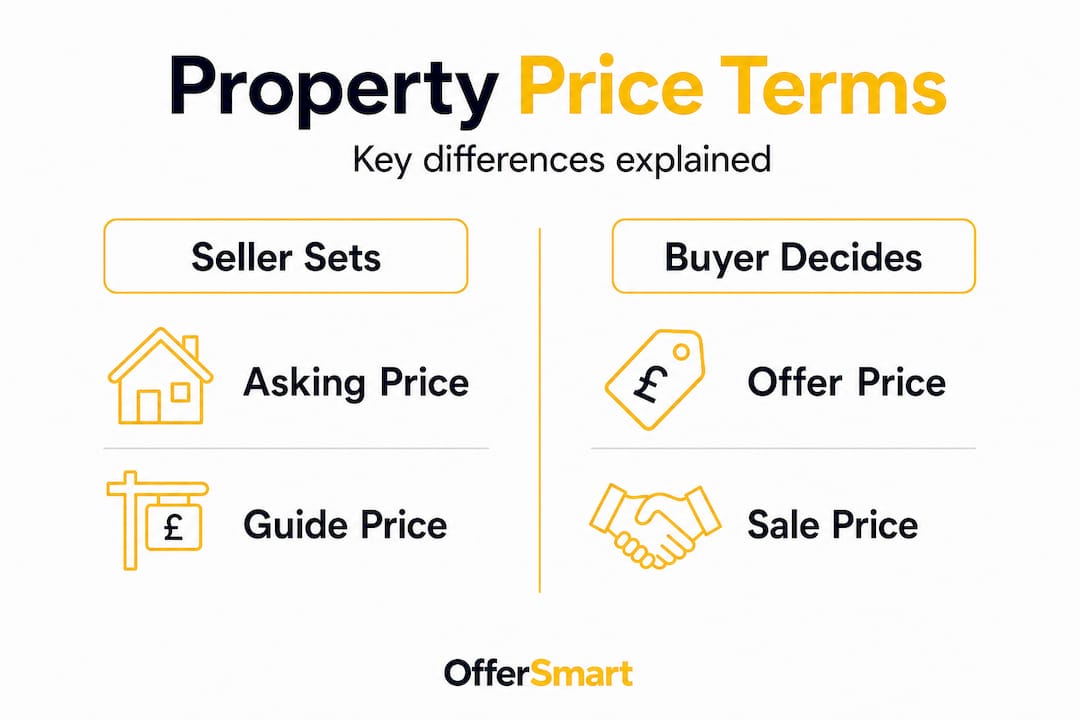
As Open House Lancashire explains, the offer price is different from listing terms like asking price or guide price. The offer is what the buyer actually proposes, while the asking price and guide price are the seller's expectations or starting points. They are not the same thing, and treating them as such puts you at a disadvantage.
Here is a clear breakdown of each term:
| Term | Who sets it | What it represents |
|---|---|---|
| Asking price | Seller (via estate agent) | The amount the seller hopes to achieve |
| Guide price | Seller (common at auction) | A broad indication of expected value, often a range |
| Offer price | Buyer | The amount the buyer proposes to pay |
| Sale price (achieved) | Agreed between both parties | The final negotiated figure recorded at completion |
The journey from asking price to sale price is rarely a straight line. A seller might list at £350,000, receive an offer of £325,000, counter at £340,000, and ultimately agree at £335,000. Every step of that process involves the offer price shifting in response to new information, urgency, or market conditions.

This matters because discounts between asking and achieved sale prices vary significantly by market and are not the same as the offer price you submit. Achieved discounts reflect actual negotiated outcomes and sold prices, not your opening offer. In a hot market, properties may sell above asking price. In a slower market, buyers regularly achieve discounts of five to ten per cent or more.
Understanding how estate agents value properties gives you important context here. Agents sometimes set asking prices optimistically to attract interest or to give the seller room to negotiate downward. Knowing this prevents you from anchoring your offer to a number that may not reflect genuine market value.
Key takeaways from this section:
- Asking price is a starting point, not a target
- Guide price at auction is often set below expected sale value to generate bidding
- Your offer price should be grounded in comparable sold data, not the listing figure
- Sale price is what the market actually supports once negotiation concludes
How to set your offer price wisely
Once you understand how the terms compare, the next step is setting your own offer price with purpose and precision. This is where preparation separates confident buyers from anxious ones.
Setting your offer price is not about guessing or splitting the difference. As Pauzible's negotiation guidance makes clear, how high or low to set your offer price is typically decided by comparing nearby comparable sold prices and your maximum budget, including costs like solicitor fees, survey, and Stamp Duty Land Tax (SDLT), rather than aiming at a fixed percentage below asking.
Follow these steps to arrive at a well-informed offer:
-
Secure a mortgage in principle. This tells you your maximum borrowing capacity and shows sellers you are a serious buyer. Without this, your offer carries less weight.
-
Calculate your total budget. Add your deposit to your mortgage amount, then subtract all purchase costs. These include solicitor fees (typically £1,500 to £3,000), a survey (£400 to £1,500 depending on type), and SDLT (Stamp Duty Land Tax), which varies based on property price and buyer status.
-
Research comparable sold prices. Look at properties of similar size, type, and condition that have sold on the same road or within a half-mile radius in the past three to six months. This is your most reliable benchmark.
-
Assess the property's condition. A property needing significant work justifies a lower offer. Factor in estimated repair costs and use them as evidence in your negotiation.
-
Consider the seller's position. A seller who has already found their next home and needs to move quickly may accept a lower offer. A seller with no chain pressure may hold firm.
-
Submit your offer in writing. Always confirm your offer by email after speaking with the agent. This creates a paper trail and reduces misunderstandings.
Pro Tip: Do not anchor your offer to the asking price. Anchor it to actual sold prices for comparable properties. If similar homes on the same street sold for £280,000 and the asking price is £310,000, your offer should reflect the sold data, not the listing figure. Using local property data is the most reliable way to validate your position before you submit anything.
One area buyers consistently underestimate is the full cost of purchase beyond the sale price. SDLT alone can add tens of thousands of pounds to your outgoings. On a £400,000 property, a first-time buyer currently pays no SDLT on the first £425,000 (under current thresholds), but a second-time buyer pays a meaningful sum. Factor this in before you decide your ceiling. Guidance on avoiding overpaying for a house covers these cost traps in detail.
Legal and negotiation realities of submitting an offer
With a figure in mind, the final piece is understanding how offer submission and negotiation work in practice, and what is actually legally binding at each stage.
The most important legal fact in UK property buying is this: offers are not legally binding until contracts are exchanged, even after an offer is accepted. This applies to both buyer and seller. You can withdraw your offer at any point before exchange without legal penalty. The seller can also accept a higher offer from another buyer, which is why the period between offer acceptance and exchange carries real risk.
The phrase "subject to contract" appears frequently in property correspondence. It means that any agreement reached is conditional on formal contracts being drawn up, reviewed, and exchanged by solicitors. Nothing is final until that exchange happens.
Here is what to expect during the negotiation phase:
- Counter-offers: The seller may reject your initial offer and propose a higher figure. You can accept, reject, or counter again.
- Best and final offers: In competitive situations, estate agents may invite best and final offers from all interested buyers by a set deadline. Each buyer submits their highest offer once, and the seller chooses. This removes the back-and-forth but raises the stakes.
- Sealed bids: Similar to best and final, but offers are submitted in sealed envelopes. Common in high-demand markets.
- Gazumping: A seller accepts your offer but later accepts a higher one from another buyer before exchange. Frustrating and legal in England and Wales.
- Gazundering: Less common, but a buyer reduces their offer just before exchange, knowing the seller is committed and under pressure.
Pro Tip: Always confirm every stage of your offer in writing via email. If you submit an offer verbally, follow it up immediately with an email to the agent stating the exact figure and any conditions attached. This protects you if there is any dispute about what was agreed.
Understanding how much to offer on a house in different market conditions is equally important. In a buyer's market, you have room to negotiate. In a seller's market, being too cautious with your offer can mean losing the property entirely.
The unseen risks and smarter paths: What most buyers miss about offer price
Here is the honest reality that most property guides skip over. Emotion is the single biggest threat to a rational offer price.
When you fall in love with a property, your brain starts working against your wallet. You begin justifying a higher offer. You tell yourself the asking price must reflect the value. You worry about losing it to another buyer. All of this is understandable, but none of it is a reliable basis for a financial decision of this scale.
The buyers who consistently get better outcomes are the ones who treat offer price as a data exercise, not an emotional one. They look at what similar properties actually sold for, not what they were listed at. They know their ceiling before they walk through the door. And they are genuinely prepared to walk away if the numbers do not work.
Here is a practical scenario. Imagine a three-bedroom semi-detached house listed at £375,000 in a suburban area. The buyer feels the property is worth it and prepares to offer close to asking price. But a quick check of comparable sold prices on the same road reveals that three similar properties sold in the past four months at £348,000, £352,000, and £355,000. The asking price is £20,000 above what the market has recently supported.
A prepared buyer uses that data to submit an offer of £350,000 with a clear written explanation referencing the comparable sales. The seller, knowing the evidence is solid, accepts at £355,000. The buyer saves £20,000 compared to what they nearly offered. That is not luck. That is preparation.
The common overpayment pitfalls that catch buyers out are almost always rooted in the same problem: not knowing what the property is actually worth before making an offer. Urgency, fear of missing out, and over-reliance on the asking price are the three most reliable routes to overpaying. Smart buyers neutralise all three with data.
Take the stress out of your next offer with Offer Smart
You now have a solid understanding of what offer price means, how it differs from asking price, and how to approach negotiation with confidence. The next step is putting that knowledge into practice with the right tools behind you.

Offer Smart is built specifically for buyers in your position. Enter a property address or paste a listing link, and you get an instant analysis of what you should realistically offer, backed by comparable local sales including properties on the same road. It goes further than price, covering flood risk, crime risk, nearby schools, and lifestyle factors so you can assess the full picture. Use the built-in mortgage calculator to model your repayments, and explore the full suite of property calculators to understand your running costs, estimated ROI, and five-year value forecast. No guesswork. No overpaying. Just clarity before you commit.
Frequently asked questions
Is the offer price what I must pay for a property?
No, the offer price is the amount you propose and can negotiate. As Rightmove confirms, offers are not legally binding until contracts are exchanged, so nothing is fixed until that point.
Can I offer less than the asking price?
Yes, you can offer below the asking price, particularly when recent sold prices support your position. The offer price is your proposed amount and may legitimately sit below the seller's asking figure based on market evidence.
What does 'subject to contract' mean when making an offer?
It means your offer is conditional on formal contracts being drawn up and exchanged. Offers described as subject to contract are not legally binding until that exchange takes place between buyer and seller solicitors.
How do I decide what offer price to make?
Research recently sold comparable properties in the area and calculate your full budget including all purchase costs before submitting. Setting your offer price based on comparable sold data rather than the asking price gives you the strongest negotiating foundation.