

You've had your offer accepted, commissioned a survey, and the report lands in your inbox full of amber and red flags. Now what? Knowing how to negotiate house price after survey findings is one of the most financially significant skills you can develop as a buyer. The difference between acting confidently on survey evidence and accepting the original price could mean thousands of pounds. This guide gives you a clear, practical framework for reading your survey, building your case, communicating with sellers, and making the smartest decision for your money.
Table of Contents
- Key takeaways
- Understand your survey before you negotiate
- Building your evidence for a price reduction
- Executing the negotiation with the seller
- Handling the outcomes
- Mistakes that undermine your negotiation
- My honest take on post-survey negotiations
- Know your numbers before and after the survey
- FAQ
Key takeaways
| Point | Details |
|---|---|
| Only major defects justify renegotiation | Focus on structural, damp, or roof issues rather than cosmetic wear and tear. |
| Get contractor quotes before negotiating | Itemised repair costs with a 10–20% contingency make your case far stronger. |
| Act quickly in the pre-exchange window | Negotiations must happen before contracts exchange or you lose your leverage entirely. |
| Present evidence, not emotion | Factual, costed claims achieve reductions far more reliably than subjective complaints. |
| Typical reductions range from 5 to 10% | Achievable reductions depend on defect severity, mainly for structural or safety-critical issues. |
Understand your survey before you negotiate
The first mistake buyers make is reaching for the phone the moment their survey arrives. Before any post-survey price negotiation begins, you need to understand exactly what you are dealing with.
Most UK surveys use a traffic-light or numerical rating system to classify findings. Red or condition rating 3 items require urgent attention. Amber or condition rating 2 items need monitoring or future repair. Green or condition rating 1 items are broadly fine. The critical point is that not every defect justifies a price reduction. Cracked render on an outbuilding is not the same as subsidence. A dripping tap is not the same as a failing roof.
The defects that genuinely support renegotiation tend to fall into a few clear categories:
- Structural movement or subsidence — significant cracking, leaning walls, or movement in the foundations
- Damp and timber decay — penetrating damp, rising damp, or evidence of dry or wet rot
- Roof failure — missing or slipped tiles, failing flashings, defective guttering causing water ingress
- Electrical and heating systems — outdated wiring, condemned boilers, or systems that need full replacement
- Drainage problems — collapsed drains confirmed by CCTV survey
Cosmetic issues such as tired decoration, worn carpets, or superficial cracks in plasterwork are part of normal property wear. Raising these in negotiation undermines your credibility for the issues that genuinely matter.
Pro Tip: Call your surveyor directly after reading the report. Ask them to rank the top three defects by urgency and estimated cost. Surveyors are often more candid in conversation than in writing, and that clarity shapes your entire negotiation strategy.
Mortgage valuations differ from independent surveys and provide no useful basis for renegotiation. Only an independent survey gives you credible, detailed evidence. If you have not yet commissioned one, the property surveys guide for first-time buyers explains exactly what to look for.
Building your evidence for a price reduction
Once you have identified the defects worth pursuing, the quality of your preparation determines whether you get a reduction or a flat refusal. Vague claims do not move sellers. Costed, itemised evidence does.
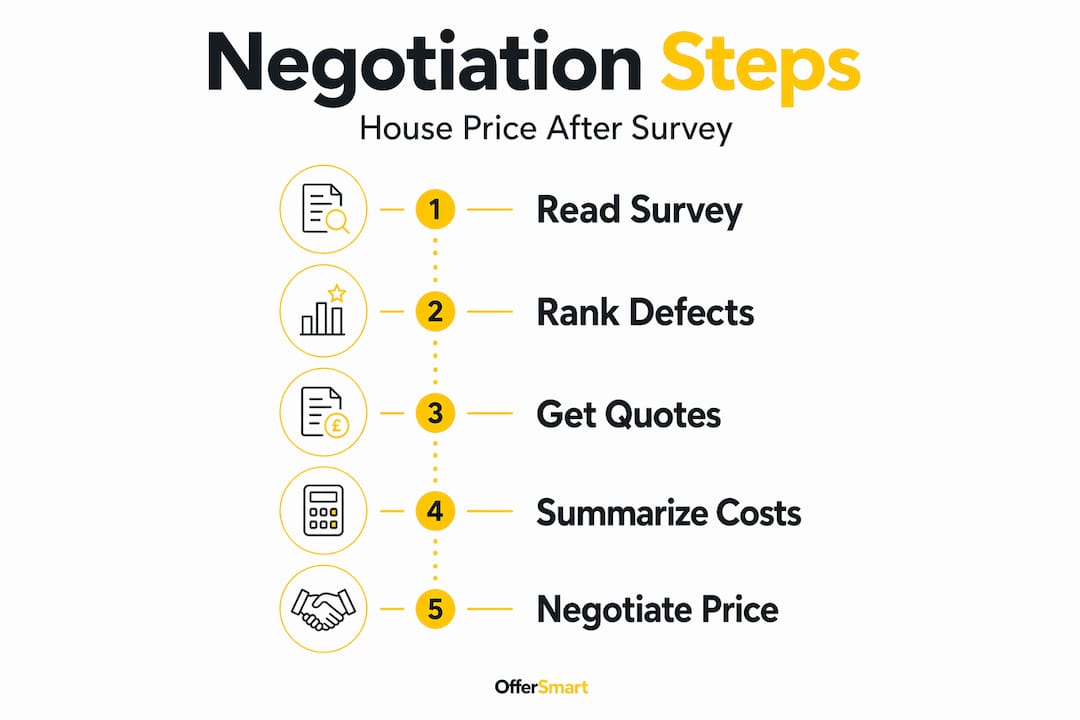
Follow these steps to build a strong negotiation case:
-
List every significant defect from the survey report, using the surveyor's own language and condition rating. This anchors your request in professional findings, not personal opinion.
-
Request written cost estimates from your surveyor where possible. Many surveyors include indicative repair costs or cost ranges within the report itself. Use the upper-end cost figures when structuring your negotiation, since this reduces the risk of the seller arguing the issue was overstated later.
-
Obtain independent contractor quotes for the two or three most significant defects. A quote from a specialist damp proofing company, a roofing contractor, or a structural engineer carries far more weight than a surveyor's estimate alone. Aim for at least one written quote per major defect.
-
Add a 10 to 20% contingency on top of your total estimated repair costs. Actual costs regularly exceed early estimates, particularly once contractors access hidden areas. Building this in protects you and gives you a reasoned explanation for the figure you present.
-
Calculate your total and set a target reduction. Do not simply guess a round number. Your figure should reflect the documented repair cost plus contingency, expressed either as a price reduction or as a request for the seller to complete specific works before completion.
Here is an example of how this might look in practice:
| Defect | Surveyor estimate | Contractor quote | With 15% contingency |
|---|---|---|---|
| Roof re-covering (rear slope) | £4,000–£6,000 | £5,500 | £6,325 |
| Damp treatment (ground floor) | £1,500–£2,500 | £2,200 | £2,530 |
| Electrical rewire (partial) | £2,000–£3,500 | £3,100 | £3,565 |
| Total | £10,800 | £12,420 |
With evidence like this, asking for a £10,000 to £12,000 reduction is reasonable and defensible. Buyers achieve better results when they present itemised, costed claims rather than a single lump-sum demand with no supporting detail.
Pro Tip: Prepare a short written summary, no more than one page, that lists each defect, its condition rating, the estimated repair cost, and your proposed reduction. Send this to the estate agent in writing. It creates a clear record and signals that you are serious and organised.
Executing the negotiation with the seller
You have your evidence. Now you need to communicate it effectively. The goal is not to win an argument. The goal is to reach an agreement that reflects the property's true condition.

In almost all cases, you should communicate through the estate agent rather than approaching the seller directly. The agent has a professional duty to pass on all offers and material information. Keeping them involved protects your interests legally and keeps the process orderly.
When presenting your case, keep these principles in mind:
- Lead with facts, not frustration. Open by referencing the survey and the specific condition ratings. State the defects clearly and attach your written evidence summary.
- Name your revised figure directly. Do not hint at a reduction. State the number you are proposing and explain how you arrived at it. Sellers respond better to a clear, reasoned figure than to an open-ended complaint.
- Be open to alternatives. If a seller refuses a price reduction, they may agree to complete specific repairs before completion, contribute to a snagging fund held by solicitors, or provide a structural warranty. Any of these can achieve the same financial outcome.
- Stay professional throughout. Sellers are emotionally attached to their homes. A tone that feels accusatory shuts conversations down. A tone that is factual and constructive keeps them open.
On timing: pre-exchange negotiations are your only legitimate window in England and Wales. Once contracts exchange, the agreed price is legally binding. Do not delay your approach once you have received the survey. Every week that passes without action weakens your position, particularly if the seller is under pressure from a chain above.
Handling the outcomes
Not every negotiation ends with a straightforward acceptance. Knowing your options before you start means you will not be caught off guard.
| Outcome | What it means | Your next step |
|---|---|---|
| Seller accepts your revised price | Agreement reached on new figure | Instruct solicitors to update contracts promptly |
| Seller makes a counteroffer | Partial reduction offered | Evaluate against repair costs. Accept if reasonable, counter if not |
| Seller refuses any reduction | No movement on price | Decide whether to proceed, request works, or withdraw |
| Seller offers to complete repairs | Works agreed before completion | Get the scope and timeline in writing via your solicitor |
| Seller offers a contribution | Cash allowance at completion | Confirm this is reflected clearly in the final contract |
Withdrawing from a purchase is a genuine option, not a threat. If the seller will not move and the repair costs make the purchase financially unsound, walking away protects your long-term financial wellbeing. You will lose your survey fee, but that is a far smaller loss than overpaying by tens of thousands of pounds on a property with serious defects.
One point that buyers often overlook: significant defects can affect your mortgage. If a lender's valuation picks up the same issues, they may reduce the amount they are willing to lend, or apply a retention until works are completed. This is another reason to act on survey findings rather than ignore them.
Mistakes that undermine your negotiation
Even well-prepared buyers make avoidable errors. These are the ones that most consistently damage outcomes:
- Negotiating on minor issues. Raising ten small defects dilutes your credibility. Focus on the two or three most costly items and concede ground on everything else.
- Using emotional language. Phrases like "the property is in a terrible state" or "we were really disappointed" invite a defensive response from sellers. Stick to facts and figures.
- Waiting too long after receiving the survey. Delaying your renegotiation reduces leverage as both parties move closer to exchange. Act within a week of receiving the report.
- Ignoring the seller's position. If the seller is in a chain and has already committed to onward purchases, they face real pressure too. A modest, well-reasoned reduction may be easier for them to accept than a larger demand that feels confrontational.
- Failing to document agreements. Any price reduction or agreed works must be confirmed in writing by your solicitor. A verbal agreement from an estate agent is not legally binding.
Pro Tip: Your position as a buyer matters. Cash buyers with no chain have stronger leverage because they offer certainty. If you are in this position, mention it. If you are in a chain, emphasise that your solicitors are ready to move quickly. Speed and certainty are worth something to most sellers.
Your conveyancer plays a role here too. They can formally record any agreed reduction or schedule of works in the contract. Loop them in early so there are no delays once you reach an agreement.
My honest take on post-survey negotiations
I have seen buyers treat their survey report like a verdict and sellers treat it like an attack. Both responses miss the point entirely.
What I have learned is that the buyers who get the best results are not the most aggressive ones. They are the most prepared. A single contractor quote, a clear summary of findings, and a specific revised figure consistently outperforms any amount of emotional pressure. The negotiation is a data conversation, not a personality contest.
The other thing I would say honestly: many buyers are so relieved to have had an offer accepted that they talk themselves out of negotiating at all. They fear the seller will pull out. In practice, sellers who are motivated to sell rarely collapse a transaction over a reasonable, evidence-based request. They may push back, they may counteroffer, but they rarely walk away from a buyer who presents a fair case professionally.
The uncomfortable truth about renegotiating real estate price after a survey is that most buyers leave money on the table simply by not trying. The survey gives you legitimate grounds to revisit the price. Use them.
— Rhys
Know your numbers before and after the survey

Survey negotiations are most effective when you already know the true market value of the property you are buying. If you go into a negotiation without understanding what comparable properties on the same road have sold for, you are working blind.
Offersmart analyses recent local sales, calculates what you should realistically offer, and gives you a full financial picture including running costs and a mortgage calculator to model your adjusted offer after a price reduction. Use the property calculators to quantify your position before you make your move. The data removes the guesswork and puts you in the strongest possible position at the negotiating table.
FAQ
How much can I negotiate after a survey?
Achievable reductions typically range from 5 to 10% of the agreed price, depending on the severity of defects found. Structural issues, damp, or roof failure carry the most weight.
Can a seller refuse to negotiate after a bad survey?
Yes, sellers can refuse. If that happens, you can request they complete repairs, offer a contribution at completion, or you can choose to withdraw from the purchase entirely.
When is the deadline for renegotiating after a survey?
You must negotiate before contracts exchange. The pre-exchange window in England and Wales is your only opportunity to formally revise the agreed price based on survey findings.
Should I use the lender's valuation to negotiate?
No. Mortgage valuations do not substitute for an independent survey and carry no weight in price negotiations. Only a RICS survey provides the detailed defect evidence needed to justify a reduction.
What if the seller accepts my offer verbally but won't confirm in writing?
Verbal agreements through an estate agent are not legally binding in England and Wales. Instruct your solicitor to confirm any agreed reduction or works schedule in the formal contract before proceeding.