

Sold price data is the actual final price recorded for a completed property transaction, not an estimate, not an asking price, and not an algorithm's guess. In the UK, the primary authoritative source is HM Land Registry Price Paid Data, which has tracked residential sales in England and Wales since january 1995. Understanding what is sold price data, and how to read it correctly, is one of the most reliable ways to judge whether a property is fairly priced before you make an offer. This guide explains the dataset in full, clears up common misconceptions, and shows you how to put the numbers to work.
What does sold price data actually include?
Sold price data, known formally as Price Paid Data in the UK, is a record of completed residential property transactions lodged with HM Land Registry. Each entry captures the price paid, date of transfer, property type, and tenure. That means you can see whether a sale was a detached house, a semi-detached, a terraced property, or a flat, and whether it was sold freehold or leasehold.
The dataset covers England and Wales only. Scotland and Northern Ireland maintain separate registers under different legal frameworks, so you will not find Scottish or Northern Irish transactions here. The records go back to 1 january 1995 and are updated monthly, giving you nearly three decades of transaction history to draw on.
Not everything that changes hands appears in the dataset. The following categories are excluded:
- Commercial property sales — only residential transactions are recorded
- Non-market transfers — gifts, inheritances, and transfers between family members at below-market value
- Non-registered transactions — deals that do not require registration with HM Land Registry
- Scotland and Northern Ireland sales — covered by separate national registers
There is also a distinction between standard and additional price paid transactions. Standard entries represent typical arm's-length sales. Additional entries cover sales that fall outside normal market conditions, such as repossessions or sales to sitting tenants. Sold price data becomes valuation-grade only after you filter out these non-market cases and normalise for transaction category. Treating every entry as equivalent is one of the most common errors buyers make.
How does sold price differ from asking price or estimates?
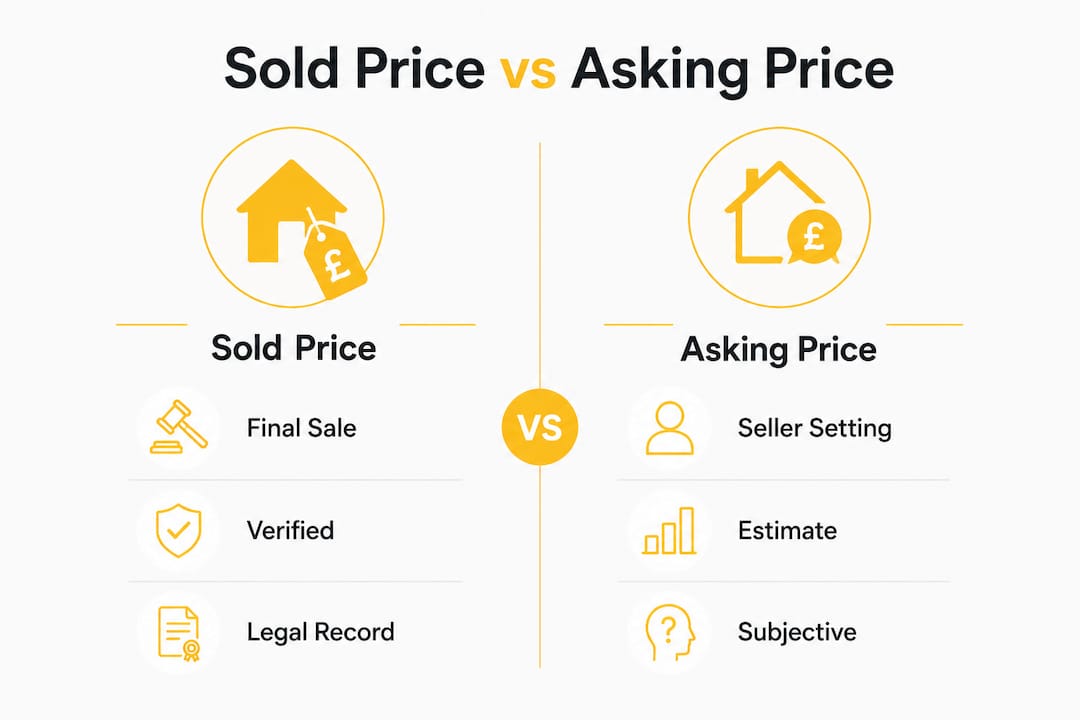
Asking prices are set by sellers and their estate agents, not by the market. Online property estimates, such as those generated by automated valuation models on property portals, are algorithm-driven approximations based on historical data and local trends. Neither reflects what a buyer actually paid on the day contracts were exchanged and completion occurred.

Each record uses the actual price paid recorded from the Stamp Duty Land Tax return on the legal completion date. That single fact makes sold price data far more reliable for valuation purposes than any figure a seller or algorithm produces. The completion date is also important to note: the price appears in the dataset when the sale legally completes, which can be weeks or months after the property was listed.
This timing gap creates a common misunderstanding. A buyer might see a sold price from six months ago and assume it reflects today's market. It does not. Sold price data is best used as post-sale historical evidence, not as a live market feed. The data tells you what buyers were willing to pay in the past, which is still enormously useful, but it must be read alongside current listings to build a complete picture.
Pro Tip: When you see an online estimate for a property, check the sold price history for that same address and the surrounding street. If the estimate sits significantly above recent comparable sales, treat it with scepticism.
Users often mistake asking prices or online estimates for market value, overlooking the reliability of verified sold prices. The gap between what sellers hope to achieve and what buyers actually pay can be substantial, particularly in slower markets or for properties with specific drawbacks.
How to use sold price data when buying or selling
Sold price data helps you find reliable comparable sales, known as comps, for setting a realistic offer price or valuation. Comparable sales show actual past transaction amounts within a local area, giving buyers and sellers a factual basis for negotiation rather than relying on gut feeling or estate agent assurances.
Here is a practical process for using sold price data effectively:
- Identify comparable properties. Search for sales on the same road or within a quarter-mile radius. Filter by property type, tenure, and approximate size. Aim for at least three to five recent sales within the past twelve months.
- Adjust for differences. A three-bedroom semi with a garage sold for more than one without. A leasehold flat with 80 years remaining on the lease will sell for less than one with 150 years. Apply logical adjustments to make the comps genuinely comparable.
- Cross-reference with current listings. Check what similar properties are currently asking. If sold prices are consistently below asking prices, that tells you the market is negotiating downward. Use this to inform your offer strategy.
- Factor in timing. A sale from eighteen months ago carries less weight than one from last month. Weight recent sales more heavily and note any market shifts between the two periods.
- Check rental yields for investment properties. If you are buying to let, cross-reference sold prices with local rental values to calculate whether the numbers stack up before committing.
Online property portals such as Zoopla and Rightmove display sold prices sourced from HM Land Registry data, which makes the information accessible without needing to query a government database directly. They improve user-friendliness but may lack the raw data depth or API access that property professionals require. For developers and analysts, HM Land Registry provides a public SPARQL endpoint that allows programmable queries filtering by address, postcode, price, property type, and tenure without authentication.
Pro Tip: Always look at sold price data for the specific road, not just the postcode. Two streets in the same postcode can have meaningfully different price levels depending on school catchment areas, traffic, and proximity to amenities.
To avoid overpaying for a property, combine sold price data with flood risk, crime statistics, and local amenity data. Price alone never tells the full story.
What affects sold price trends and how to interpret them
Market factors such as regional economic shifts, property condition, and tenure type significantly affect sold price trends and must be considered when you analyse the data. A sold price figure without context is just a number. With context, it becomes evidence.
The table below outlines the main variables that influence sold prices and what each means for your interpretation:
| Factor | Effect on Sold Price | What to Do When Analysing |
|---|---|---|
| Regional economic conditions | Strong local employment pushes prices up; economic decline suppresses them | Compare sold prices against regional wage and employment data |
| Property condition | Renovated properties command premiums over those needing work | Discount comps that were clearly sold in poor condition |
| Tenure type | Freehold consistently outperforms leasehold, especially as lease length shortens | Filter comps by tenure to avoid skewed comparisons |
| Seasonality | Spring and autumn typically see higher transaction volumes and prices | Note the month of sale when weighting recent comps |
| Legal completion timing | Prices reflect completion date, which may lag listing by 8–16 weeks | Account for market movement between listing and completion |
Seasonality is a particularly underappreciated factor. The UK property market tends to be more active in spring and autumn, which can inflate sold prices recorded in those months compared to winter sales. If you are analysing sold price trends across a full year, smooth out seasonal variation by looking at rolling twelve-month averages rather than month-by-month figures.
Tenure type deserves special attention. Leasehold properties, particularly flats in urban areas, carry additional legal complexity. A leasehold flat with fewer than 80 years remaining on the lease will sell at a discount because mortgage lenders become cautious and buyers face future extension costs. When using local property data to assess value, always check the lease terms before drawing conclusions from a sold price.
Key takeaways
Sold price data is the most reliable foundation for property valuation in the UK because it records what buyers actually paid, not what sellers hoped to achieve.
| Point | Details |
|---|---|
| Primary UK source | HM Land Registry Price Paid Data covers England and Wales from january 1995, updated monthly. |
| Sold price vs asking price | Sold prices reflect completed transactions; asking prices are seller-set and often above final sale values. |
| Data limitations | Exclude non-market sales, commercial properties, and Scotland or Northern Ireland transactions before drawing conclusions. |
| Practical application | Use three to five recent comparable sales, adjusted for tenure, condition, and timing, to set a realistic offer. |
| Context is required | Sold price trends are shaped by seasonality, tenure type, regional economics, and legal completion timing. |
Why most buyers read sold price data wrong
Most buyers look at a sold price and treat it as a verdict. They see a number, compare it to the asking price, and decide whether the deal looks fair. That is a reasonable starting point, but it misses most of what the data is actually telling you.
In my experience, the biggest mistake is ignoring the transaction category. A repossession sale on the same street as a well-presented family home will show a lower sold price, but that does not mean the street is worth less. It means one seller was under pressure and one was not. Mixing those two data points without filtering produces a distorted view of value.
The second mistake is treating sold price data as current. I have seen buyers walk away from genuinely good properties because a sold price from two years ago looked low, without accounting for the market movement that occurred in between. Sold price data is historical evidence. It anchors your thinking, but it does not replace judgement about where the market sits today.
The most reliable approach I have found is to use sold price data as your floor, not your ceiling. Find the range of what comparable properties have actually sold for, adjust for the specific features of the property in front of you, and then layer in current market conditions. That combination gives you a defensible number to take into negotiation.
One more thing: go directly to HM Land Registry or use a tool that pulls from it, rather than relying solely on portal displays. Portals are useful, but they sometimes lag on updates and can present data in ways that obscure the transaction category. The raw data, or a tool built on top of it, gives you the clearest picture.
— Rhys
See exactly what a property is worth before you offer
Understanding sold price data is one thing. Applying it quickly and accurately before you make an offer is another challenge entirely.
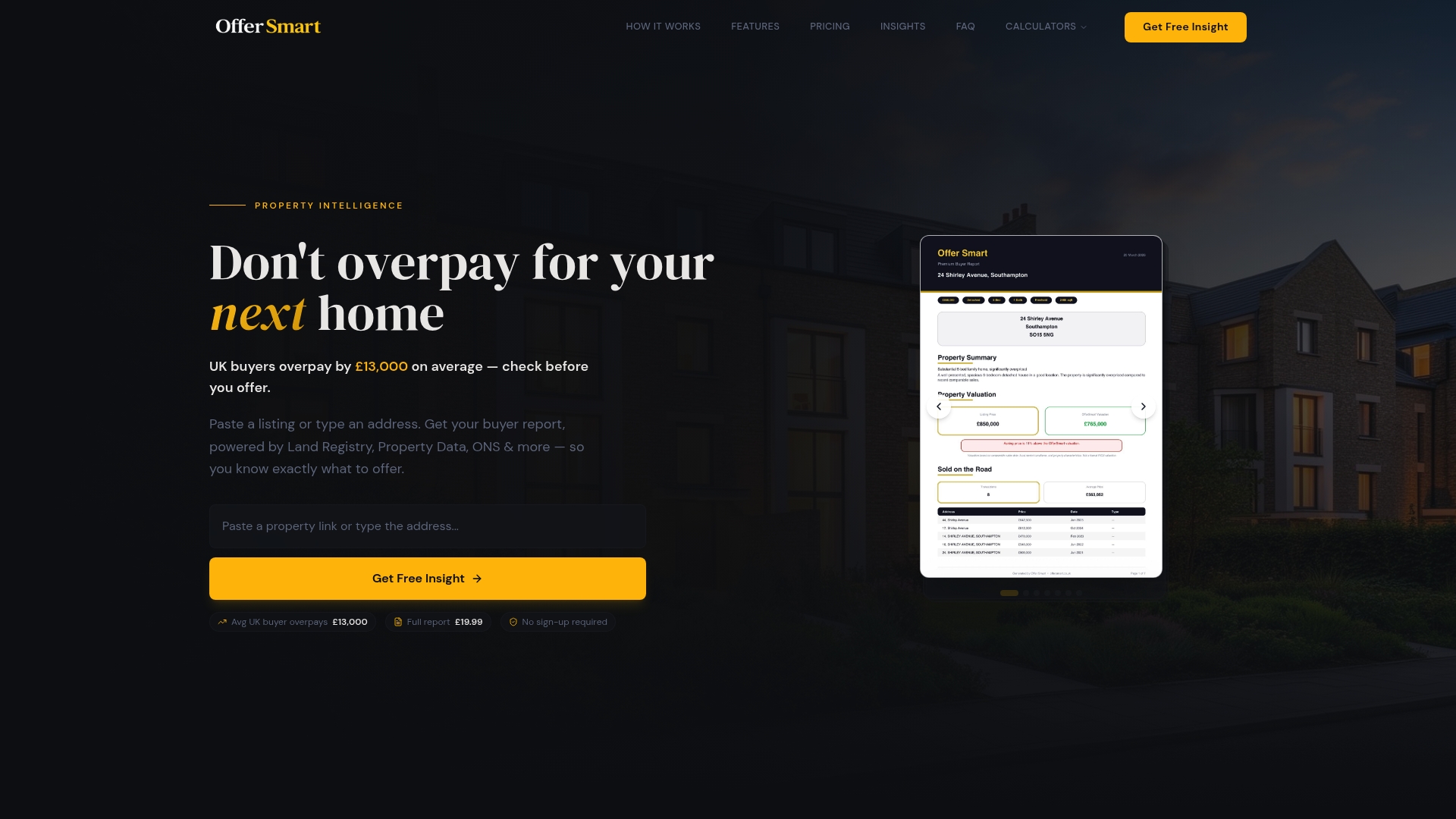
Offersmart pulls together recent local sales, including properties on the same road, and combines them with flood risk, crime data, school proximity, and rental yield calculations to give you a complete picture of any UK property. Enter an address or paste a listing link, and you will see what comparable homes have actually sold for, alongside a mortgage cost estimate and a five-year value forecast. You can also use the stamp duty calculator to understand the full cost of purchase before committing. No guesswork, no relying on estate agent assurances. Just clear, data-backed insight to help you offer with confidence.
FAQ
What is sold price data in the UK?
Sold price data is the official record of the final price paid for a completed residential property transaction. In England and Wales, this is published by HM Land Registry as Price Paid Data, updated monthly and available from january 1995.
Where can i find sold price data for a UK property?
HM Land Registry publishes Price Paid Data directly on GOV.UK. Portals such as Zoopla and Rightmove also display sold prices sourced from the same dataset, making it accessible without querying government databases directly.
How does sold price data differ from an online property estimate?
Sold price data reflects the actual price paid on the legal completion date, recorded via the Stamp Duty Land Tax return. Online estimates are algorithm-generated approximations and are not verified transaction records.
Can i use sold price data to decide what to offer on a property?
Yes. Identifying three to five comparable recent sales, adjusting for property type, tenure, and condition, gives you a factual basis for your offer. Cross-referencing with current listings strengthens the analysis further.
Does sold price data cover scotland and northern ireland?
No. HM Land Registry Price Paid Data covers England and Wales only. Scotland uses the Registers of Scotland, and Northern Ireland uses the Land and Property Services register.