

Using data to make a property offer means applying objective market analytics, automated valuations, and seller motivation signals to determine a confident, evidence-based price. This approach replaces guesswork with quantifiable inputs drawn from sources like automated valuation models (AVMs), comparable sales records, and ownership history. Tools such as HouseCanary, ATTOM, and Offersmart give UK buyers access to the kind of property intelligence that was once reserved for professional investors. This guide walks you through the data sources you need, how to interpret them, and how to translate that analysis into a competitive offer.
What data sources do you need to make a property offer?
Data-driven property offers depend on layering multiple data types rather than relying on a single figure. Public property records, Land Registry sales data, AVM outputs, and market trend indicators each tell a different part of the story. No single source is complete on its own.
The core data categories every UK homebuyer should gather before making an offer are:
- Comparable sales (comps): Recent sold prices for similar properties on the same road or within a half-mile radius, drawn from Land Registry records or platforms like Rightmove and Zoopla.
- Automated valuation model outputs: AVM tools such as HouseCanary and CoreLogic generate estimated values using statistical models. AVMs carry a 5–7% accuracy range on residential properties, meaning a £300,000 estimate could reflect a true value anywhere between £279,000 and £321,000.
- Ownership history and equity position: How long the seller has owned the property and whether there are outstanding liens or charges affects their flexibility on price.
- Days on market and list-to-sale ratios: These market velocity metrics reveal whether a local area favours buyers or sellers at a given moment.
- Motivation signals: Probate filings, tax delinquency records, and vacancy indicators suggest sellers who may need to move quickly, creating negotiation room.
| Data source | Use case | Reliability |
|---|---|---|
| Land Registry sold prices | Establish comp baseline | High (official record) |
| AVM outputs (HouseCanary, CoreLogic) | Rapid valuation estimate | Moderate (5–7% variance) |
| Ownership and equity data | Assess seller flexibility | High when verified |
| Days on market | Gauge competitive pressure | High (real-time listings) |
| Probate and tax delinquency records | Identify motivated sellers | Moderate (requires cross-check) |
Pro Tip: Always verify parcel IDs when matching data across platforms. Address formatting inconsistencies between sources can lead to mismatched records and flawed valuations.
How do you analyse property data to estimate value and seller motivation?
Interpreting property data is where most buyers lose confidence. The process is more structured than it appears once you understand what each metric is telling you.

Start with your AVM output as a rough anchor, not a final answer. Because AVMs have a 5–7% accuracy range, treat the figure as the midpoint of a valuation band rather than a precise number. Cross-reference it against at least three to five recent comparable sales within the past six months. If the comps cluster below the AVM estimate, adjust your band downward.
Next, factor in the seller's equity position. A seller who purchased ten years ago at a significantly lower price has more room to negotiate than one who bought two years ago near the current market peak. Outstanding charges or liens reduce that flexibility further. This context shapes your opening offer and your walk-away point.
Market velocity data adds the timing dimension. A property that has been listed for more than sixty days in a market where average days on market is twenty-five signals either overpricing or a problem the seller has not disclosed. Both scenarios create negotiation leverage for you as a buyer.
Motivation signals are the most underused element in residential buying. Probate filings are the highest-converting seller motivation indicator, because they combine a verified life event with genuine urgency to sell. Tax delinquency records and long-term vacancy data serve a similar function. Foreclosure notices and liens rose 66% year-on-year in recent data, which signals a growing pool of motivated sellers worth identifying early.
Common motivation signals and what they imply:
- Probate filing: Estate sale, executor may prioritise speed over maximum price.
- Tax delinquency: Financial pressure on the seller, higher likelihood of accepting below-asking offers.
- Extended vacancy: Carrying costs accumulating, seller motivated to close.
- Multiple price reductions: Seller has already signalled flexibility; further negotiation is expected.
- Divorce or relocation listing: Time pressure often outweighs price optimisation for the seller.
Pro Tip: Cross-check motivation signals against the listing history. A probate property that has already had two price reductions and has been on the market for ninety days is a strong candidate for a below-asking offer strategy grounded in comparable sales data.
Step-by-step: how to use data to craft a competitive offer
A structured workflow turns raw data into a defensible offer. Follow these steps before submitting any figure to a seller or estate agent.
-
Gather your data inputs. Collect AVM outputs, Land Registry comps, days on market, ownership history, and any motivation signals. Use at least two independent sources for each data type to reduce the risk of a single-source error.
-
Clean and validate your inputs. Remove comps that are more than six months old or that differ significantly in size, condition, or location. Inaccurate data matching across platforms is one of the most common causes of flawed offer calculations. Parcel IDs are more reliable identifiers than street addresses when cross-referencing records.
-
Build a valuation band. Set a low, mid, and high estimate based on your cleaned comps and AVM output. Your opening offer should sit near the low end of the band if motivation signals are present. Your ceiling should reflect the mid-to-high end only if the property is genuinely scarce or in a fast-moving market.
-
Score competitive intensity. Check how many similar properties are currently listed nearby and how quickly they are selling. A low-supply, high-demand micro-market warrants a more aggressive opening offer. Real-time listing data prevents you from bidding on properties already under offer, which wastes time and distorts your sense of competition.
-
Optimise your offer terms, not just your price. Winning bids balance valuation with seller preferences such as closing windows, survey contingencies, and chain-free status. Optimising offer terms can increase acceptance probability by approximately 35% compared to a higher-priced but less tailored offer. A seller who needs to complete within six weeks will often prefer a chain-free buyer at £10,000 below asking over a higher bid with an uncertain chain.
-
Submit and monitor. After submitting, track any new comparable sales or listing changes in real time. If the seller counters, revisit your valuation band before responding rather than negotiating from instinct.
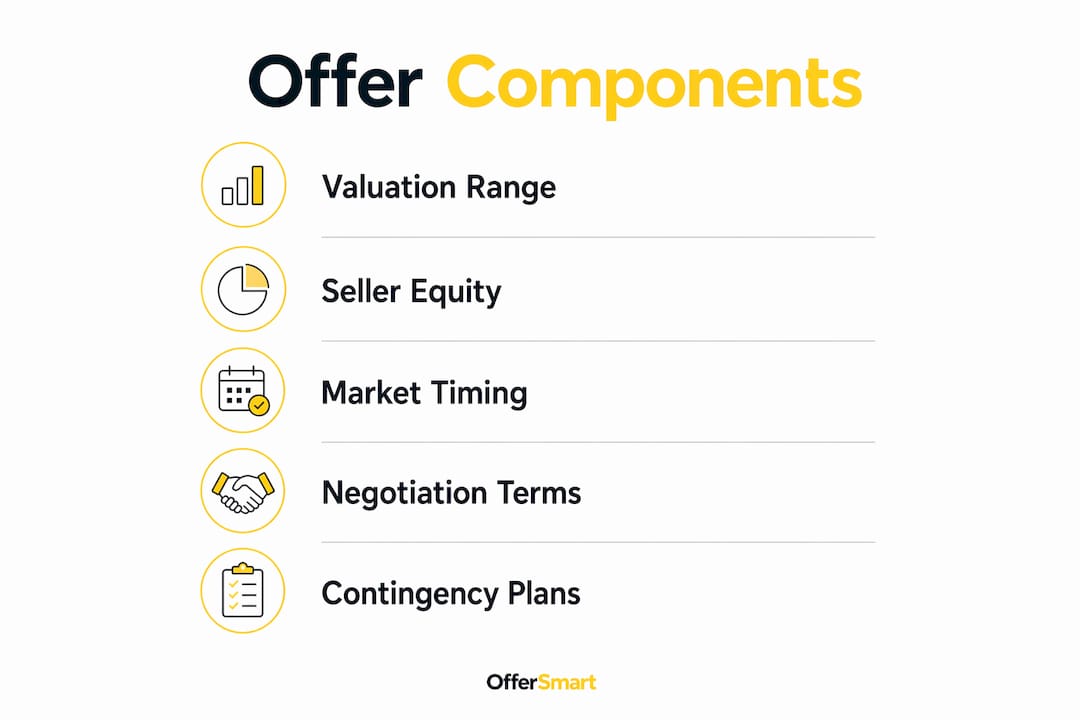
| Offer component | Impact on acceptance likelihood |
|---|---|
| Price within valuation band | High: anchors offer in credible range |
| Chain-free or mortgage agreed in principle | High: reduces seller risk |
| Flexible completion date | Medium: addresses seller timeline |
| Minimal contingencies | Medium: signals commitment |
| Written rationale with comps | Low to medium: builds credibility |
What mistakes should you avoid when using property data?
The most common error is treating the asking price as a proxy for market value. Asking prices reflect seller aspiration, not confirmed market data. Basing your offer on the listing figure without independent analysis means you are negotiating from the seller's starting point rather than your own evidence.
A second frequent problem is using stale data. Property markets in cities like London, Manchester, and Bristol can shift materially within a quarter. Comps from twelve months ago may no longer reflect current conditions, particularly after interest rate changes or local supply shocks. Quality of data inputs directly constrains the quality of your offer decision. Outdated or unverified figures produce unreliable valuations.
Mismatched property records are a subtler but equally damaging issue. Address formatting differences between Rightmove, Land Registry, and local council records can cause you to pull data for the wrong property or miss relevant transactions entirely. Using unique parcel identifiers rather than street addresses resolves most of these discrepancies.
Troubleshooting checklist if your data or offer strategy is not working:
- Offer rejected well below asking: Re-examine your comps. Are they genuinely comparable in size, condition, and location? Have you accounted for recent improvements to the property?
- Motivation signals appear strong but seller is not negotiating: The signal may be outdated. Probate cases can take months to resolve; the urgency may have passed.
- AVM estimate differs significantly from comps: Trust the comps over the AVM when the sample size is sufficient. AVMs perform less reliably on unusual or non-standard properties.
- Market shifted after you submitted: Do not feel locked into your original figure. Request updated comparable sales and revise your position before proceeding.
"Moving from gut instinct to quantified data inputs improves both the quality of your offer and your confidence in defending it to the seller."
Key takeaways
Data-driven property offers work because they replace assumption with evidence, giving you a defensible price, a clear negotiation ceiling, and the ability to spot motivated sellers before other buyers do.
| Point | Details |
|---|---|
| Use multiple data sources | Combine AVMs, Land Registry comps, and motivation signals for a complete picture. |
| Build a valuation band | Treat AVM outputs as a range, not a fixed figure, and adjust using verified comps. |
| Prioritise offer terms | Optimising completion dates and contingencies can raise acceptance rates by around 35%. |
| Identify motivated sellers | Probate filings, tax delinquency, and extended vacancy signal genuine negotiation room. |
| Validate all inputs | Stale or mismatched data produces unreliable offers; always cross-check using parcel IDs. |
Why data-driven offers changed how I think about property buying
By Rhys
I spent years watching buyers make offers based on what felt right. They would look at the asking price, knock off a round number, and hope for the best. The problem is that gut instinct is not a strategy. It is just a guess with confidence attached.
The shift I have seen in buyers who use structured data is not just that they pay less. It is that they negotiate differently. When you can point to three comparable sales on the same road and show that the asking price is 8% above the six-month average, you are not haggling. You are presenting evidence. Sellers and estate agents respond to that differently than they do to a low offer with no rationale.
What surprised me most when I started applying multi-source data workflows was how often motivation signals changed the entire calculus. A property that looked overpriced on paper became a genuine opportunity once I understood the seller was dealing with a probate situation and had already reduced the price twice. The data did not just tell me what to offer. It told me why the seller might accept it.
The complexity is real, particularly for first-time buyers. But the answer is not to avoid the data. It is to use tools that do the heavy lifting for you, so you can focus on interpreting the output rather than gathering the inputs manually.
— Rhys
See your offer clearly before you commit
Offersmart is built specifically for UK homebuyers who want to move beyond guesswork. Enter a property address or paste a listing link, and Offersmart instantly analyses recent local sales, including properties on the same road, to tell you what you should realistically offer.
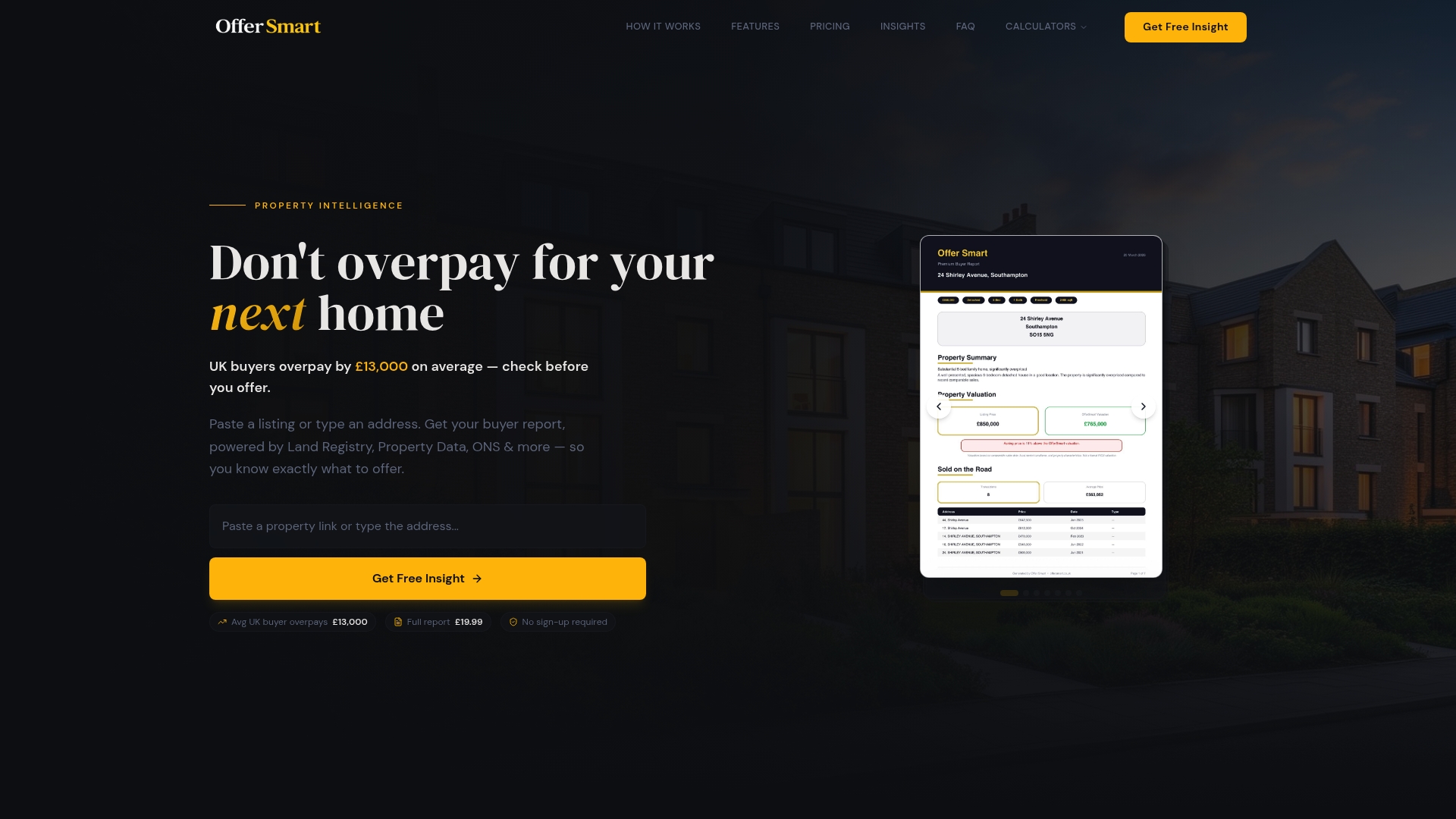
Beyond comparable sales, Offersmart surfaces flood risk, crime data, school proximity, and a five-year value forecast so you understand the full picture before committing. The built-in mortgage calculator gives you a complete financial view alongside your offer strategy. For buyers who want to make informed property offers without spending hours on manual research, Offersmart delivers the clarity you need in minutes.
FAQ
What does it mean to use data to make a property offer?
Using data to make a property offer means basing your bid on objective evidence such as comparable sold prices, automated valuations, days on market, and seller motivation signals rather than the asking price alone. This approach produces a defensible figure grounded in real market conditions.
How accurate are automated valuation models for UK properties?
Automated valuation models carry a 5–7% accuracy range on residential properties. Always cross-reference AVM outputs against recent comparable sales from Land Registry records before finalising your offer.
What are the most useful seller motivation signals?
Probate filings, tax delinquency records, extended vacancy, and multiple listing price reductions are the strongest indicators of a motivated seller. Probate filings in particular combine verified urgency with a genuine need to complete, making them the highest-converting signal for buyers.
Can adjusting offer terms really improve my chances of acceptance?
Yes. Optimising terms such as completion date and contingencies can increase acceptance probability by approximately 35% compared to a higher-priced offer that does not address the seller's specific needs.
How do I avoid using outdated property data in my offer?
Use platforms that provide real-time or near-real-time listing updates, and limit comparable sales to transactions completed within the past six months. Cross-check records using parcel IDs rather than street addresses to avoid mismatched data across sources.