

Making an offer on a home is one of the most financially consequential decisions you will ever make, yet most buyers go into it with little more than gut feeling and a rough idea of the asking price. Understanding what is a realistic offer means going beyond guesswork. It means grounding your figure in recent local sales data, understanding the market conditions around the property, and packaging your offer so a seller takes it seriously. Get this right and you avoid overpaying. Get it wrong and you either lose the home or spend years recovering the difference.
Table of Contents
- Key takeaways
- What constitutes a realistic offer
- Using comparable sales to evaluate your offer
- Beyond price: what sellers actually consider
- Strategies for negotiating realistic offers
- Common mistakes that undermine your offer
- My honest take on making realistic offers
- Make smarter offers with Offersmart
- FAQ
Key takeaways
| Point | Details |
|---|---|
| Data beats instinct | Base your offer on comparable sales from the last 60 to 90 days, not the asking price alone. |
| Market conditions set the range | Competitive markets with multiple bids often require offers 3 to 10% above asking price. |
| Non-price factors matter | Deposit size, financing strength, and flexibility on completion dates influence seller decisions significantly. |
| Justified offers get responses | Offers backed by comparable sales data are far more likely to open negotiations than arbitrary low figures. |
| Preparation is the best tactic | Pre-approval, clear terms, and fast responses all signal to sellers that your offer is low-risk. |
What constitutes a realistic offer
A realistic offer is not simply a number you feel comfortable with. It is a data-backed proposal that reflects the genuine market value of a property, accounts for current local conditions, and is structured to appeal to the seller's priorities alongside price.
In the UK market, what constitutes a fair offer varies considerably depending on whether you are buying in a competitive city market or a slower rural area. In a hot market with several competing buyers, paying above asking price is often the norm rather than an exception. Specifically, buyers in markets with four or more competing offers typically pay 3 to 10% over the list price. When only two or three offers are present, a premium of 1 to 5% is more typical. In a slow market with a single interested buyer, an at-list or even slightly below-list offer may be entirely realistic.
Key market signals to look out for include:
- Days on market. Properties sitting for more than 30 days often have room for negotiation.
- Price reductions. A reduced listing signals the seller has already moved and may move again.
- Volume of viewings. High viewing numbers with quick sales indicate a competitive environment.
- Sold-to-asking-price ratios. Local estate agents can share this data, and it tells you precisely how far buyers are going.
Understanding these signals before you make an offer is what separates a buyer who pays a fair price from one who pays too much.
Using comparable sales to evaluate your offer
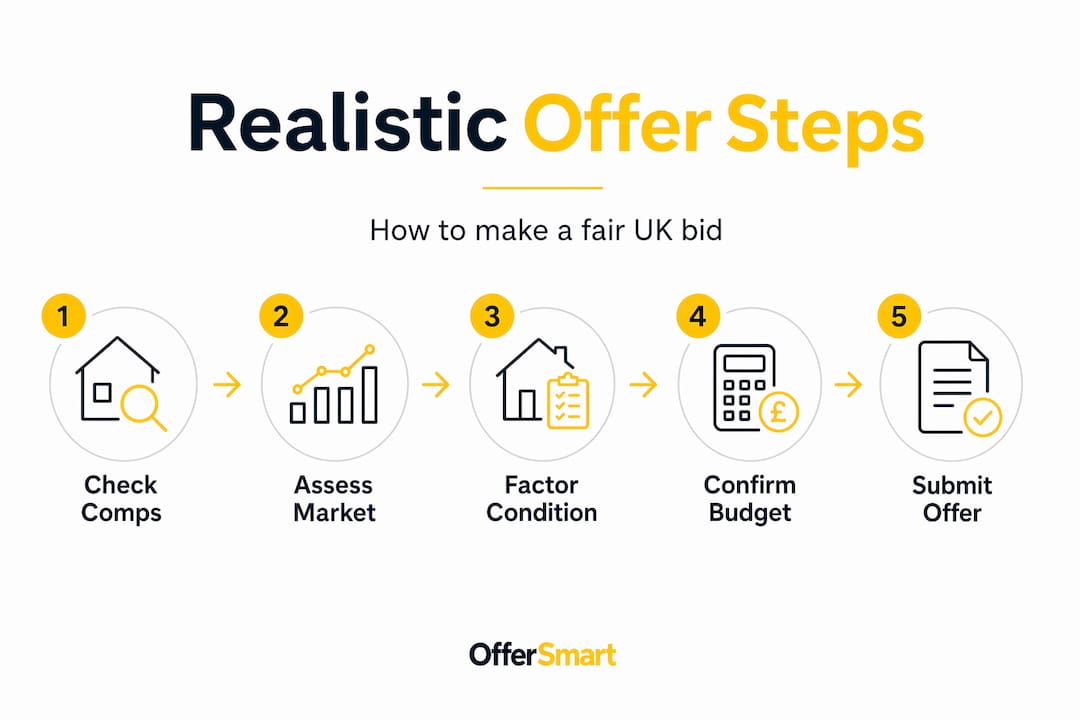
Comparable sales, often called "comps," are recent transactions for properties similar in size, condition, and location to the one you are considering. They are the single most reliable tool for evaluating a fair offer price.
The key word is recent. You should use sales from the last 60 to 90 days to avoid relying on price data that no longer reflects current conditions. A sale from 18 months ago in a shifting market tells you almost nothing useful.
When assessing comps, focus on properties that share the following characteristics with the home you want:
- Similar square footage and number of bedrooms
- Comparable condition (renovated versus original, for example)
- Same postcode or street where possible
- Similar property type (terraced, semi-detached, detached, flat)
A realistic offer example: suppose you are looking at a three-bedroom semi-detached in Leeds asking £280,000. Three comparable properties on nearby streets sold in the past eight weeks for £268,000, £272,000, and £275,000. Those figures suggest the asking price is already slightly above current market value. An offer of £268,000 to £272,000, supported by those comps, is not a lowball. It is a justified, data-driven position.
Pro Tip: Rightmove's "Sold Prices" section and HM Land Registry both show completed UK transactions. Cross-reference both sources because Land Registry data can lag by several weeks.

The pitfall most buyers fall into is relying on data that is either too old, drawn from a different postcode, or based on properties with meaningfully different characteristics. A four-bedroom detached house on a main road tells you very little about the value of a two-bedroom flat behind the high street. Keep comps tight and relevant.
Offers backed by recent comparable sales have a significantly higher chance of initiating genuine seller negotiations than arbitrary low figures, which sellers and agents tend to dismiss outright.
Beyond price: what sellers actually consider
Price is only one part of what sellers evaluate. A good offer is a balanced package that reflects your seriousness as a buyer, your financial certainty, and your willingness to work with the seller's circumstances.
Here is how common offer elements compare in terms of seller appeal:
| Offer element | Lower appeal | Higher appeal |
|---|---|---|
| Deposit size | 1 to 3% of purchase price | 5 to 10% of purchase price |
| Financing status | No mortgage in principle | Full mortgage agreement in principle |
| Survey contingency | Standard lengthy period | Shortened survey period (5 to 7 days) |
| Completion timeline | Vague or inflexible | Aligned with seller's preferred date |
| Chain status | Long chain or unconfirmed | Chain-free or confirmed sale |
Earnest money deposits in the UK context relate to the initial commitment you signal through your solicitor's process and any reservation fees. In competitive markets, deposits rising to 5 to 10% of the purchase price signal genuine intent and give sellers confidence you will not walk away lightly.
Deal certainty frequently outweighs the highest price. A seller facing a relocation deadline or a onward purchase that is time-sensitive will often accept a slightly lower offer from a chain-free, financially prepared buyer over a higher figure from someone whose sale is still uncertain.
Pro Tip: Ask your solicitor to prepare a summary of your financial position alongside your offer. This one-page overview, covering your mortgage agreement in principle, deposit size, and chain status, can meaningfully shift seller perception in your favour.
Sellers may also value flexibility on move-in dates or a short leaseback arrangement, particularly when relocating or awaiting a new build. Being open to these terms costs you little but can make your offer the one that stands out.
Strategies for negotiating realistic offers
Knowing how to make a realistic offer is one thing. Positioning it effectively is another. Here is a practical approach for UK buyers across different market conditions.
-
Assess the competition first. Ask the estate agent directly how many viewings the property has had and whether other offers are expected. This is publicly acceptable, and agents will often give you a useful signal even if they cannot share specifics.
-
Anchor your offer with data. Present your figure with reference to comparable sales. You do not need to share a spreadsheet, but mentioning that recent similar properties in the area sold for a particular figure gives your offer credibility and makes it harder to dismiss.
-
Use agent-to-agent intelligence. Direct communication between agents reveals seller motivations that never appear in public listings. Preferred completion dates, reasons for sale, and whether competing offers exist are all details your agent may uncover with a single call to the listing agent.
-
Consider an appraisal gap clause. In competitive situations, an appraisal gap clause commits you to covering any difference between the surveyor's valuation and your agreed price up to a specified limit. This tells the seller their deal is protected even if the survey comes in low, making your offer genuinely competitive without simply raising the number.
-
Respond quickly to counteroffers. Delayed responses signal uncertainty. If you are serious, treat each counteroffer as urgent. Sellers who feel they are being strung along will look elsewhere, even if your price is right.
Pro Tip: If you are in a multiple-offer situation, ask your agent what would make your offer the most attractive beyond price. The answer will often surprise you. Sellers frequently want certainty and speed more than an extra few thousand pounds.
For a detailed walkthrough of the entire offer preparation process, the guide on how to prepare a winning offer covers each stage clearly.
Common mistakes that undermine your offer
Even buyers who have done their research can fall into habits that weaken an otherwise strong offer. These are the most common errors to avoid.
- Lowballing without justification. Offering 20% below asking price with no comparable sales to support the figure is not negotiation. It signals to the seller that you are not serious, and many will not respond at all.
- Ignoring seller priorities. Focusing entirely on price while overlooking that the seller needs a four-month completion timeline or a flexible move-out date can cost you the deal to a buyer who simply asked the right questions.
- Weak or absent mortgage preparation. Submitting an offer without a mortgage agreement in principle in place is a significant red flag. Pre-approval letters from reputable lenders reassure sellers that the deal is financially viable and reduce their perceived risk.
- Removing survey contingencies entirely. Shortening the survey period to five to seven days makes your offer more competitive. Waiving the survey altogether exposes you to potentially serious financial risk and should be avoided in almost all circumstances.
- Taking too long to respond to counters. Negotiating realistic offers requires momentum. Sitting on a counteroffer for three days without a clear reason gives the seller time to entertain new interest and reconsider their position.
My honest take on making realistic offers
I have spoken with enough buyers over the years to spot a pattern that rarely gets addressed directly. Most people approach an offer as a financial transaction. The seller sees it as something far more personal.
In my experience, the buyers who consistently get their offers accepted are not always the ones paying the most. They are the ones who have done the work to understand the seller's situation, packaged their offer clearly, and communicated with respect through their agent. A rushed offer full of aggressive contingencies, even at a strong price, can trigger a seller's anxiety and send them toward a more straightforward buyer at a lower number.
What I have learned is that the three pillars of offer acceptance are price, terms, and certainty. Buyers who treat all three with equal seriousness rarely lose out. I have also seen buyers protect themselves well by keeping a shortened survey period rather than waiving it entirely. The saving in stress and potential repair costs is almost always worth that extra week.
My advice is to use data without becoming cold about it. Bring your comparable sales, know your range, and then ask yourself what the person on the other side of this transaction actually needs. The best offers I have seen are both justified and human.
— Rhys
Make smarter offers with Offersmart
Knowing what a realistic offer looks like is only half the challenge. Calculating precisely where to pitch yours requires access to the right data at the right moment.

Offersmart analyses any UK property address or listing link and tells you what you should realistically offer, comparing recent sales on the same road and in the surrounding area. Beyond comparable pricing, it gives you a picture of flood risk, local amenities, school proximity, and a five-year value forecast. Use the built-in mortgage calculator to understand exactly what you can afford before committing to a figure. For a complete view of your buying costs, the Offersmart calculators hub brings mortgage, stamp duty, and running cost estimates together in one place. Stop guessing. Start with data.
FAQ
What is a realistic offer on a house in the UK?
A realistic offer is one grounded in recent comparable sales for similar properties in the same area, adjusted for current market conditions. It reflects genuine market value rather than simply discounting the asking price.
How much below asking price can I offer in the UK?
In a slow market, offers of 5 to 10% below asking price can be reasonable if supported by comparable sales data. In a competitive market with multiple bidders, offers above asking price of 3 to 10% are common.
What makes an offer more attractive to a seller beyond price?
Sellers consider the full offer package, including financing strength, deposit size, chain status, survey timeline, and flexibility on completion dates. A chain-free buyer with a mortgage agreement in principle often beats a higher offer from a buyer in a complicated chain.
How do I find comparable sales for a property I want to buy?
Use Rightmove's sold prices section and HM Land Registry to find completed transactions within the last 60 to 90 days for similar properties on nearby streets. Focus on matching property type, size, and condition as closely as possible.
Should I always offer below the asking price?
Not necessarily. If comparable sales show the asking price is already at or below market value, offering below it may simply result in rejection. A property negotiation strategy based on data will tell you whether to go below, at, or above the asking price depending on the specific property and market conditions.