

For most first-time buyers in the UK, the gap between having an offer accepted and actually holding the keys feels like a fog. You know something is happening, but you are not entirely sure what, or how long it will take. To understand homebuying process timeline from start to finish is to replace that fog with a clear map. This guide walks you through every major stage, typical durations, and the decisions that keep things moving. Whether you are weeks away from making an offer or already in the thick of conveyancing, this is the clarity you need.
Table of Contents
- The common timeline stages in a UK home purchase
- Preparing for a smooth homebuying journey
- Understanding home surveys and their timing
- Mortgage offer validity and managing your timeline
- Exchange of contracts to completion explained
- Why managing uncertainty is key throughout the homebuying timeline
- How Offer Smart can support your homebuying timeline
- Frequently asked questions
Key Takeaways
| Point | Details |
|---|---|
| Typical timeline duration | A UK homebuying process for first-time buyers usually takes 12 to 24 weeks from offer to keys. |
| Conveyancing duration | Legal conveyancing generally requires 8 to 12 weeks and can extend with transaction complexity. |
| Mortgage offer validity | Mortgage offers typically last between three and six months and require careful timing to avoid expiry. |
| Early parallel actions | Starting solicitor instruction, mortgage processing, and surveys immediately after offer acceptance can reduce delays. |
| Exchange importance | Exchanging contracts marks the legally binding ‘point of no return’ and occurs about 1–2 weeks before completion. |
The common timeline stages in a UK home purchase
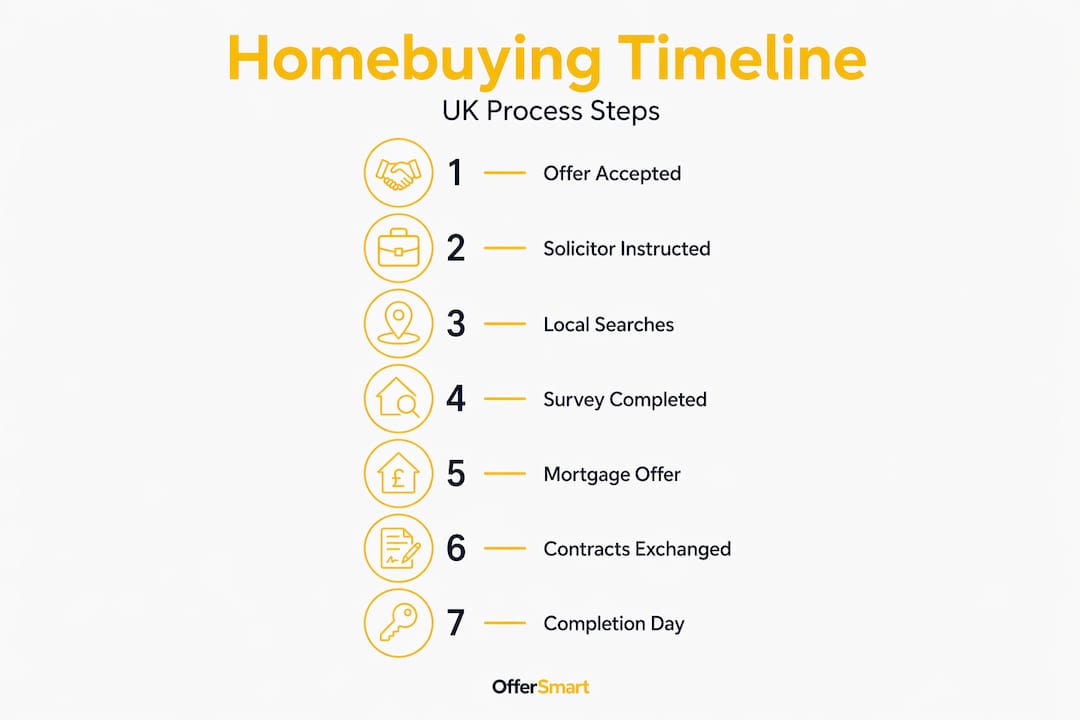
Before anything else, it helps to see the full picture. The UK homebuying process has several distinct stages, and each one feeds into the next. Skipping ahead or letting one stall can push your completion date back by weeks.
Here are the key stages in order:
- Offer accepted by the seller (Day 1)
- Solicitors instructed by both parties
- Mortgage application submitted or progressed
- Survey booked and completed
- Local authority searches and enquiries raised by your solicitor
- Mortgage offer issued by your lender
- Enquiries resolved and title confirmed
- Exchange of contracts (legally binding)
- Completion and key handover
The UK conveyancing process typically takes around 8 to 12 weeks on a straightforward freehold case for first-time buyers in England and Wales. Add a chain, a leasehold property, or a slow local council, and you are looking at longer. A realistic total from offer to keys is somewhere between 12 and 24 weeks, which is roughly 3 to 6 months.
| Stage | Typical duration |
|---|---|
| Solicitors instructed | 1–3 days |
| Local authority searches | 2–6 weeks |
| Survey booked and completed | 1–3 weeks |
| Mortgage offer issued | 2–6 weeks from application |
| Enquiries and title checks | 2–6 weeks |
| Exchange to completion | 1–2 weeks |
| Total (offer to keys) | 12–24 weeks |
The wide ranges above are not vague estimates. They reflect the real variability in the process. A proactive buyer working with a fast solicitor in an uncontested chain might exchange in ten weeks. A leasehold flat with a missing fire safety certificate could take six months. Your first home buying checklist is a good place to start tracking these moving parts.
Having set the stage with overall expectations, the next section explains how to prepare effectively before and right after your offer is accepted.
Preparing for a smooth homebuying journey
Speed in the early days matters enormously. Many buyers wait passively after their offer is accepted, assuming the solicitor will drive everything. That is a costly mistake. The buyers who compress their timeline are the ones who act fast across multiple fronts simultaneously.

Instructing your solicitor, booking your survey, and progressing your mortgage application within 48 to 72 hours of offer acceptance is the single most effective way to save weeks later. These three tracks can run in parallel, and they should.
Here is what to action immediately after your offer is accepted:
- Instruct a conveyancing solicitor and provide all required ID documents upfront
- Notify your mortgage broker or lender and submit any outstanding documents
- Book your home survey without waiting for searches to begin
- Obtain buildings insurance quotes early, as you will need cover from exchange
- Gather key paperwork: payslips, bank statements, proof of deposit, and ID
- Confirm your solicitor has the memorandum of sale from the estate agent
Understanding the home buying process means recognising that delays rarely happen at completion. They happen in weeks two to eight, when searches are pending, mortgage valuations are queued, and documents are still being chased. The buyers who check the right things before making an offer and prepare their paperwork in advance consistently move faster.
Pro Tip: Ask your solicitor to raise preliminary enquiries to the seller's solicitor within the first week. The seller's replies to enquiries often take two to four weeks to come back. Starting that clock early can save you a full month.
Understanding home surveys and their timing
A home survey is one of the most misunderstood parts of the timeline. Some buyers see it as a box-ticking exercise. Others delay booking it while waiting for other things to move. Both approaches cost time and money.
In the UK, there are two main survey types relevant to most first-time buyers:
- RICS Level 2 (HomeBuyer Survey): Suitable for conventional properties in reasonable condition. Covers visible defects and basic structural observations.
- RICS Level 3 (Building Survey): More thorough, recommended for older properties, unusual construction, or where you suspect significant issues.
A Level 2 survey typically books within 3 to 10 working days, with the inspection lasting one to two hours and the written report arriving within two to five working days. A Level 3 survey takes longer at each stage due to its greater scope.
| Level 2 (HomeBuyer) | Level 3 (Building survey) | |
|---|---|---|
| Booking lead time | 3–10 working days | 5–15 working days |
| Inspection duration | 1–2 hours | 3–8 hours |
| Report delivery | 2–5 working days | 5–10 working days |
| Total time from booking | ~2–3 weeks | ~3–5 weeks |
Several factors influence how quickly a survey can be arranged and completed:
- Property access: Tenanted properties or occupied homes may limit appointment availability
- Surveyor availability in your area, particularly in busy spring and autumn markets
- Property complexity: Non-standard construction, large plots, or extended properties take longer to assess
- Report length: A Level 3 report on an older property may require additional specialist input
Surveys rarely cause the biggest delays in a home purchase timeline guide. That honour goes to conveyancing searches. But booking late adds unnecessary time and can slow your lender's valuation too, since some lenders wait for a survey before progressing the mortgage.
Mortgage offer validity and managing your timeline
Your mortgage offer is not the finish line. It is a timed approval that can expire or be withdrawn if circumstances change. Many first-time buyers do not fully grasp this risk until they are close to exchange.
Mortgage offers in the UK typically remain valid for 3 to 6 months. New build properties often attract shorter validity windows due to the time required to reach completion. If your purchase runs beyond that window, you may need to request an extension or, in some cases, reapply entirely, which can affect the rate you were originally offered.
There is a second risk that catches buyers off guard. Lenders can withdraw a mortgage offer if your financial circumstances change materially before completion. That means large purchases on credit, redundancy, or even a missed payment can put your offer at risk.
To protect your mortgage offer through to completion:
- Avoid taking out new credit or loans after your offer is issued
- Do not change jobs or go self-employed during the process without speaking to your broker
- Keep your bank accounts stable and avoid large, unexplained transactions
- Respond to any lender requests or queries within 24 to 48 hours
- Track your offer expiry date and flag it to your solicitor at least six weeks before it lapses
Pro Tip: Treat your mortgage offer as conditional approval, not final confirmation. Your finances need to remain exactly as they were when you applied, right through to completion day.
"The most common reason mortgage offers fail in the final weeks is a change in borrower circumstances that went unreported. A new car finance agreement, a redundancy, or even a salary reduction that seemed minor can be enough for a lender to reassess." Managing your offer price strategy and your finances with equal attention is what separates smooth purchases from stressful ones.
Exchange of contracts to completion explained
Exchange is the moment everything becomes real. Before it, either party can walk away. After it, withdrawal means financial penalties. That shift in legal status is why exchange day feels so significant, and why everything leading up to it matters so much.
The exchange of contracts usually occurs 1 to 2 weeks before completion and is the point at which the sale becomes legally binding for both buyer and seller. On exchange, you will pay your deposit, typically 5 to 10 per cent of the purchase price, and a fixed completion date is set.
The gap between exchange and completion exists to allow both parties to arrange removals, give notice on rented properties, and ensure all final checks are completed without panic. Use this time well.
Here is a numbered checklist for the exchange to completion period:
- Confirm buildings insurance is active from the day of exchange
- Book your removal company as early as possible, as popular dates fill quickly
- Notify utility providers of your move date and set up accounts for your new address
- Arrange a final meter reading at both properties on completion day
- Confirm your solicitor has received mortgage funds from your lender in advance
- Do a final walkthrough of the property before completing, if possible
Key actions before exchange that many buyers overlook:
- Confirm the deposit is in your solicitor's client account well before exchange day
- Review the draft contract and completion statement carefully with your solicitor
- Check the agreed fixtures and fittings list matches what you originally agreed
Pro Tip: Book your removal company as soon as you have a realistic exchange date in sight, not after exchange itself. Removal firms in most UK cities are booked up weeks in advance, especially on Fridays. Waiting until after exchange often means paying a premium or accepting an inconvenient date.
Your exchange and completion checklist should be prepared and reviewed at least two weeks before your expected exchange date.
Why managing uncertainty is key throughout the homebuying timeline
Here is the honest truth that most guides gloss over: the homebuying process timeline is only partially within your control. The structured steps above make it look orderly. In practice, it is anything but, particularly in the first eight weeks.
Many first-time buyers experience genuine uncertainty before exchange due to factors like delayed searches, unanswered enquiries, and lender valuation timelines that nobody can fully predict. Council search times in some boroughs run to six weeks. A single missing document from the seller's freeholder can pause the whole chain.
What we have seen is this: buyers who try to force the process by chasing solicitors daily often create friction without gaining speed. Buyers who establish a clear communication rhythm with their solicitor, their broker, and their estate agent, checking in twice a week with specific questions, consistently move faster and feel less anxious.
"The wait before exchange is where most buyer anxiety lives. You have committed emotionally, you may have handed in notice on a rental property, and yet nothing feels certain. Recognising this as a normal part of the process is not resignation. It is preparation."
The distinction between what you can control and what you cannot is worth writing down. You control your response speed, your document readiness, and your communication. You do not control council search timescales, chain complexity, or your seller's solicitor's workload. Focusing energy on the former and accepting the latter with clear contingency planning is the most practical approach.
Pro Tip: Set a weekly calendar reminder to ask your solicitor one specific question: "What is outstanding on my file, and what can I do to move it forward?" This single habit keeps your case at the top of the pile without being disruptive.
How Offer Smart can support your homebuying timeline
Understanding your timeline is one part of buying confidently. Knowing you are paying the right price is the other.

Offer Smart is built for exactly this moment. Before you make an offer, it analyses the property and surrounding area, compares recent local sales, and tells you what you should realistically offer based on real market data. No guesswork. No overpaying. You can also use the built-in mortgage calculators to confirm your borrowing capacity and model your monthly costs before committing, which directly supports the preparation advice in this guide. Explore the full suite of property calculators to get a clear financial picture, including estimated running costs, rental yield, and a five-year value forecast. When you know the numbers before you proceed, every step in the timeline feels more manageable.
Frequently asked questions
How long does the UK conveyancing process usually take for first-time buyers?
Conveyancing typically takes 8 to 12 weeks for straightforward cases, though complex transactions or leasehold properties can extend this to 16 weeks or more.
What is the validity period of a UK mortgage offer?
Mortgage offers are valid for roughly 3 to 6 months, depending on your lender and property type. If your purchase is delayed beyond that window, you may need to request an extension or reapply.
When does exchange of contracts happen, and why is it important?
Exchange typically occurs 1 to 2 weeks before completion and is the point at which both parties are legally bound to proceed. Withdrawal after exchange results in financial penalties for the party pulling out.
How soon should I book a home survey after my offer is accepted?
Book your survey immediately after offer acceptance so that the inspection and report can proceed in parallel with your solicitor's legal work. Waiting even a week can push your overall timeline back.
Can delays in local authority searches affect my homebuying timeline?
Yes. Local authority search times vary widely between councils and can add several weeks to your conveyancing timeline, which is why instructing your solicitor fast is so important.