

Property valuation is the professional assessment of a property's current market value, used by mortgage lenders to confirm a property is worth what you have agreed to pay for it. Understanding how property valuation works is one of the most practical things you can do before exchanging contracts. The process involves qualified surveyors, recognised standards such as those set by the Royal Institution of Chartered Surveyors (RICS), and a range of methods from brief lender checks to detailed independent reports. Get it wrong, and you risk overpaying, losing mortgage funding, or buying a property with hidden problems.
How does property valuation work in the UK?
Property valuation is a formal estimate of what a property would sell for on the open market on a given date. It is not the same as an estate agent's asking price, and it is not a condition survey. The valuation figure is the number a lender uses to decide how much it will lend you, which makes it one of the most consequential numbers in your purchase.
The property appraisal process in the UK is shaped by two main forces: the lender's need to protect its loan, and the buyer's need to understand true market value. These two goals overlap but are not identical. A lender's valuation tells you whether the property is adequate security for the mortgage. An independent RICS valuation tells you what the property is genuinely worth in the current market, with professional liability attached.

RICS Red Book standards are the benchmark for all formal valuations in the UK. Any valuation conducted under these standards must follow consistent, transparent methodology. That consistency is what makes RICS valuations legally defensible and accepted by HMRC, probate courts, and mortgage lenders alike.
What are the different types of property valuations?
Not all valuations are equal. Buyers encounter several distinct types during a purchase, and confusing them is a common and costly mistake.
- Mortgage valuation: Ordered and paid for by your lender, this is a brief risk check. It confirms the property is worth enough to secure the loan. It is not a survey and offers you no buyer protection.
- RICS Level 2 survey (HomeBuyer Report): An independent report commissioned by the buyer. It covers condition, defects, and market value, with professional liability attached.
- RICS Level 3 survey (Building Survey): The most detailed option, suited to older, larger, or unusual properties. It covers structure, condition, and potential repair costs in depth.
- Estate agent appraisal: An informal estimate used to set a marketing price. It carries no professional liability and is not accepted for mortgage or legal purposes.
- Automated valuation model (AVM): A desktop estimate generated by algorithms using historic sales data. Lenders use these for lower-risk remortgages. They are not suitable for complex or unusual properties.
- Online house price estimates: Rough guidance tools based on Land Registry data and local comparables. Useful for initial research, not for making offers.
| Type | Who orders it | Purpose | Professional liability |
|---|---|---|---|
| Mortgage valuation | Lender | Loan security check | No (protects lender only) |
| RICS Level 2 or 3 survey | Buyer | Condition and value | Yes |
| Estate agent appraisal | Agent | Marketing price | No |
| Automated valuation model | Lender | Desktop risk check | No |
Pro Tip: Commission your own RICS survey even if your lender has already arranged a mortgage valuation. The two serve completely different purposes, and only one of them protects you.
How does a mortgage valuation work?
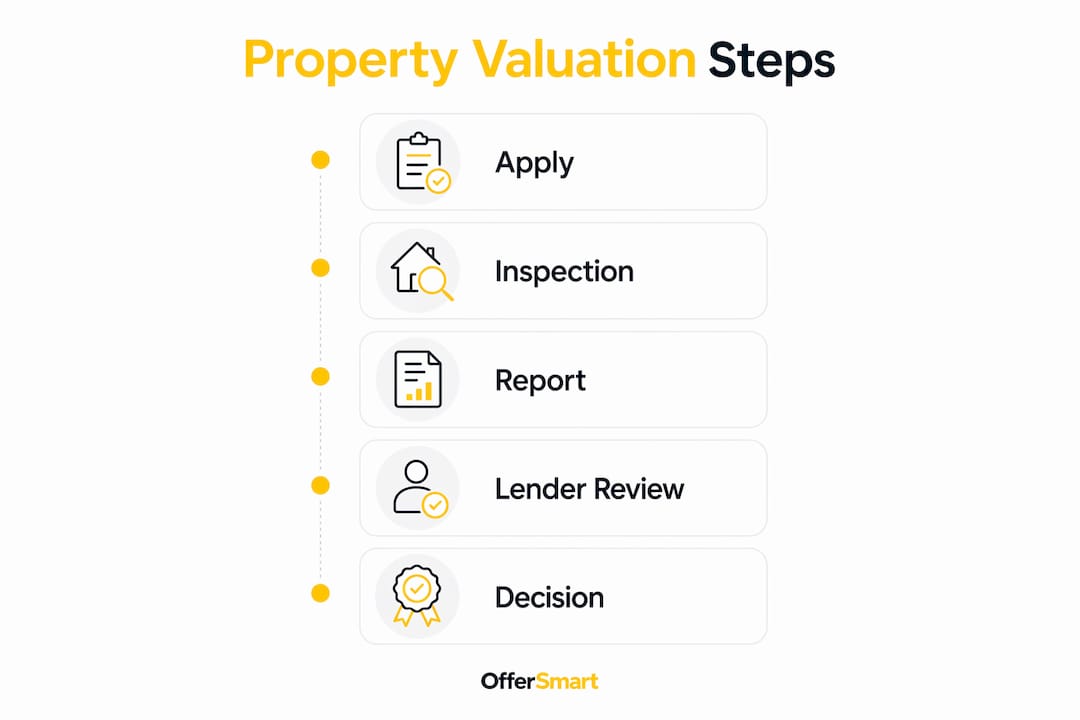
A mortgage valuation is arranged by your lender after you submit a mortgage application. You typically pay a valuation fee as part of the application process, even though the report belongs to the lender and not to you.
The physical inspection is brief. A mortgage valuation takes 15–30 minutes onsite and focuses on whether the property is suitable as loan security, not on its detailed condition. The surveyor checks the property type, general condition, obvious defects, and recent comparable sales in the area. The report goes to the lender, not to you, though some lenders share a summary.
Not every mortgage valuation involves a physical visit. Lenders may use desktop or drive-by valuations for lower-risk properties, relying entirely on data and comparable sales without entering the building. This is increasingly common for standard properties in well-documented areas. The typical timeline from instruction to report is one to two weeks.
The most significant outcome to prepare for is a down valuation. A down valuation occurs when the lender values the property below your agreed purchase price. The lender will only lend against the lower figure. That means you must either cover the gap with a larger deposit, renegotiate the purchase price with the seller, or walk away.
- Receive the valuation result. Your lender will inform you of the valuation figure and whether it matches the purchase price.
- Check for a shortfall. If the valuation is lower than the purchase price, calculate the exact gap you need to cover.
- Request evidence. Ask your lender or solicitor for the comparable sales the valuer used. Errors do occur.
- Renegotiate with the seller. A formal valuation gives you grounds to request a price reduction.
- Consider a second opinion. You can commission an independent RICS valuation to challenge a down valuation with evidence.
Pro Tip: A mortgage valuation is not buyer protection. It assesses the property as collateral for the lender. Never rely on it to confirm the property is in good condition.
What factors influence a property's valuation in the UK?
Valuers do not pull figures from thin air. The main factors influencing property value are location, condition, size, tenure, comparable sales, and environmental risks. Each one feeds into the final figure, and understanding them helps you assess whether a valuation result is reasonable.
- Location: Proximity to good schools, transport links, shops, and green space all add value. Crime rates and anti-social behaviour in the area reduce it.
- Property size and layout: Total floor area, number of bedrooms, and usable living space directly affect value. Extensions and loft conversions add measurable square footage.
- Condition: Structural problems, damp, roof condition, and the state of windows and heating systems all influence the valuation. A property in poor condition will be valued lower, and some lenders will refuse to lend on it at all.
- Comparable sales: Valuers rely heavily on recent sales of similar properties on the same road or in the same postcode. These comparables anchor the valuation to actual market evidence.
- Tenure: Freehold properties are generally valued higher than leasehold equivalents. A leasehold property with fewer than 80 years remaining on the lease is a significant red flag. Mortgage lenders often refuse to lend on short leases, and the cost of extending a lease can be substantial.
- Environmental risks: Flood risk, subsidence history, and proximity to contaminated land all affect value. Lenders treat high-risk properties with caution.
- Construction type: Non-standard construction such as timber frame, prefabricated concrete, or steel frame can limit lender appetite and reduce valuation figures.
You can research how house prices are determined in your target area before making an offer, which puts you in a much stronger negotiating position.
How do RICS valuations differ from estate agent appraisals?
The distinction matters enormously, and many buyers do not realise it until something goes wrong. RICS valuations carry professional liability and are accepted for mortgage lending, probate, and HMRC purposes. Estate agent appraisals carry none of these qualities.
Estate agent appraisals are marketing tools, often pitched to attract sellers with optimistic price suggestions. They are not independent, not evidence-based in a formal sense, and not regulated by RICS standards. An agent's appraisal tells you what the agent thinks the property might achieve on the market. A RICS valuation tells you what a qualified, independent Chartered Surveyor believes the property is worth, backed by documented methodology.
RICS valuations follow Red Book standards, requiring detailed inspections and formal market analysis. They are legally defensible and consistent across valuers. Online estimates sit at the opposite end of the reliability scale. They use algorithms and Land Registry data, which means they lag behind the current market and cannot account for property condition or local nuance.
A RICS valuation is necessary in four specific situations: mortgage applications, probate, HMRC tax assessments, and legal disputes. In all other situations, an estate agent appraisal or online estimate may be sufficient for initial guidance, but you should treat those figures as starting points rather than facts.
How can buyers use property valuations to make better decisions?
The valuation process gives you information. What you do with that information determines whether you buy well or overpay. These steps give you a clear framework.
- Do not rely on the lender's valuation for condition. A lender's mortgage valuation is a risk check, not a detailed condition report. Commission a RICS Level 2 or Level 3 survey separately.
- Use comparable sales before making an offer. Research recent sold prices on the same road. This tells you whether the asking price is realistic before the lender's valuer confirms it.
- Prepare for a down valuation. Have a contingency plan ready. Know your maximum deposit, and decide in advance whether you would renegotiate or withdraw.
- Check the lease length on leasehold properties. A lease below 80 years affects both valuation and mortgage eligibility. Factor in the cost of a lease extension before committing.
- Review environmental risk data. Flood risk and subsidence history affect both value and insurance costs. These factors show up in formal valuations and should inform your offer.
- Time your survey correctly. Commission your independent survey after your offer is accepted but before you exchange contracts. This gives you the information you need while you still have room to renegotiate.
Pro Tip: If a property has signs of overpricing relative to comparable sales, a formal valuation will likely confirm it. Use that evidence to negotiate, not just your instinct.
Key takeaways
Property valuation in the UK is a formal, evidence-based process governed by RICS Red Book standards, and buyers who understand the difference between a lender's risk check and an independent survey make significantly better purchase decisions.
| Point | Details |
|---|---|
| Lender valuations protect the lender | A mortgage valuation is a risk check for the lender, not a condition report for the buyer. |
| RICS surveys offer buyer protection | Commission a RICS Level 2 or Level 3 survey independently to assess condition and true value. |
| Down valuations require a plan | If the lender values below the purchase price, you must cover the gap, renegotiate, or withdraw. |
| Lease length affects value and lending | Leasehold properties with fewer than 80 years on the lease face valuation and mortgage complications. |
| Comparable sales anchor every valuation | Valuers use recent local sold prices as the primary evidence base for any formal valuation figure. |
What I have learned about valuations that most buyers find out too late
Rhys here. After years of watching buyers navigate the UK property market, the single most consistent mistake I see is treating the lender's mortgage valuation as a clean bill of health for the property. It is not. The lender's surveyor is there to protect the bank's money, full stop. If the roof is leaking but the property still has enough value to secure the loan, that surveyor has done their job. You, on the other hand, have learned nothing useful about what you are actually buying.
The second misconception is around estate agent appraisals. Buyers often walk into a purchase believing the agent's valuation figure is authoritative. It is not regulated, not independent, and not liable. I have seen properties appraised at figures that bore little relationship to what comparable sales in the same street actually showed. Always cross-reference with Land Registry data before you trust any number an agent gives you.
My honest recommendation for 2026: use independent data before you make an offer, commission a proper RICS survey after your offer is accepted, and treat any valuation gap as a negotiating opportunity rather than a crisis. The buyers who do this consistently pay less and buy with more confidence. The buyers who skip it often find out the hard way.
— Rhys
What Offersmart gives you before the valuation even happens
Knowing what a property is worth before you make an offer puts you in a fundamentally stronger position. Offersmart analyses comparable sales on the same road, flags flood risk and crime data, and gives you a clear picture of true market value before you commit to anything.

Enter a property address or paste a listing link, and Offersmart produces a full buyer property report covering local sold prices, area risk factors, school proximity, rental value, and a five-year value forecast. That means when the lender's valuation comes back, you already know whether the figure makes sense. You are not waiting to be told what the property is worth. You already know.
FAQ
What is the difference between a valuation and a survey?
A valuation assesses market value for lending purposes, while a survey assesses the physical condition of the property. Only a RICS Level 2 or Level 3 survey gives buyers detailed information about defects and repair costs.
Who pays for a mortgage valuation?
The buyer typically pays the mortgage valuation fee as part of the lender's application process, even though the report belongs to the lender and is not shared in full with the buyer.
What happens if the mortgage valuation is lower than the purchase price?
A down valuation means the lender will only lend against the lower figure. Buyers must cover the shortfall with a larger deposit, renegotiate the purchase price, or withdraw from the purchase.
How long does a property valuation take?
A physical mortgage valuation takes 15–30 minutes onsite, with the full report typically delivered within one to two weeks of instruction.
Are online property valuations accurate?
Online estimates use historic Land Registry data and algorithms. They provide useful rough guidance but cannot account for current condition, local nuance, or recent off-market sales, so treat them as a starting point only.