

A property survey is defined as a formal inspection report that documents the physical condition of a home and directly influences what you should pay for it. How survey results affect offers is straightforward: they provide documented evidence of defects that justify renegotiating your original figure. In the 2026 UK market, where elevated mortgage costs have made buyers more cautious, survey reports have become central financial tools rather than optional paperwork. Understanding how to read and act on a survey report is the difference between paying the right price and overpaying by thousands.
How do survey results affect offers in UK property deals?
Survey results affect offers by giving buyers documented proof that a property's condition does not match its asking price. The Royal Institution of Chartered Surveyors (RICS) classifies defects using a traffic light system: Condition 1 (green) for minor issues, Condition 2 (amber) for items needing attention, and Condition 3 (red) for serious defects requiring urgent action. A Condition 3 rating on any element gives you concrete grounds to request a price reduction or repairs before exchange. Without a survey, you are negotiating blind.
Renegotiating after a survey is a normal, expected part of buying a home. The strongest leverage comes from a well-evidenced report showing issues not reflected in the asking price. Lenders also rely on survey findings: a down-valuation by a lender's surveyor can reduce the mortgage funds released, making survey results critical not just for negotiation but for your entire purchase to proceed.

What survey findings are most likely to impact your offer?
Not every defect in a survey report carries the same weight. The distinction between cosmetic and structural issues determines how much leverage you actually hold.
Cosmetic issues include worn carpets, dated décor, or minor cracks in plasterwork. These rarely justify a price reduction because sellers rightly argue they are visible and already priced in. Requesting money off for cosmetic problems weakens your credibility and can sour negotiations before they start.
Structural and serious defects are a different matter entirely. The following issues consistently justify renegotiation or further investigation:
- Subsidence — movement in the foundations that can cost tens of thousands to stabilise and affects future insurability.
- Damp — rising or penetrating damp causes timber decay, health risks, and expensive remediation work.
- Major timber defects — wet rot, dry rot, or woodworm in roof timbers or floor joists can require full replacement.
- Unauthorised alterations — extensions or conversions built without planning permission or building regulations approval create legal and mortgage complications.
- Roof defects — failed flashings, missing tiles, or deteriorating flat roof coverings lead to water ingress and structural damage over time.
Significant issues like subsidence, major timber defects, or damp warrant specialist investigations before you decide to proceed or walk away. A general surveyor's report flags the problem; a specialist gives you the repair cost figure you need to negotiate with.
Pro Tip: Never ask for a price reduction based on a surveyor's estimate alone. Commission at least two independent contractor quotes for the specific defect. Precise, documented figures give sellers far less room to dismiss your request.
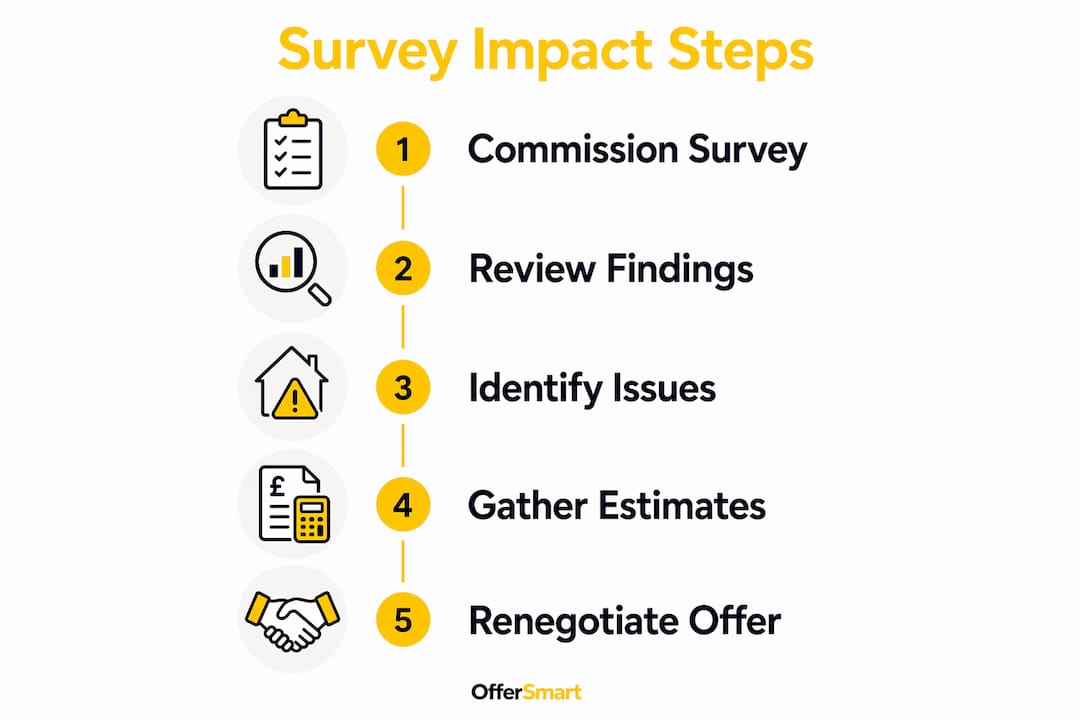
The quality of evidence in your survey report directly shapes your negotiation power. A vague note that "some damp was observed" is far weaker than a surveyor's photograph, moisture meter reading, and a written recommendation for specialist investigation.
Which survey type gives you the most negotiation power?
The type of survey you commission determines how much detail you have to work with when the time comes to renegotiate.
| Survey type | Scope | Negotiation strength |
|---|---|---|
| Lender's mortgage valuation | Confirms property is worth the loan amount only | Very limited. Does not identify defects. |
| RICS Level 2 HomeBuyer Report | Visual inspection of accessible areas, traffic light ratings | Moderate. Identifies issues but limited cost data. |
| RICS Level 3 Full Structural Survey | Detailed inspection including roof space and subfloor where accessible | Strong. Itemised findings support specific price claims. |
HomeBuyer Reports offer less detailed cost data than Full Structural Surveys, which limits your ability to negotiate effectively. A Full Structural Survey provides itemised findings that translate directly into financial claims. That specificity is what sellers and their solicitors respond to.
Relying solely on a lender's mortgage valuation is the most common and costly mistake buyers make. That report protects the lender, not you. It will not tell you the roof needs replacing or that the chimney breast has been removed without structural support. Advanced surveys in 2026 increasingly use thermal imaging and damp detection technology, giving buyers clearer and more specific information. For older properties, period homes, or anything with visible signs of wear, a Level 3 survey is the right choice.
Understanding property surveys for first-time buyers is particularly important if this is your first purchase, as the report types and their implications are not always explained clearly by estate agents.
How to use survey results to renegotiate your offer
A structured approach to renegotiation produces better results than an emotional one. Follow these steps to convert survey findings into a revised offer.
-
Read the full report before reacting. Identify all Condition 2 and Condition 3 items. List them by severity, not by how alarmed you feel reading them.
-
Commission specialist quotes for serious defects. Obtaining multiple independent contractor quotes transforms vague survey concerns into specific financial claims that sellers find harder to dismiss. Aim for two or three written quotes per major defect.
-
Calculate a realistic reduction, not the full repair cost. Effective renegotiation is typically anchored at 50–75% of repair costs for non-structural issues. Asking for the full amount signals inexperience and often collapses negotiations.
-
Frame your request around facts, not feelings. Requests framed as "The survey shows X, costing Y to fix" succeed far more often than vague calls for discounts. Send your request in writing, referencing the specific survey paragraph and the contractor quotes.
-
Involve your solicitor. Verbal agreements carry no weight. Follow any discussion with a written summary from your solicitor confirming the revised terms before exchange.
-
Act promptly. Present findings within 5–7 working days of receiving the report. Delays signal indecision and give sellers reason to doubt your commitment.
Pro Tip: Request a price reduction rather than asking the seller to carry out repairs. Solicitors warn that asking sellers to perform repairs before exchange is often unenforceable and risks rushed, poor-quality work. A price cut gives you full control over who does the work and to what standard.
The most common buyer mistake is asking for money off cosmetic issues or demanding the full repair cost for structural problems. Both approaches reduce your credibility. Sellers are more receptive to rational, documented requests than emotional appeals, and that distinction matters enormously in a competitive market.
For a detailed walkthrough of the process, the Offersmart guide on negotiating after a survey covers evidence-based tactics in full.
What do survey results mean for your mortgage?
Survey findings affect more than your negotiation position. They can directly alter the terms of your mortgage or delay your completion.
- Down-valuations: When a lender's surveyor identifies defects that reduce the property's assessed value, the lender may offer a smaller mortgage than agreed. You must then cover the shortfall in cash or renegotiate the purchase price downward.
- Retained funds: Lenders sometimes release the mortgage in stages, holding back a portion until specific repairs are verified as complete. This affects your cash flow and completion timeline.
- Mortgage refusal: Serious structural issues, such as subsidence or significant damp, can cause a lender to decline the mortgage entirely until remediation work is done and independently verified.
- Insurance implications: Some defects, particularly subsidence history, make buildings insurance difficult or expensive to obtain. Without valid insurance, your mortgage cannot complete.
- Walking away: Not every defect warrants renegotiation. If specialist investigations reveal costs that exceed the value of the discount you can realistically achieve, walking away protects you from a financially damaging purchase.
Lender surveyors' valuations and the possibility of retained funds add a financing layer to survey impact that goes beyond price negotiation. A survey problem that your seller refuses to address may not just cost you money. It may prevent the purchase from completing at all.
Understanding the questions to ask before you reach exchange is equally important. The Offersmart guide on questions before exchanging contracts covers the legal and financial checks that sit alongside your survey findings.
Key takeaways
Survey results are the most reliable financial tool a UK buyer has for evidence-based price renegotiation, and using them correctly requires documented defect costs, prompt action, and solicitor involvement.
| Point | Details |
|---|---|
| RICS Condition 3 defects drive renegotiation | Red-rated defects give you the strongest grounds to request a price reduction or walk away. |
| Full Structural Surveys outperform HomeBuyer Reports | Level 3 surveys provide itemised findings that support specific financial claims in negotiation. |
| Request 50–75% of repair costs, not the full amount | Anchoring at a realistic proportion keeps negotiations viable and credible. |
| Act within 5–7 working days of receiving the report | Prompt, documented action prevents sellers from doubting your commitment or finding another buyer. |
| Survey findings affect mortgage terms, not just price | Down-valuations and retained funds can delay or block completion if defects are serious enough. |
The evidence-based approach most buyers still get wrong
From working with buyers across the UK market, the pattern I see most often is this: a buyer receives a survey report, panics at the length of it, and either does nothing or fires off an emotional email demanding a large discount with no supporting evidence. Both responses fail.
The 2026 market has shifted power toward buyers in many areas, with elevated mortgage rates and increased stock giving buyers more room to negotiate. But that leverage only works when it is backed by documented costs. A seller who receives a written request citing a specific survey paragraph, two contractor quotes, and a solicitor's covering letter will take that seriously. A seller who receives a phone call saying "the survey was bad and we want £10,000 off" will not.
The other misunderstanding I encounter regularly is around repair costs. Buyers assume they should ask for the full cost of fixing every defect. That approach almost always fails. Anchoring at 50–75% of repair costs for non-structural issues is far more likely to succeed because it signals that you understand the negotiation is a shared problem, not an attempt to extract maximum value.
My honest view is that the survey report is not the end of the process. It is the beginning of a documented, evidence-led conversation. Buyers who treat it that way close deals. Buyers who treat it as a reason to panic or a weapon to wield bluntly tend to lose the property or overpay.
— Rhys
How Offersmart supports your property buying decisions
Knowing how a survey affects your offer is only part of the picture. Before you even commission a survey, you need to know whether the asking price reflects the local market.

Offersmart analyses recent comparable sales on the same road, calculates a realistic offer range, and provides local data on flood risk, crime, schools, and running costs. That means you arrive at the survey stage already knowing your baseline figure, so any renegotiation is grounded in both market data and survey evidence. Visit Offersmart to analyse any UK property address before you make your move.
FAQ
Can I renegotiate my offer after a survey?
Yes. Renegotiating after a survey is a normal part of the UK buying process. The strongest requests are backed by specific survey findings and independent contractor quotes for repair costs.
What types of defects justify a price reduction?
Structural defects such as subsidence, significant damp, major timber decay, and unauthorised alterations consistently justify price reductions. Cosmetic issues rarely do.
Should I ask for repairs or a price reduction?
A price reduction gives you more control. Asking sellers to carry out repairs before exchange is often unenforceable and risks poor-quality work completed under time pressure.
How quickly should I act after receiving a survey report?
Present your findings and renegotiation request within 5–7 working days of receiving the report. Delays weaken your position and can give sellers grounds to doubt your commitment.
Can a survey affect my mortgage?
Yes. A lender's surveyor may down-value the property or retain mortgage funds until repairs are completed, which can delay or block completion if serious defects are identified.