

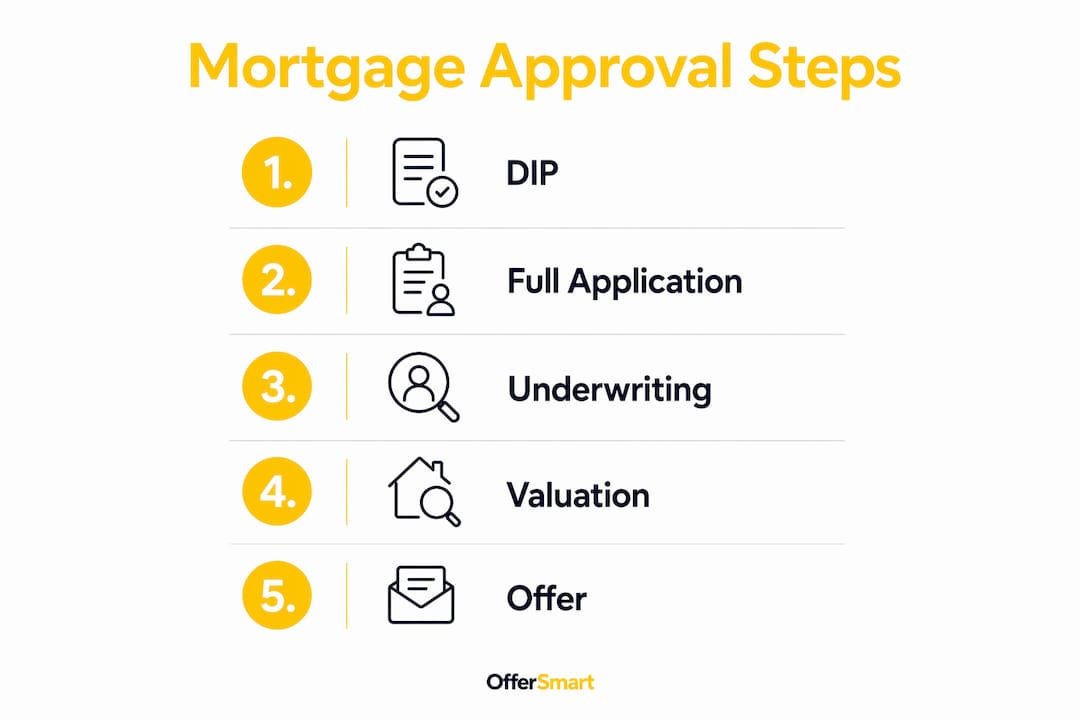
The mortgage approval process is a structured sequence of lender assessments that ends with a formal mortgage offer, giving you the legal basis to purchase a property. For first-time buyers in the UK, understanding how the mortgage approval process works is the difference between a smooth purchase and a stressful one. The process moves through five distinct stages: Decision in Principle, full application, property valuation, underwriting, and formal offer. Each stage has its own requirements, timelines, and potential pitfalls. Get to grips with all five before you start viewing properties.
What are the main stages of the mortgage approval process?
The mortgage approval process follows a fixed sequence. Skipping or misunderstanding any stage causes delays or declines.
-
Decision in Principle (DIP). A DIP is a preliminary assessment from a lender confirming how much they are likely to lend you. DIPs are completed online in as little as 10 minutes and use a soft credit check, meaning no footprint on your credit file. Estate agents often require a DIP before accepting an offer on a property. Treat it as a starting point, not a guarantee.
-
Full mortgage application. Once a seller accepts your offer, you submit a full application. This triggers a hard credit check and requires verified income documents, bank statements, and proof of deposit. A DIP uses soft searches; the full application triggers hard checks and manual underwriting. A positive DIP does not guarantee approval at this stage.
-
Property valuation. The lender instructs a surveyor to value the property independently. This confirms the asset is worth the loan amount. If the valuation comes in lower than the agreed sale price, the lender may reduce the loan or withdraw the offer entirely. You would then need to renegotiate the price or increase your deposit.
-
Underwriting. An underwriter reviews your full financial picture against the lender's lending policy. This is the most detailed stage and the most common source of delays. The underwriter examines spending patterns, income consistency, and any outstanding debts.
-
Formal mortgage offer. Once underwriting is complete and satisfactory, the lender issues a formal mortgage offer. This is a binding document valid for a set period, typically six months. Conveyancing and legal work then continue before you reach completion.
Pro Tip: Get your DIP before you start viewing properties seriously. It sets your budget ceiling and signals to estate agents that you are a credible buyer.
What documents do lenders need for mortgage approval?

Lenders require a specific set of documents to verify your identity, income, and deposit. Missing even one item causes delays.
Most lenders require at least three months of payslips, three months of bank statements, proof of deposit, and valid photo ID. Self-employed buyers typically need two to three years of tax returns or SA302 forms from HMRC. Having these ready before you apply removes the most common source of application delays.
The standard document checklist includes:
- Proof of income: Three months of payslips or, for the self-employed, two to three years of accounts or SA302 forms
- Bank statements: Three months of personal current account statements showing income and outgoings
- Proof of deposit: Savings account statements or a gift letter if the deposit is partly funded by family
- Photo ID: A valid passport or UK driving licence
- Proof of address: A recent utility bill or council tax statement dated within three months
- Details of existing debts: Credit card balances, personal loans, car finance, and any other credit commitments
Lenders scrutinise your bank statements closely. Regular gambling transactions, unexplained large withdrawals, or frequent overdraft use all raise flags during underwriting. Your statements should reflect the financial behaviour of someone who manages money reliably.
Pro Tip: Avoid applying for new credit, making large cash withdrawals, or changing jobs in the three months before your mortgage application. Lenders look for financial consistency, and sudden changes create questions.
How long does mortgage approval take?
The mortgage approval timeline varies significantly depending on your financial situation and how prepared you are.
The application-to-offer stage typically takes 2–6 weeks, with the fastest lenders processing clean applications in under 11 days. That speed is only achievable when all documents are submitted correctly on the first attempt. Complex cases, including self-employed applicants or properties with unusual construction, take considerably longer.
| Stage | Typical duration | Key variable |
|---|---|---|
| Decision in Principle | 10–60 minutes | Online process, soft credit check |
| Full application submission | 1–3 days | Document completeness |
| Property valuation | 3–10 days | Surveyor availability |
| Underwriting | 1–4 weeks | Financial complexity |
| Formal mortgage offer | 1–2 days after underwriting | Lender processing speed |
Several factors extend the timeline beyond the typical range:
- Self-employed income that requires additional verification from HMRC
- Properties built from non-standard materials such as timber frame or concrete
- A valuation that comes back lower than the agreed purchase price
- Slow responses to underwriter queries from the applicant or their broker
- High application volumes at the lender, particularly in spring and autumn
Conveyancing after the mortgage offer can add several months to the overall purchase timeline. The mortgage offer is not the finish line. Budget time and money accordingly, as conveyancing fees typically run between £1,000 and £1,800 on top of your deposit and stamp duty.
What happens during underwriting and why does it matter?
Underwriting is the stage where a lender's underwriter manually reviews your entire financial profile to decide whether to approve your mortgage. It is the most consequential step in the process.
Underwriting is a detailed risk assessment where your lifestyle and financial patterns are scrutinised against lender policy. Unexplained financial changes between your DIP and full application are a leading cause of declined applications. The underwriter is not looking for reasons to approve you. They are looking for reasons to decline, and your job is to give them none.
During underwriting, the lender reviews:
- Income stability: Consistent salary credits or, for the self-employed, regular business income
- Spending behaviour: Monthly outgoings, subscriptions, and discretionary spending assessed against your stated income
- Credit history: Payment history on all credit accounts over the past six years
- Existing liabilities: All debts, including student loans, car finance, and credit cards
- Deposit source: Confirmation that the deposit is genuine savings or a documented gift
Responding to underwriter queries within 24–48 hours is critical. Delays in responses can restart the queue and add weeks to the timeline. If you are using a mortgage broker, they can submit case notes on your behalf to address borderline issues before the underwriter raises them formally.
A mortgage broker acts as your advocate during underwriting. They know what lenders are looking for and can frame your financial situation in the most favourable, accurate light. For first-time buyers with non-standard income or a thin credit history, a broker is not optional. They are the difference between an approval and a decline.
Hard credit checks during the full application reveal financial behaviours not visible at DIP stage. A clean DIP does not protect you if your bank statements tell a different story. Prepare your finances for scrutiny at least three months before you apply.
Key takeaways
The mortgage approval process in the UK moves through five stages: Decision in Principle, full application, property valuation, underwriting, and formal offer, each requiring specific documents and timely responses to succeed.
| Point | Details |
|---|---|
| DIP is not a guarantee | A Decision in Principle uses a soft credit check and does not confirm final approval. |
| Documents determine speed | Submitting complete, accurate documents on the first attempt is the fastest route to a mortgage offer. |
| Underwriting is the critical stage | Underwriters look for reasons to decline; consistent finances and prompt responses protect your application. |
| Valuations can change your deal | A low valuation forces a price renegotiation or a larger deposit before the lender proceeds. |
| Approval is not completion | Conveyancing continues after the mortgage offer and typically adds several months to the overall timeline. |
What I have learned about mortgage approval after years in UK property
Rhys's perspective on navigating the process
Most first-time buyers treat the Decision in Principle as the hard part. It is not. The DIP takes minutes and uses a soft credit check. The real test is the six to twelve weeks that follow, when an underwriter examines every direct debit, every cash withdrawal, and every credit card payment you have made in the past three months.
The buyers I see run into trouble are not the ones with bad credit. They are the ones who changed jobs two months before applying, took out a car loan after their DIP, or moved a large sum of money between accounts without a paper trail. Underwriters are trained to find inconsistencies. Give them a consistent, well-documented financial picture and the process moves quickly.
One thing most guides do not tell you: the mortgage offer is just one phase. Legal work, surveys, and the conveyancing chain continue after your offer arrives. I have seen buyers receive their mortgage offer in two weeks and then wait four months for completion because of a slow chain. Understand the full homebuying timeline before you set your moving expectations.
My practical advice is simple. Organise your documents before you speak to a lender. Stop applying for credit the moment you start thinking about buying. And if your finances are anything other than straightforward, use a broker. The cost is almost always worth it.
— Rhys
Offersmart tools that support your mortgage preparation
Getting a mortgage offer is only part of the financial picture. Knowing what you can realistically borrow, and what a property is genuinely worth, puts you in a far stronger position before you apply.

Offersmart's mortgage calculator gives you a clear borrowing estimate based on your income and deposit, so you can approach lenders with realistic figures rather than guesswork. Beyond borrowing power, Offersmart analyses comparable local sales, estimated running costs, and a five-year value forecast for any UK property. That means you can confirm a property is worth the price before you commit to a mortgage application. Use the full calculators suite to check affordability, estimate monthly payments, and assess whether the numbers stack up before you make an offer.
FAQ
What is a Decision in Principle?
A Decision in Principle is a preliminary assessment from a lender indicating how much they are likely to lend you, based on a soft credit check. It is not a guaranteed mortgage offer and does not replace the full application process.
How long does mortgage approval take in the UK?
The full application to formal offer stage typically takes 2–6 weeks, with straightforward cases processed in under 11 days by the fastest lenders. Complex finances or unusual properties extend this timeline significantly.
What are the main requirements for mortgage approval?
Lenders require at least three months of payslips, three months of bank statements, proof of deposit, and valid photo ID. Self-employed buyers also need two to three years of accounts or SA302 forms from HMRC.
Can a mortgage be declined after a Decision in Principle?
Yes. A DIP uses a soft credit check, but the full application triggers a hard credit check and manual underwriting. Issues not visible at DIP stage, such as inconsistent spending or undisclosed debts, can lead to a decline.
What happens after the mortgage offer is issued?
The conveyancing process begins after the mortgage offer, covering legal searches, contract exchange, and completion. This phase can add several months to the overall timeline, depending on the property chain.