

A mortgage is defined as a long-term secured loan used to purchase property, where the lender registers a legal charge at HM Land Registry giving them the right to repossess the property if repayments are not maintained. This is the foundation of how most UK homebuyers finance a purchase. You borrow a sum from a lender, typically a bank or building society, and repay it with interest over an agreed period. Understanding the mortgage basics explained in this guide will help you make confident decisions before committing to one of the largest financial obligations of your life.
What is a mortgage explained: the core definition
A mortgage is not simply a loan. It is a loan secured against the property you are buying, which means the property itself acts as collateral. The three key numbers in any mortgage are the loan amount, the interest rate, and the repayment term. These three figures determine your monthly payment and the total cost you will pay over the life of the loan.
The typical UK mortgage term runs between 25 and 35 years, with monthly repayments covering both the capital borrowed and the interest charged. Longer terms reduce monthly payments but increase the total interest paid. A £250,000 mortgage over 35 years will cost significantly more in total interest than the same loan over 25 years, even at an identical rate.

The lender's security is the property itself. This gives lenders legal rights that go beyond a credit score check. Even a borrower with a strong credit history can face possession proceedings if repayments stop. That legal reality is what makes a mortgage fundamentally different from an unsecured personal loan.
What are the main types of mortgages and how do they differ?
Mortgage types split into two broad categories: how you repay the loan, and how your interest rate is set. Getting both decisions right matters as much as finding the right property.
Repayment vs interest-only
A repayment mortgage reduces your loan balance every month. Each payment covers both the interest charged and a portion of the capital borrowed. By the end of the term, you own the property outright. In the early years, repayments are mostly interest, with capital repayment accelerating as the loan balance falls.
An interest-only mortgage requires you to pay only the interest each month, leaving the full capital sum to be repaid at the end of the term. Monthly payments are lower, but you need a credible repayment plan for the capital, such as an investment vehicle or the sale of the property. Interest-only is now rare for mainstream residential purchases in the UK, and lenders scrutinise repayment plans carefully before approving them.
Fixed-rate, tracker, and discount mortgages
The table below compares the most common rate types available to UK borrowers.
| Mortgage type | How the rate is set | Main benefit | Main risk |
|---|---|---|---|
| Fixed-rate | Locked for product period (2, 5, or 10 years) | Predictable monthly payments | Higher rates if base rate falls |
| Tracker | Moves with Bank of England base rate | Benefits from rate cuts | Payments rise when base rate rises |
| Discount | Set below lender's SVR for a period | Lower initial payments | SVR can change at lender's discretion |
| Offset | Linked to savings account to reduce interest | Reduces interest charged | Requires discipline with savings |
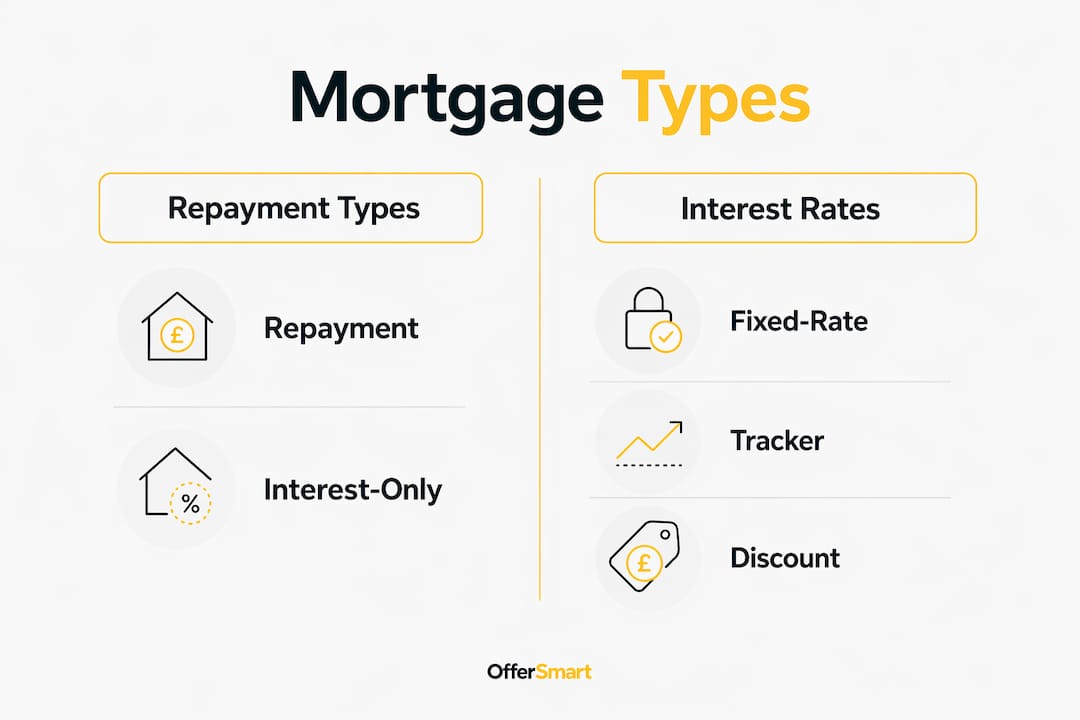
Fixed-rate mortgages lock your interest rate for the product period, while tracker rates move directly with the Bank of England base rate. After any product period ends, your mortgage reverts to the lender's Standard Variable Rate (SVR), which is almost always higher than the deal you were on.
Pro Tip: Always calculate the total cost of a mortgage over its full term, not just the monthly payment during the initial product period. A low two-year fixed rate followed by reversion to a high SVR can cost far more than a slightly higher five-year fix.
How does the mortgage term and product period work in the UK?
One of the most widespread points of confusion for UK buyers is the difference between the mortgage term and the product period. These are not the same thing, and mixing them up leads to costly surprises.
The mortgage term is the total length of time you have agreed to repay the loan. This is typically 25 to 35 years. The product period is the length of time your chosen interest rate applies. Common product periods are 2, 5, or 10 years. When the product period ends, your lender moves you onto their SVR automatically unless you act.
Here is what that means in practice:
- You take a five-year fixed-rate mortgage with a 30-year term.
- For the first five years, your rate and monthly payment are fixed.
- At year five, the product period ends and you revert to the SVR, which could be 2 to 3 percentage points higher.
- You then have the option to remortgage, either with your existing lender or a new one, to secure a new product period at a competitive rate.
- This process repeats throughout the life of the loan until the full term ends.
Remortgaging is not a sign of financial difficulty. It is a standard part of understanding mortgages in the UK and something most homeowners do multiple times over the life of their loan. The key is to start looking for a new deal around three to six months before your current product period expires.
Pro Tip: Set a calendar reminder six months before your product period ends. Mortgage offers are typically valid for three to six months, so you can lock in a new rate before your current deal expires and avoid even a single month on the SVR.
What is the mortgage possession process if repayments are missed?
Missing mortgage repayments does not result in immediate eviction. The possession process is staged, and borrowers have multiple opportunities to resolve the situation before losing their home.
The median repossession timeline in the UK runs to approximately 45.7 weeks from the initial court claim to possession. That is nearly a year, and it reflects the legal protections built into the system for borrowers. Courts expect lenders to demonstrate they have tried to work with the borrower before granting a possession order.
If you fall into arrears, the steps typically unfold as follows:
- Arrears notice. Your lender contacts you to discuss the shortfall and explore options such as a payment holiday, reduced payments, or extending the term.
- Formal demand. If arrears continue, the lender issues a formal demand for the outstanding amount.
- Court claim. The lender applies to the county court for a possession order. You will receive notice and can attend the hearing.
- Possession order. The court may grant an outright order or a suspended order, giving you time to clear arrears.
- Warrant for possession. If you fail to comply with the order, the lender applies for a warrant and a bailiff eviction date is set.
The most important step is the first one: contact your lender as soon as you anticipate difficulty. Early borrower engagement consistently reduces the risk of possession reaching court. Lenders are regulated by the Financial Conduct Authority and are required to treat borrowers fairly, which includes considering alternatives before pursuing possession.
How are mortgage affordability and eligibility assessed in the UK?
Lenders do not simply check your credit score and approve or decline your application. The FCA's affordability framework requires lenders to assess whether you can sustain repayments without undue difficulty, using professional judgement alongside numerical analysis. It is not a mechanical pass or fail system.
A standard affordability assessment considers the following:
- Income verification. Payslips, tax returns, and employer references confirm your gross and net income. Self-employed applicants typically need two to three years of accounts.
- Expenditure analysis. Lenders review bank statements to assess committed outgoings including loans, credit cards, childcare, and regular bills.
- Stress testing. Your ability to maintain repayments if interest rates rise is tested, typically by adding 2 to 3 percentage points to the current rate.
- Loan-to-income ratio. Most lenders cap borrowing at 4 to 4.5 times your annual income, though some lenders offer higher multiples for specific professions or income levels.
- Credit history. Defaults, county court judgements, and missed payments affect both eligibility and the rates available to you.
The home buying decision factors that lenders weigh go beyond raw numbers. Two applicants with identical incomes can receive different outcomes based on their spending patterns and financial commitments. Using a home affordability calculator before approaching a lender gives you a realistic picture of what you are likely to be offered.
What support schemes exist for first-time buyers in the UK?
First-time buyers in the UK have access to several government-backed schemes designed to reduce the deposit barrier and improve access to mortgage lending.
The Mortgage Guarantee Scheme allows eligible buyers to purchase with a 5% deposit, with the government guaranteeing a portion of the mortgage to reduce lender risk. The scheme has been extended and updated, with availability from July 2025 subject to income, property type, and location criteria.
Other schemes worth knowing include:
- Shared Ownership. You buy a share of a property (typically 25% to 75%) and pay rent on the remainder, with the option to buy more shares over time.
- First Homes Scheme. Eligible first-time buyers can purchase new-build homes at a discount of at least 30% below market value in participating areas. Read the full First Homes Scheme guide for eligibility details.
- Lifetime ISA. Save up to £4,000 per year and receive a 25% government bonus, which can be used towards a first home purchase.
Scheme availability varies by region, property type, and lender participation. Not every mortgage lender accepts every scheme, so checking eligibility before selecting a property saves time. The first-time buyer definition also matters here, as some schemes have strict criteria around previous property ownership. Understanding how much deposit you need as a first-time buyer will help you identify which scheme fits your situation.
Key takeaways
A mortgage is a secured loan registered against your property, and understanding its structure, types, and legal implications is the foundation of confident homebuying in the UK.
| Point | Details |
|---|---|
| Mortgage definition | A secured loan with a legal charge at HM Land Registry, giving lenders repossession rights if payments fail. |
| Repayment vs interest-only | Repayment mortgages clear the loan over the term; interest-only requires a separate capital repayment plan. |
| Term vs product period | The mortgage term is 25 to 35 years; the product period (2, 5, or 10 years) determines your rate before SVR reversion. |
| Possession timeline | Repossession takes approximately 45.7 weeks from court claim to possession. Early lender contact reduces this risk. |
| First-time buyer schemes | The Mortgage Guarantee Scheme enables 5% deposit purchases, with Shared Ownership and First Homes as further options. |
My honest view on mortgages for new UK buyers
The single biggest mistake I see first-time buyers make is treating the mortgage as an afterthought to the property search. They fall in love with a house, then scramble to understand what they can actually borrow. That order of events costs people money and, sometimes, the property itself.
The confusion between the mortgage term and the product period is real and widespread. I have spoken to buyers who genuinely believed their five-year fix meant their rate was set for five years of a five-year mortgage. When they discovered they had 25 years left on the loan after that fix expired, the financial reality of SVR reversion was a shock they were not prepared for.
Affordability assessments are also more nuanced than most buyers expect. A lender is not just checking whether you earn enough. They are assessing whether your spending habits, financial commitments, and stress-tested income make you a sustainable borrower. Cleaning up your bank statements and reducing discretionary spending in the three to six months before application genuinely improves your outcome.
If you ever find yourself struggling with repayments, contact your lender before you miss a payment, not after. The legal process is slow by design, but the damage to your credit file and the stress of court proceedings are entirely avoidable with early communication. The possession process exists as a last resort, not a first response.
— Rhys
Plan your mortgage with Offersmart
Understanding the mortgage process is the first step. Knowing what you can realistically afford, and what a property is genuinely worth, is the next.

Offersmart includes a built-in mortgage calculator that helps you estimate monthly repayments, compare rate scenarios, and understand the full financial picture before you make an offer. Alongside mortgage calculations, Offersmart analyses comparable local sales, flood risk, crime data, and estimated running costs so you are never making a decision based on incomplete information. Enter a property address or paste a listing link and get a clear, data-driven picture of what you should offer and what the purchase will cost you. No guesswork. No surprises.
FAQ
What is a mortgage in simple terms?
A mortgage is a loan secured against a property, repaid with interest over a term of typically 25 to 35 years. If repayments are not maintained, the lender has the legal right to repossess the property.
What is the difference between a mortgage term and a fixed period?
The mortgage term is the total repayment period, usually 25 to 35 years. The fixed period is the shorter window, typically 2, 5, or 10 years, during which your interest rate is locked before reverting to the lender's SVR.
How does a lender decide how much to lend?
Lenders assess income, expenditure, credit history, and stress-tested repayment ability. Most cap borrowing at 4 to 4.5 times annual income, though the FCA requires professional judgement rather than a purely mechanical assessment.
Can first-time buyers get a mortgage with a 5% deposit?
Yes. The Mortgage Guarantee Scheme allows eligible first-time buyers to borrow up to 95% of the property value with a 5% deposit, subject to income, property type, and lender participation criteria.
What happens if I miss mortgage repayments?
Missing repayments triggers a staged process beginning with lender contact and potentially leading to court possession proceedings. The median timeline from court claim to possession is approximately 45.7 weeks, and early communication with your lender is the most effective way to avoid escalation.