

A first-time buyer in the UK typically needs a minimum deposit of 5% of the property's purchase price to secure a mortgage. This is the standard threshold for a 95% loan-to-value (LTV) mortgage, meaning the lender covers the remaining 95%. On a £250,000 property, that translates to £12,500 upfront. The Lifetime ISA (LISA), offered by providers such as Moneybox and Nutmeg, can boost your savings with a 25% government bonus of up to £1,000 per year. Nationwide Building Society data shows the average 10% deposit for a first-time buyer sits around £23,000 nationally, though this figure varies sharply by region.
How much deposit does a first-time buyer need at each percentage?
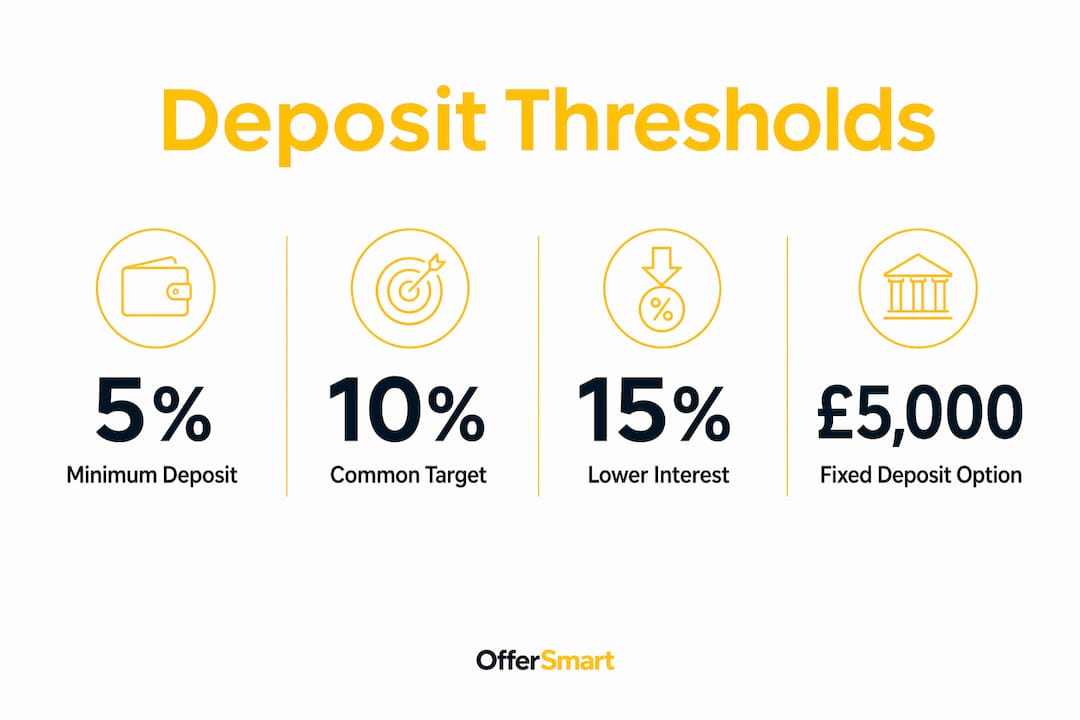
The three most common deposit thresholds are 5%, 10%, and 15%, and each one carries different consequences for your mortgage rate and monthly repayments. A 5% deposit gets you on the ladder sooner, but lenders charge higher interest rates at 95% LTV because they carry more risk. Moving to 10% or 15% opens up a wider range of mortgage products and meaningfully lower rates, which can save you thousands over a two or five-year fixed term.
The table below shows how these percentages translate into real cash requirements at common property prices:
| Property price | 5% deposit | 10% deposit | 15% deposit |
|---|---|---|---|
| £150,000 | £7,500 | £15,000 | £22,500 |
| £200,000 | £10,000 | £20,000 | £30,000 |
| £250,000 | £12,500 | £25,000 | £37,500 |
| £300,000 | £15,000 | £30,000 | £45,000 |
| £400,000 | £20,000 | £40,000 | £60,000 |
Lenders assess income multiples and debt alongside your deposit percentage, so two buyers with identical deposits can receive very different mortgage offers. A buyer with a 10% deposit and a clean credit history will often access better rates than one with a 15% deposit and significant existing debt. The deposit percentage is your starting point, not the whole picture.
- 5% deposit: Lowest barrier to entry; higher interest rates; fewer lender options
- 10% deposit: Mid-range choice; noticeably better rates; broader product selection
- 15% deposit: Strong position; competitive rates; greater lender confidence
Pro Tip: If you are close to crossing from 5% to 10%, it is worth delaying your purchase by a few months to save the extra amount. The reduction in mortgage rate can offset the additional saving period within the first year of ownership.
How does your region affect the cash deposit you need?
Where you buy in the UK has a bigger impact on your deposit target than almost any other single factor. The same 10% deposit requirement produces vastly different cash demands depending on local property prices, and regional deposit disparities mean a buyer in London needs more than three times the cash of a buyer in the North East.
Nationwide Building Society analysis puts the regional picture in sharp focus:
| Region | Average 10% deposit |
|---|---|
| North East | £13,100 |
| Scotland | £13,900 |
| Yorkshire and the Humber | £15,400 |
| Wales | £16,200 |
| East Midlands | £18,500 |
| Outer Metropolitan (South East) | £32,000 |
| London | £44,800 |
These figures carry a direct implication for saving timelines. A buyer in Yorkshire saving £500 per month reaches a 10% deposit in roughly two and a half years. A buyer in London saving the same amount needs over seven years. That gap explains why shared ownership and low deposit schemes are disproportionately used in the capital and the South East. Your first home buying checklist should account for your specific region's average prices before you set a savings target, not a national average.
The regional picture also affects stamp duty exposure, which compounds the affordability gap further. Properties in London regularly breach thresholds where stamp duty becomes a significant additional cost, even with first-time buyer relief applied.
What low deposit mortgage options exist for first-time buyers in 2026?
The minimum deposit for a first home is not always the percentage-based figure you might expect. From 18 May 2026, Lloyds Banking Group began offering a £5,000 fixed deposit mortgage for first-time buyers through Lloyds, Halifax, and Bank of Scotland, covering properties priced up to £300,000. This means a buyer purchasing a £250,000 home needs just £5,000 upfront rather than the standard £12,500 at 5%.
However, eligibility criteria and property caps limit who can actually access these products. Creditworthiness, income, and the specific property type all factor into lender decisions. A headline figure of £5,000 does not mean every applicant qualifies.
Other low deposit routes worth knowing:
- Shared ownership: Buy a share of a property (typically 25% to 75%) and pay rent on the remainder, reducing the deposit needed to a percentage of your share value only
- Rent to Buy: A government-backed scheme allowing renters to save while living in a new-build property at a reduced rent
- Developer incentives: Some new-build developers contribute to deposits or offer cashback schemes, effectively reducing your upfront cash requirement
- 95% LTV mortgages: Standard products from lenders including Barclays, NatWest, and Halifax that require a 5% deposit with no fixed cash cap
A survey by Mortgage Advice Bureau found that 73% of first-time buyers were unaware that 5% deposit mortgages were available. That knowledge gap leads buyers to save far beyond what is necessary, delaying their purchase by years without any financial benefit.
Pro Tip: Before assuming you need a 10% or 15% deposit, speak to a whole-of-market mortgage broker. They can confirm which 95% LTV or low deposit products you qualify for based on your actual financial profile, not a generic assumption.
What additional costs should first-time buyers budget for beyond the deposit?
The deposit is the largest single upfront cost, but total upfront funds needed consistently exceed the deposit figure alone. Many buyers underestimate this gap and arrive at exchange underprepared. Planning for these costs from the start prevents last-minute shortfalls.
The main additional costs to budget for are:
- Stamp duty land tax: First-time buyers in England pay no stamp duty on properties up to £300,000, and a reduced rate on the portion between £300,001 and £500,000. Properties above £500,000 attract standard rates. Scotland and Wales operate separate systems (Land and Buildings Transaction Tax and Land Transaction Tax respectively).
- Solicitor and conveyancing fees: Typically £1,000 to £2,500 depending on property complexity and location
- Valuation fee: Usually £150 to £500, charged by the lender to confirm the property's worth
- Survey costs: A HomeBuyer Report from a RICS-accredited surveyor costs roughly £400 to £700; a full structural survey runs £600 to £1,500. Understanding property surveys for first-time buyers before you commit can save you from expensive surprises post-purchase.
- Moving costs: Removal firms typically charge £300 to £1,500 depending on volume and distance
| Cost item | Typical range |
|---|---|
| Solicitor fees | £1,000 to £2,500 |
| Valuation fee | £150 to £500 |
| HomeBuyer survey | £400 to £700 |
| Moving costs | £300 to £1,500 |
| Stamp duty (varies) | £0 to several thousand |
On a £250,000 purchase, a buyer could realistically need £3,000 to £6,000 on top of their deposit. That is a meaningful addition to your savings target and one that catches many first-time buyers off guard.
How can first-time buyers save for their deposit more efficiently?
Saving for a first home deposit is a structured financial goal, not a vague aspiration. The most effective approach combines a government-backed savings vehicle with consistent monthly contributions and a realistic timeline based on your target region.
- Open a Lifetime ISA as early as possible. The government's Lifetime ISA allows you to save up to £4,000 per year and receive a 25% bonus, worth up to £1,000 annually. You must be aged 18 to 39 to open one, and funds must remain in the account for at least 12 months before use on a property purchase. The property must be priced at £450,000 or below.
- Separate your deposit savings from your current account. Keeping your deposit fund in a dedicated account, ideally a high-interest cash ISA or fixed-rate savings account, removes the temptation to dip into it and allows interest to compound.
- Set a monthly savings target based on your regional deposit figure. Use the regional data above to set a realistic cash target, then divide by your intended saving period. Adjust your budget to meet that figure consistently rather than saving whatever is left over each month.
- Review your target annually. Property prices shift, and your income may increase. Reassessing your target each year keeps your plan aligned with the actual market.
- Do not over-save beyond what is necessary. Given that 73% of first-time buyers are unaware of 5% deposit products, many delay purchasing by saving to 10% or 15% when a 5% deposit mortgage would have been accessible years earlier. Confirm your eligibility for lower deposit products before extending your saving timeline unnecessarily.
Pro Tip: The Help to Buy ISA closed to new applicants in 2019, but existing account holders can still use it until 2030. If you opened one before the deadline, check whether combining it with a Lifetime ISA is possible for your purchase, as specific rules apply.
Key takeaways
The minimum deposit for a first-time buyer in the UK is 5% of the purchase price, but the total cash needed depends on your region, chosen mortgage product, and additional purchase costs beyond the deposit itself.
| Point | Details |
|---|---|
| Minimum deposit threshold | A 5% deposit is the standard minimum, equating to £12,500 on a £250,000 property. |
| Regional cash variation | A 10% deposit ranges from £13,100 in the North East to £44,800 in London. |
| Low deposit options exist | Lloyds Banking Group offers a £5,000 deposit mortgage for properties up to £300,000 from May 2026. |
| Budget beyond the deposit | Solicitor fees, surveys, and moving costs typically add £3,000 to £6,000 on top of your deposit. |
| Lifetime ISA boosts savings | The government adds a 25% bonus up to £1,000 per year on LISA contributions for eligible buyers. |
My honest view on deposit planning for first-time buyers
The conversation around deposits in the UK tends to focus almost entirely on the percentage figure, and that framing causes real problems. I have seen buyers spend three additional years saving from 5% to 15% when they could have purchased at 5% and built equity through ownership instead. The maths rarely favours extended saving when property prices are rising.
What I think gets overlooked is the affordability assessment. Lenders do not just look at your deposit. They look at your income, your outgoings, and your credit profile. A buyer with a 5% deposit and a clean financial record will often get a better mortgage offer than one with a 12% deposit and a history of missed payments. Focusing solely on the deposit percentage misses this entirely.
My practical advice: speak to a whole-of-market mortgage broker before you set your savings target, not after. They will tell you what you actually qualify for today, which may be significantly more accessible than you assumed. Use the homebuying process timeline to understand where the deposit fits within the full purchase journey, and build your savings plan around real numbers rather than assumptions. Waiting for a larger deposit is sometimes the right call. But it is often not, and the cost of waiting is rarely calculated honestly.
— Rhys
Plan your deposit with Offersmart's calculators
Knowing the deposit percentage is only the starting point. The real question is what your total upfront cash requirement looks like for a specific property in a specific area.

Offersmart's mortgage calculator lets you enter a property price and deposit amount to see your estimated monthly repayments instantly, with no guesswork. The stamp duty calculator shows exactly what you owe based on your purchase price and buyer status, including first-time buyer relief. Together, these tools give you a complete picture of your upfront costs before you make an offer, so you can move forward with confidence and avoid being caught short at exchange.
FAQ
What is the minimum deposit for a first-time buyer in the UK?
The minimum deposit for a first home is typically 5% of the property's purchase price, which gives you a 95% LTV mortgage. On a £200,000 property, that means £10,000 upfront.
How much does the average first-time buyer put down as a deposit?
Nationwide Building Society data shows the average 10% deposit for a first-time buyer is approximately £23,000 nationally, ranging from £13,100 in the North East to £44,800 in London.
Can I get a mortgage with less than a 5% deposit?
From May 2026, Lloyds Banking Group offers a £5,000 fixed deposit mortgage for properties up to £300,000 through Lloyds, Halifax, and Bank of Scotland, subject to eligibility and affordability checks.
Does a bigger deposit always mean a better mortgage rate?
A larger deposit generally unlocks lower interest rates and more product options, but lenders also assess income, outgoings, and credit history. Deposit size is one factor, not the only one.
What costs beyond the deposit do first-time buyers need to budget for?
First-time buyers should budget for solicitor fees (£1,000 to £2,500), a property survey (£400 to £700), a lender valuation (£150 to £500), and moving costs (£300 to £1,500), in addition to any stamp duty liability.