

A property report is a consolidated document of key real estate data, covering ownership history, valuation estimates, and local market insights, designed to help buyers and investors make informed decisions before committing to a purchase. Understanding what is a property report explained in plain terms is the first step to using one effectively. These reports pull together data from government records, Land Registry filings, and comparable sales to give you a factual picture of a property's position in the market. Offersmart builds on this foundation by adding flood risk, crime data, rental yield estimates, and a five-year value forecast, turning a standard data summary into a full decision-making tool for UK buyers.
What information does a typical property report include?
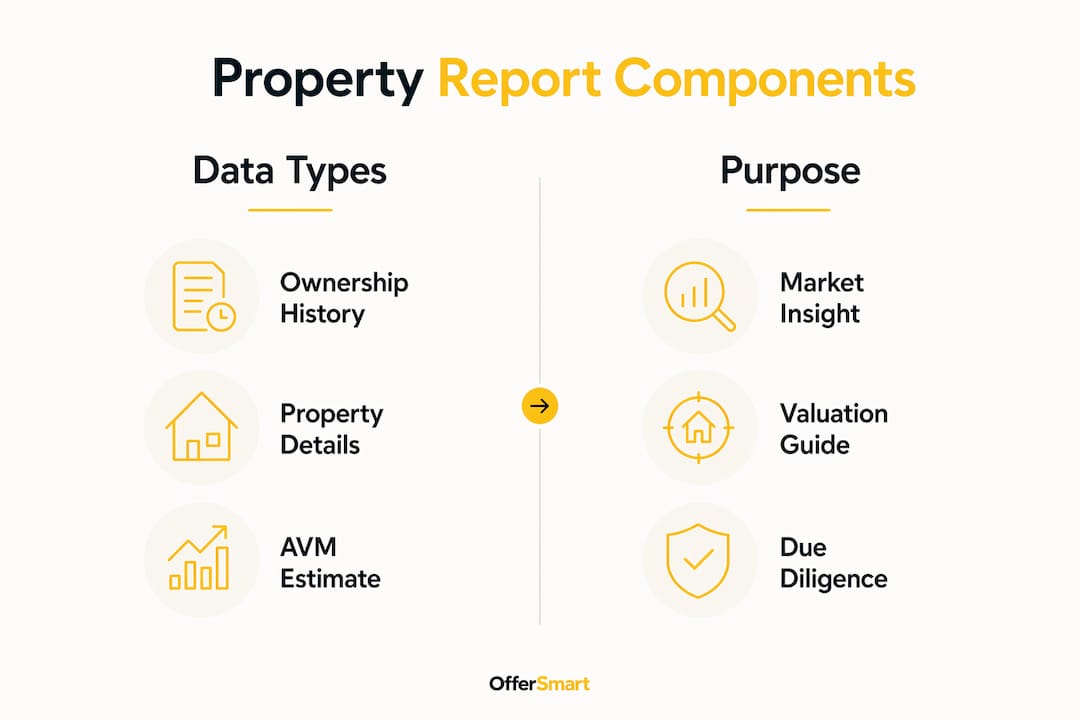
A property report consolidates essential real estate data into one structured document. The core purpose is to save you hours of manual research by presenting verified facts in a readable format.
Most reports cover the following categories:
- Property characteristics: Number of bedrooms and bathrooms, floor area in square metres, property type (terraced, semi-detached, flat), and construction year.
- Ownership and sales history: Previous sale prices with dates, number of times the property has changed hands, and current registered owner details.
- Automated Valuation Model (AVM) estimate: A statistically generated price estimate based on comparable sales and local market data.
- Comparable sales (comps): Recent transactions on the same road or within a defined radius, showing what similar homes actually sold for.
- Local market trends: Median prices, average days on market, and price movement over the past 12 months in the surrounding area.
The data sources behind these reports matter. Reputable reports draw from HM Land Registry, local authority records, and Ordnance Survey data. That combination gives you verified ownership details alongside accurate geographic context.
| Data category | What it tells you |
|---|---|
| Property characteristics | Size, layout, and type of the home |
| Sales history | Past prices and frequency of ownership changes |
| AVM estimate | Statistical market value without physical inspection |
| Comparable sales | What similar nearby homes actually sold for |
| Local market trends | Price direction and demand in the surrounding area |

The AVM is the figure most buyers focus on first. Treat it as a starting point, not a final answer. Its accuracy depends entirely on the quality and volume of comparable sales data available in that area.
How do property reports differ from formal valuations and legal surveys?
Property reports differ fundamentally from professional valuations and legal surveys. Confusing the three is one of the most common mistakes buyers make, and it can lead to costly assumptions.
Here is how they break down:
- Property report: A data aggregation tool. No physical inspection. No legal standing. Used for research and preliminary decision-making.
- Formal valuation: Conducted by a RICS-accredited surveyor. Involves a physical visit. Required by mortgage lenders to confirm the property is worth the loan amount.
- Legal survey (HomeBuyer Report or Building Survey): Identifies structural defects, damp, subsidence, and other physical risks. Carries professional liability. Cannot be replaced by any digital report.
AVMs estimate market value purely through statistical modelling, without any physical inspection. That distinction matters because two identical-looking properties on the same street can have very different structural conditions.
The confidence score attached to an AVM is the figure most buyers overlook. A low confidence score signals that the model had limited comparable sales to work from, meaning the estimate carries more uncertainty. When you see a low score, treat the AVM as directional rather than definitive.
Pro Tip: Before making an offer, check whether the property has had a homebuyer report commissioned recently. A seller who volunteers this information is signalling confidence in the property's condition.
Property reports are best understood as the starting point of property due diligence, not the end of it. They tell you what the market thinks a property is worth. They do not tell you whether the roof needs replacing.
How to obtain and interpret a property report wisely
Buyers and investors can often obtain property reports for free or at low cost through mortgage brokers, lenders, or property insight tools. Knowing where to look and how to read what you find separates confident buyers from those who rely on gut feeling.
Where to access a property report:
- Mortgage brokers and lenders: Many run automated checks as part of the application process. Ask for a copy of the AVM and comparable sales data they use.
- Property insight tools: Platforms like Offersmart let you enter an address or paste a listing link to generate an instant report covering valuation, local sales, flood risk, crime data, and lifestyle factors.
- HM Land Registry: Provides verified ownership and title data directly. Free to search, with paid downloads for full title registers.
- Local authority planning portals: Useful for checking planning history, permitted development, and any enforcement notices attached to the property.
How to read the report once you have it:
- Start with the AVM and its confidence score. A high-confidence estimate on a well-traded street is reliable context. A low-confidence estimate on a unique property needs cross-referencing.
- Review the comparable sales. Look at properties sold within the past six months on the same road or within 0.25 miles. Adjust mentally for differences in size, condition, and features.
- Check the sales history. A property sold three times in five years warrants a question. Frequent turnover can indicate undisclosed issues.
- Look for data discrepancies. Reports compiled from multiple sources can contain inconsistencies. If the floor area listed differs from the estate agent's brochure, verify with the Land Registry title plan.
- Use the market trend data for negotiation. If median prices in the area have fallen over the past three months, you have evidence to support a lower offer.
Pro Tip: Take the comparable sales section to your viewing. Ask the agent directly why this property is priced above or below recent sales on the same road. Their answer tells you a great deal about the seller's position.
How have property insight tools changed real estate decisions?
Modern property insight tools use APIs and AI to provide dynamic, real-time data rather than static snapshots. That shift has fundamentally changed how buyers and investors approach property research.
A static report, generated once and printed, goes stale within weeks in an active market. A live report, updated through data feeds connected to Land Registry, local authority systems, and market listings, reflects conditions as they actually are. The difference between the two can be the difference between a well-priced offer and an overpayment.
Property reports now serve as inputs to automated workflows, triggering mortgage calculations, rental yield estimates, and maintenance forecasts without manual data entry. That operational shift reduces the time from research to decision from days to minutes.
The data types now commonly included in modern property insight reports go well beyond the basics:
- Flood risk ratings: Drawn from Environment Agency data, showing surface water and river flood probability.
- Crime risk scores: Aggregated from police.uk data, broken down by category (burglary, vehicle crime, antisocial behaviour).
- Zoning and planning data: Current use class, permitted development rights, and nearby planning applications.
- Demographic data: Age profile, tenure split (owner-occupied vs rented), and population density for the surrounding area.
- Lifestyle factors: Proximity to schools, parks, restaurants, and transport links, which directly affect both liveability and resale value.
Real estate analysis increasingly uses AI and geographic information systems to integrate demographic, transaction, and spatial data into a single predictive layer. Offersmart applies this approach to UK property data, giving buyers a five-year value forecast alongside the standard market comparables.
Data freshness is critical for high-stakes decisions. A report based on sales from 18 months ago in a market that has moved significantly will mislead rather than inform.
Key takeaways
A property report is a research tool, not a legal document. Its value lies in synthesising market data quickly so you can enter negotiations with facts, not assumptions.
| Point | Details |
|---|---|
| Property report definition | A consolidated document covering ownership history, AVM estimates, and local market comparables. |
| AVM confidence score | A low score signals limited comparable data; cross-check with recent local sales before relying on the figure. |
| Not a substitute for surveys | Reports carry no legal standing and cannot replace a RICS valuation or structural survey. |
| Data discrepancies are common | Verify inconsistencies through HM Land Registry or local authority records before making major decisions. |
| Modern reports are dynamic | Live data feeds make current reports far more reliable than static documents generated weeks earlier. |
Why I think most buyers misuse property reports
Most buyers treat a property report as a verdict. They see the AVM, compare it to the asking price, and decide whether to proceed. That is the least useful way to read one.
The real value of a property report is in the questions it raises, not the answers it provides. A sales history showing three transactions in four years is not a red flag on its own. But it is a prompt. It tells you to ask why. The AVM confidence score is not a reliability rating for the whole report. It is a signal about data density in that specific location.
What I have found consistently is that buyers who use reports as conversation starters get more out of viewings. They walk in knowing the comparable sales. They ask the agent why the price sits above the road average. They reference the flood risk rating when discussing insurance costs. That approach shifts the dynamic. You are no longer a passive viewer. You are a prepared buyer with data behind you.
The other mistake I see regularly is over-reliance on a single report from a single source. Property data aggregated from multiple sources can contain inconsistencies. Cross-referencing two or three sources takes 20 minutes and can save you from acting on a figure that was simply wrong.
Property reports are most powerful when they sit inside a broader workflow: report first, viewing second, survey third, offer last. Treat them as the first layer of evidence, not the final word.
— Rhys
How Offersmart puts property data to work for you
Offersmart is a property insight tool built specifically for UK buyers, investors, and homeowners who want clarity before committing to an offer.
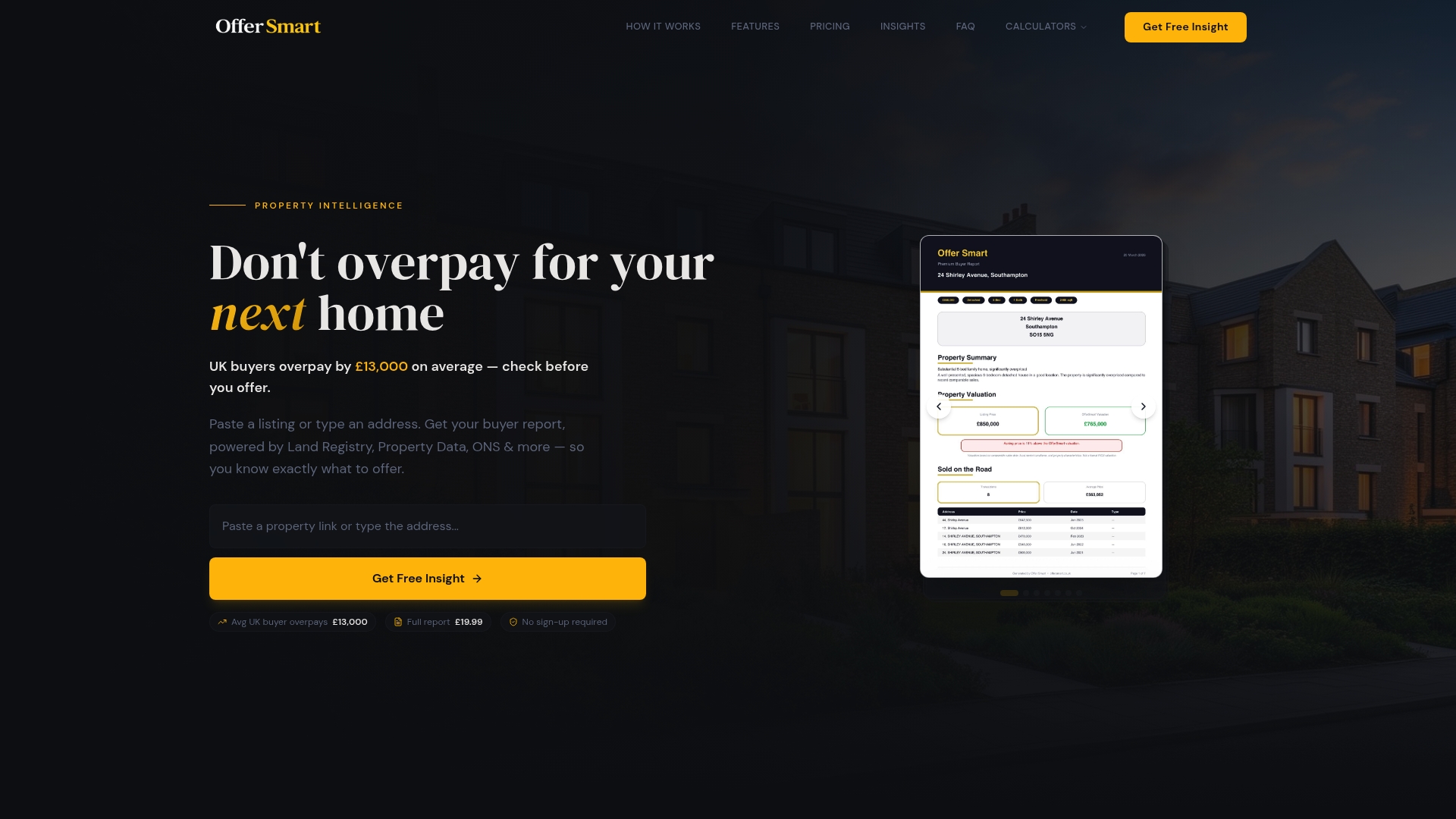
Enter a property address or paste a listing link, and Offersmart generates an instant report covering comparable sales on the same road, flood risk, crime data, school proximity, rental yield, estimated ROI, and a five-year value forecast. The built-in mortgage calculator gives you a full financial picture before you negotiate, so you know exactly what a realistic offer looks like. For investors, the rental yield and running cost estimates remove the manual calculation work entirely. Offersmart replaces hours of fragmented research with one clear, data-backed report. Use the full suite of property calculators to model your decision before you commit.
FAQ
What is a property report?
A property report is a consolidated document covering a property's characteristics, ownership history, AVM estimate, and local market comparables. It is a research tool used by buyers and investors to assess value before making an offer.
How does an AVM differ from a formal valuation?
An AVM is a statistical estimate generated without physical inspection, while a formal valuation is conducted by a RICS-accredited surveyor and carries legal weight for mortgage purposes.
Can I rely on a property report to make an offer?
Use a property report as your starting point, not your only source. Cross-check the AVM with recent comparable sales and verify any data discrepancies through HM Land Registry before finalising an offer.
What does a low AVM confidence score mean?
A low confidence score means the model had limited comparable sales to draw from, making the estimate less reliable. Treat it as directional and seek additional market evidence.
How do I use a property report in negotiations?
Take the comparable sales data to your viewing and reference it directly with the agent. If similar properties on the same road sold for less, that data supports a lower offer and gives you a factual basis for negotiation.