
Buying your first home in the UK rarely moves at the pace you imagine. Most people assume the process wraps up in a few weeks. In reality, how long buying a house takes typically spans three to six months from your first property search to collecting the keys. The range is wide because the timeline depends on your financing method, how quickly your solicitor moves, the state of the chain you are joining, and how prepared you are before you even make an offer. This guide breaks down every stage, gives you honest time estimates, and shows you exactly where delays happen and how to avoid them.
Table of Contents
- Key takeaways
- How long buying a house takes, stage by stage
- What speeds up or slows down your timeline
- Conveyancing: the legal backbone of your purchase
- Tips to manage your timeline as a first-time buyer
- My honest take on timeline expectations
- Plan your purchase with the right tools
- FAQ
Key takeaways
| Point | Details |
|---|---|
| Budget three to six months | The full house purchase duration from search to completion averages three to four months under normal conditions. |
| Mortgage adds significant time | Standard mortgage processing time runs 30 to 45 days; some government-backed loans take considerably longer. |
| Cash buyers move fastest | Cash purchases can complete in as little as 7 to 14 days once a property is found. |
| Pre-underwriting beats pre-approval | Getting fully pre-underwritten before you search can slash weeks off the offer-to-close phase. |
| Conveyancing is the wildcard | Legal searches, surveys, and chain complications routinely extend the average home buying process by four to eight weeks. |
How long buying a house takes, stage by stage
The house-buying process in the UK has several distinct stages, and each one has its own timeline. Understanding the full sequence removes most of the anxiety first-time buyers feel.
-
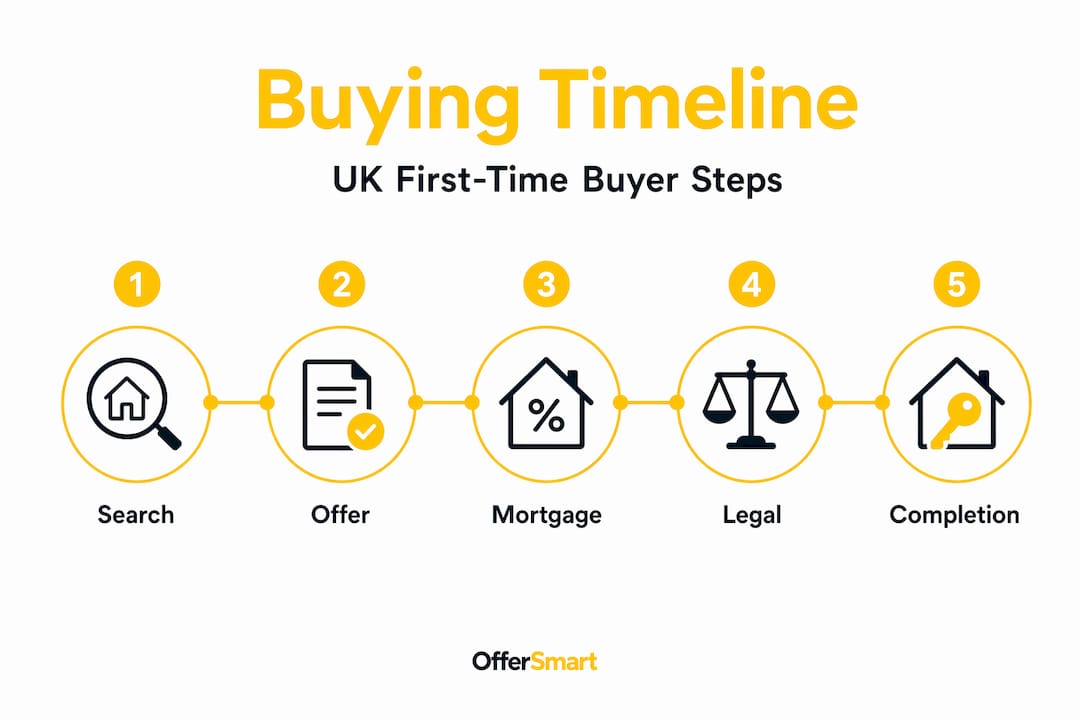
House hunting (four to twelve weeks). The search phase varies enormously. First-time buyers typically spend two to four months in this stage, largely because they are still refining what they actually want. Repeat buyers, who already know their priorities, often move through this phase in half the time. Your readiness with a mortgage agreement in principle also affects how quickly you can move when the right property appears.
-
Offer and negotiation (one to two weeks). Once you find a property, making an offer and reaching an agreed price usually takes a few days to two weeks depending on how much back and forth there is. Some sellers accept immediately; others negotiate for longer, particularly in a slow market.
-
Mortgage application and valuation (two to six weeks). After your offer is accepted, you submit your full mortgage application. The average closing time runs 43 days for mortgage-funded purchases, though this figure includes the legal stages. The mortgage processing segment alone typically takes two to four weeks if your documents are in order.
-
Conveyancing and legal searches (eight to twelve weeks). This is where most delays occur. Your solicitor will commission local authority searches, check the title, and review the contract. This phase alone commonly takes eight to twelve weeks, especially in busy areas or complex chains.
-
Survey (one to two weeks). Your survey is usually booked once your offer is accepted. Home inspections typically happen within 7 to 10 days of offer acceptance, though availability of surveyors in your area can push this later.
-
Exchange of contracts (one to two weeks after searches complete). Once all searches return and both parties are happy with the contract, solicitors exchange. You pay your deposit at this point and the sale becomes legally binding.
-
Completion (one to four weeks after exchange). Completion is usually set one to four weeks after exchange, though some buyers exchange and complete on the same day to keep costs down.
Pro Tip: Use the property purchase checklist to track each stage and flag when things are falling behind schedule. Knowing which step you are in gives you far more control than simply waiting for your solicitor to call.
What speeds up or slows down your timeline
The first-time home buyer timeline is not fixed. Several variables can compress it significantly or stretch it by months.
Factors that slow the process:
- Chain complications. If the seller is buying another property, or if there are multiple transactions linked together, each one must be ready before completion. A single struggling buyer further up the chain can stall everyone else for weeks.
- Mortgage type. Government-backed loans can extend the mortgage closing timeline by three to four weeks compared to standard residential mortgages because of additional documentation and inspection requirements.
- Slow document submission. Lenders and solicitors cannot progress without your paperwork. Missing a single document, such as a P60, bank statement, or ID, can pause proceedings for days at a time.
- Appraisal and survey backlogs. Scheduling delays for valuations and surveys are a common source of hold-ups, particularly in high-demand areas during spring and summer.
- Last-minute loan changes. Changing your mortgage product, adjusting the loan amount, or switching lenders after submission restarts parts of the process and extends your timeline considerably.
Factors that speed up the process:
- Being a cash buyer is the single fastest route. Cash buyers can complete in 7 to 14 days after agreeing a sale, bypassing the entire mortgage processing stage.
- Buying a property with no chain attached, such as a new-build or a home where the seller has already moved out, removes the most common source of delay.
- Choosing a responsive solicitor who uses digital communication rather than post speeds up the legal stages noticeably.
- Market conditions also play a role. Around 18.5% of homes sell within seven days in today's market, which means in competitive areas you need to be ready to act fast. If you are not prepared, you will lose properties to buyers who are.
Pro Tip: In a competitive market, being fully pre-underwritten rather than holding a basic agreement in principle makes your offer significantly stronger. Sellers and agents take you far more seriously.
Conveyancing: the legal backbone of your purchase
Conveyancing is the legal transfer of property ownership from seller to buyer. It is not optional, and it cannot be meaningfully rushed without introducing serious risk. Understanding the sequence helps you set realistic expectations.
| Legal stage | Typical duration |
|---|---|
| Instructing a solicitor | 1 to 3 days |
| Local authority searches | 3 to 6 weeks |
| Drainage and environmental searches | 1 to 3 weeks |
| Review of title and contracts | 1 to 2 weeks |
| Raising and resolving enquiries | 2 to 4 weeks |
| Mortgage offer received and checked | 1 to 2 weeks |
| Exchange of contracts | 1 to 2 days once all parties are ready |
| Completion | 1 to 28 days after exchange |
The searches phase is where most first-time buyers are surprised. Local authority searches, which check for planning issues, road schemes, or restrictions affecting the property, take three to six weeks through most councils. Some councils in high-demand areas are slower still.

Once searches come back, your solicitor reviews the results, raises enquiries with the seller's solicitor, and waits for answers. This back-and-forth can take another two to four weeks if the seller is slow to respond or if there are complications such as boundary disputes or missing building regulation certificates.
The exchange of contracts is a critical milestone. Before this point, either party can walk away without legal consequence (though you may lose survey costs). After exchange, you are legally committed. Completion, the day you get your keys, follows exchange by a period both parties agree on.
For a deeper look at surveys in particular, the first-time buyer survey guide explains what each survey level covers and how long to expect each one to take.
Tips to manage your timeline as a first-time buyer
Preparation is the most effective tool you have. These steps will help you avoid the avoidable delays.
- Get your documents together before you start searching. Lenders and solicitors will need proof of identity, three to six months of bank statements, payslips or tax returns, and a record of your deposit source. Having these ready saves days of back-and-forth once your offer is accepted.
- Obtain a mortgage agreement in principle early. This is not the same as full pre-underwriting, but it signals to sellers that you are a credible buyer. Pair it with a conversation with your broker about what full underwriting involves so you can upgrade quickly if needed.
- Instruct your solicitor before your offer is accepted. Most buyers wait until the offer is accepted to find a solicitor. Instructing one in advance means they can begin ID checks and client onboarding immediately, saving a week or more at the start of the legal phase.
- Respond to all requests within 24 hours. Whether it is your lender asking for a bank statement or your solicitor requesting a signature, delays on your end have a compounding effect. One slow response can push your completion date by a week.
- Book your survey early. Do not wait for mortgage approval to book a surveyor. Schedule it as soon as your offer is accepted, because appraisal scheduling backlogs are one of the most predictable delays in the process.
- Build a buffer into your plans. Even a well-prepared purchase can be delayed by factors outside your control. Do not give notice on your rental property, book removals, or make travel plans around a completion date until exchange has happened. Before exchange, nothing is certain.
Fewer than 5% of mortgage buyers complete in under 21 days, but those who do share one thing: their documentation was complete and they responded to every request immediately. Speed is a team effort between you, your solicitor, your lender, and the seller's side.
My honest take on timeline expectations
I have seen first-time buyers go in with brilliant intentions and still end up frustrated because they were expecting a six-week process and got a four-month one. The gap between expectation and reality is the single biggest source of stress I have observed.
What I have learnt is that the buyers who cope best are not the ones with the fastest purchases. They are the ones who understood the timeline before they started. When you know conveyancing takes eight to twelve weeks under normal conditions, you are not panicking at week ten. You are just in the process.
The other thing I will say plainly: do not let urgency push you into skipping due diligence. I have seen buyers waive surveys to speed things up and later face repair costs they had no budget for. The homebuying process timeline exists for good reason. Each step protects you.
Preparation changes your experience completely. Buyers who enter the market with their documents ready, a solicitor instructed, and a realistic understanding of pre-underwriting versus pre-approval move with confidence rather than anxiety. That matters more than you think.
— Rhys
Plan your purchase with the right tools
Understanding the timeline is one thing. Knowing whether you can actually afford the property you are looking at is another. Before you make an offer, you need a clear picture of your monthly costs, not just the asking price.

Offersmart's mortgage calculators let you model different deposit sizes, interest rates, and mortgage terms so you can see exactly what your monthly payments would look like under various scenarios. You can test how a longer mortgage term reduces monthly costs, or how a rate rise would affect your budget. Paired with Offersmart's property analysis tool, which compares recent local sales and flags flood risk, crime data, and area insights, you get a complete financial picture before committing. No guesswork. No surprises. Just clarity when it counts.
FAQ
How long does buying a house take in the UK?
The full process typically takes three to six months from starting your search to completion. The legal and mortgage stages alone account for around eight to twelve weeks once an offer is accepted.
What is the fastest I can complete on a house purchase?
Cash buyers can complete in as little as 7 to 14 days, but mortgage buyers rarely close in under 30 days. Fewer than 5% of mortgage purchases complete in under 21 days even with full preparation.
Why does conveyancing take so long?
Local authority searches alone take three to six weeks through most councils. Add in enquiries, title checks, and waiting for a formal mortgage offer, and the legal phase routinely runs eight to twelve weeks in total.
Does a property chain affect my timeline?
Yes, significantly. Each transaction in the chain must be ready before any completion can take place. A delay from one buyer or seller can push your completion date back by weeks with no action you can take to resolve it.
What can I do to speed up my house purchase?
Instruct a solicitor before your offer is accepted, have all documents ready in advance, book your survey immediately after offer acceptance, and respond to all requests within 24 hours. Full pre-underwriting before you start searching also gives you a material speed advantage at the offer stage.