

Managing homebuying stress for first-time buyers means actively taking steps that clarify the process, reduce uncertainty, and build confidence before anxiety takes hold. According to a L&G survey of 2,000 UK homeowners, 48% of people name moving house as the most stressful life event they have experienced. That figure is not a warning. It is a starting point. The good news is that the stress is largely predictable, which means it is largely manageable. This guide walks you through the specific causes of homebuying anxiety, the practical steps that reduce it, and the mental strategies that keep you steady when the process slows down.
What are the main causes of homebuying stress for first-time buyers?
First-time buyer stress does not come from one source. It builds from several overlapping pressures, each compounding the others.
The biggest single driver is uncertainty. Skipton research found that 70% of buyers find purchasing and moving frustrating, with 22% specifically citing stress from not knowing when completion will happen or whether the purchase will fall through. That uncertainty is not irrational. Chains do collapse. Searches do take longer than expected. Knowing this in advance means you can plan for it rather than be blindsided by it.
The main stress contributors for UK first-time buyers include:
- Completion date uncertainty. Most buyers have no fixed date until exchange, which can be weeks after the offer is accepted. This creates a prolonged period of limbo.
- Conveyancing delays. Local authority searches, leasehold management packs, and slow responses from other parties in the chain are the most common bottlenecks.
- Financial anxiety. Unexpected costs such as survey fees, Stamp Duty Land Tax, and solicitor disbursements catch many first-time buyers off guard.
- Information overload. Solicitors, mortgage brokers, estate agents, and surveyors all communicate through different channels with different timescales, creating a fragmented picture.
- Fear of making a costly mistake. For most people, this is the largest financial commitment of their lives. The stakes make every decision feel high-risk.
The L&G data also shows that 35% of UK homeowners find buying a home more stressful than a divorce or breakup. That comparison matters because it reframes the experience. You are not being oversensitive. You are dealing with something that is objectively difficult, and that recognition alone reduces the self-imposed pressure to feel fine about it.
How to reduce homebuying anxiety before it builds
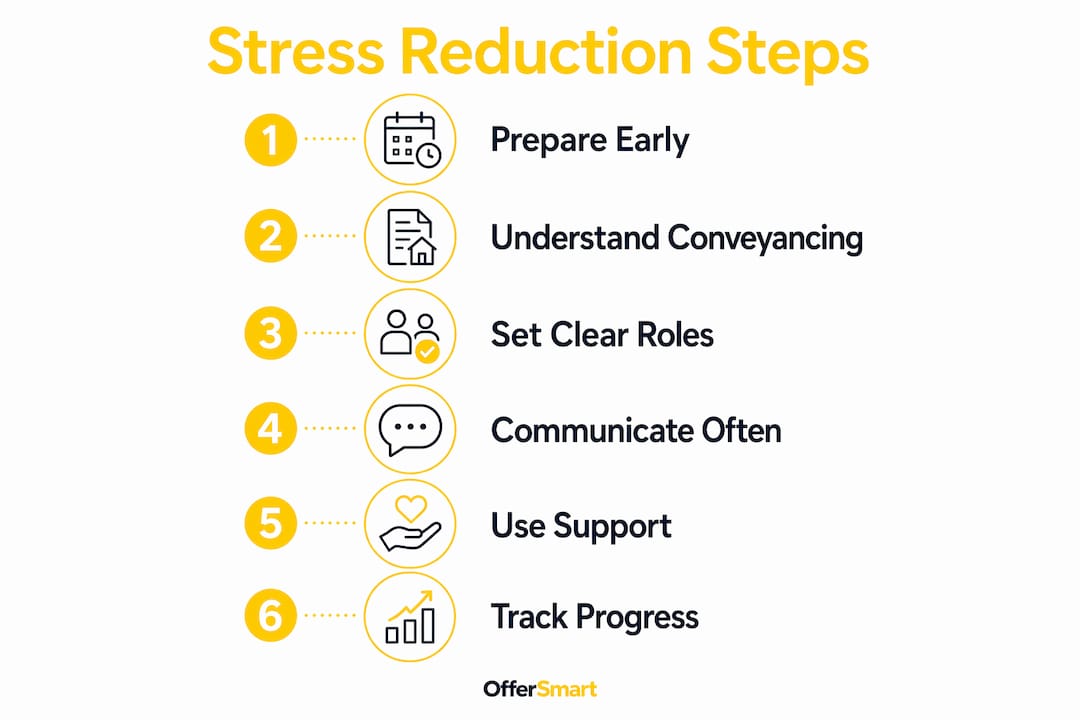
The most effective stress management for new buyers starts before the legal process begins. Waiting until problems arise to build your support structure is the single biggest mistake first-time buyers make.
Follow these steps as early as possible:
-
Instruct a conveyancing solicitor before your offer is accepted. Setfords guidance is clear that delaying solicitor instruction after offer acceptance is a key stress multiplier. Having your solicitor ready means the legal process starts the moment your offer goes through, not days later.
-
Engage a mortgage broker early. A broker establishes your borrowing limits, identifies suitable products, and gives you a realistic financial picture before you fall in love with a property you cannot afford. This removes one of the largest sources of financial anxiety.
-
Build your full support team. Research from Barratt Homes confirms that mortgage stress reduces significantly when buyers establish a team early: solicitor, mortgage broker, lender, and estate agent. Each person has a defined role, and knowing who handles what removes the paralysis of not knowing who to call.
-
Map your full costs upfront. Beyond your mortgage payments, budget for solicitor fees, survey costs, removal costs, and any immediate repair or decoration work. Use a homebuying checklist to track every cost category before you commit.
-
Create a communication plan. Agree with your solicitor and broker how often you will receive updates and through which channel. Weekly written updates, even when there is no material news, are far better than silence followed by a sudden request for urgent action.
Pro Tip: Ask your solicitor to send you a one-page summary of the conveyancing stages before the process starts. Understanding and anticipating each homebuying stage reduces anxiety by addressing the fear of the unknown.
How can first-time buyers cope with conveyancing delays?
Conveyancing is the legal process of transferring property ownership, and it is the stage where most homebuying stress concentrates. UK conveyancing typically takes 8 to 12 weeks for a freehold purchase. Leasehold adds a further two to four weeks. Delays most commonly come from local authority searches and slow chains.
Understanding this timeline in advance is one of the most effective stress-reduction tools available. When your solicitor tells you searches will take three to four weeks, that is not a problem. It is the normal process. Buyers who do not know this interpret the wait as something going wrong.
| Stage | Typical duration | Common delay cause |
|---|---|---|
| Solicitor instruction to searches submitted | 1 to 2 weeks | Slow client response to ID requests |
| Local authority searches returned | 3 to 5 weeks | Local council processing times |
| Enquiries raised and answered | 2 to 4 weeks | Seller's solicitor response speed |
| Exchange to completion | 1 to 4 weeks | Chain coordination |
The table above shows that most delays are outside your direct control. What is within your control is how quickly you respond to your solicitor's requests. Returning signed documents, providing identification, and answering queries the same day you receive them keeps your side of the chain moving and prevents you from becoming the bottleneck.
Clients who obsessively monitor conveyancing progress often increase their own stress rather than reduce it. Scheduled update points, such as a call every Thursday, are a healthier approach than checking emails hourly. This also means that when you do receive an update, it carries weight rather than blending into background noise.
Pro Tip: Ask your solicitor at the outset to communicate in plain English. First-time buyers find it less stressful when conveyancers explain legal matters without jargon. If you receive a letter you do not understand, call and ask for a plain-language explanation before worrying about it.
What emotional strategies help with home purchase stress relief?
Practical preparation handles the structural causes of stress. Emotional strategies handle the psychological ones. Both are necessary, and neither works well without the other.
Breaking the process into stages is the most effective cognitive tool available to first-time buyers. The homebuying process has roughly six distinct phases: mortgage in principle, property search, offer, conveyancing, exchange, and completion. Treating each as a separate project with its own tasks and milestones stops the whole process from feeling like one enormous, uncontrollable event.

Leaning on your support network matters more than most buyers expect. Skipton's research highlights that solo buyers face increased emotional stress when balancing finances and decisions alone. If you are buying on your own, identify two or three people you can talk to regularly, whether friends who have bought recently, a family member with property experience, or an online community of first-time buyers in the UK.
Physical stress-regulation techniques work immediately and require no preparation. Emotional burnout during the process is common, and simple techniques like slow diaphragmatic breathing or a 20-minute walk genuinely reduce cortisol levels. These are not soft suggestions. They are evidence-based interventions for acute stress.
A few further strategies worth building into your routine:
- Set a daily cut-off for property-related activity. Checking emails at 10pm does not speed up the process. It just extends the anxiety into your rest time.
- Allow realistic timelines. Rushing decisions to avoid uncertainty often creates worse outcomes. A delayed exchange is recoverable. A rushed survey that misses a structural problem is not.
- Recognise when professional support is appropriate. If anxiety is affecting your sleep, concentration, or relationships over several weeks, speaking to your GP or a counsellor is a legitimate and sensible step. Homebuying stress is a recognised trigger for anxiety disorders, and early intervention is far more effective than waiting it out.
Pro Tip: Keep a simple running document of completed tasks and resolved issues. Seeing concrete progress in writing counteracts the feeling that nothing is moving, which is one of the most common sources of homebuyer anxiety.
How does clear communication improve stress management for buyers?
Stress increases with perceived lack of control. Research confirms that clear role assignment among solicitor, lender, and estate agent enables buyers to direct concerns appropriately, cutting repeated chasing and the frustration that comes with it.
The practical application is straightforward. At the start of the process, establish who is responsible for what:
| Party | Their responsibility | When to contact them |
|---|---|---|
| Conveyancing solicitor | Legal process, searches, contracts | Conveyancing queries, document requests |
| Mortgage broker | Product selection, application, lender liaison | Finance queries, rate changes |
| Estate agent | Chain management, seller communication | Completion date negotiations, chain updates |
| Mortgage lender | Valuation, formal offer, funds release | Valuation concerns, offer conditions |
Proactive communication from mortgage brokers that sets timelines and provides regular updates demonstrably lowers buyer anxiety by replacing guesswork with realistic expectations. Ask your broker explicitly for a written timeline at the start, and ask them to flag any changes as soon as they arise rather than waiting for your next scheduled call.
When unexpected changes occur, such as a survey flagging a defect or a chain member withdrawing, having a contingency mindset reduces the emotional impact. Decide in advance what your response would be to the two or three most likely setbacks. Knowing you have a plan for a survey renegotiation, for example, means that if it happens, you move to the plan rather than into panic. You can read more about how to negotiate after a survey to prepare for that specific scenario.
Key takeaways
Managing homebuying stress as a first-time UK buyer requires early preparation, clear communication, and deliberate emotional strategies at every stage of the process.
| Point | Details |
|---|---|
| Start your team early | Instruct a solicitor and mortgage broker before offer acceptance to prevent delays and reduce uncertainty. |
| Understand conveyancing timelines | Freehold purchases typically take 8 to 12 weeks; knowing this prevents normal delays from feeling like crises. |
| Schedule updates, not constant checking | Agree fixed update points with your solicitor and broker to reduce anxiety without obsessive monitoring. |
| Assign clear roles | Know which party handles each issue so you direct concerns correctly and avoid repeated, frustrating chasing. |
| Use physical stress techniques | Slow breathing and regular walking are immediate, evidence-based tools for managing acute homebuying anxiety. |
What I have learned about homebuying stress after years in UK property
The conventional advice on homebuying stress tends to focus on the legal process. Sort your solicitor, get your mortgage, stay organised. That advice is correct, but it misses the harder truth: the stress is mostly psychological, and the process is designed in a way that makes psychological distress almost inevitable.
The UK homebuying system keeps buyers in a state of uncertainty for months. There is no legally binding commitment until exchange, which means everything before that point can unravel. Most first-time buyers do not know this going in, and the discovery mid-process is genuinely destabilising.
What I have found actually works is treating the process like a project with defined phases rather than a single prolonged event. When you are in the conveyancing phase, your job is to respond quickly, ask clear questions, and wait. That is it. You are not failing by not being able to speed up local authority searches.
The other thing most articles will not tell you is that building a support network before you need it is far more valuable than finding one when you are already stressed. Talk to people who have bought recently. Ask your broker to explain things twice if needed. Use your first-time buyer checklist as a reference point, not a source of pressure. Progress is rarely linear in homebuying, and patience is not passive. It is a deliberate, active choice that protects your decision-making quality when the stakes are highest.
— Rhys
How Offersmart helps you buy with confidence, not anxiety
Financial uncertainty is one of the biggest drivers of homebuying stress, and it is one of the most solvable.
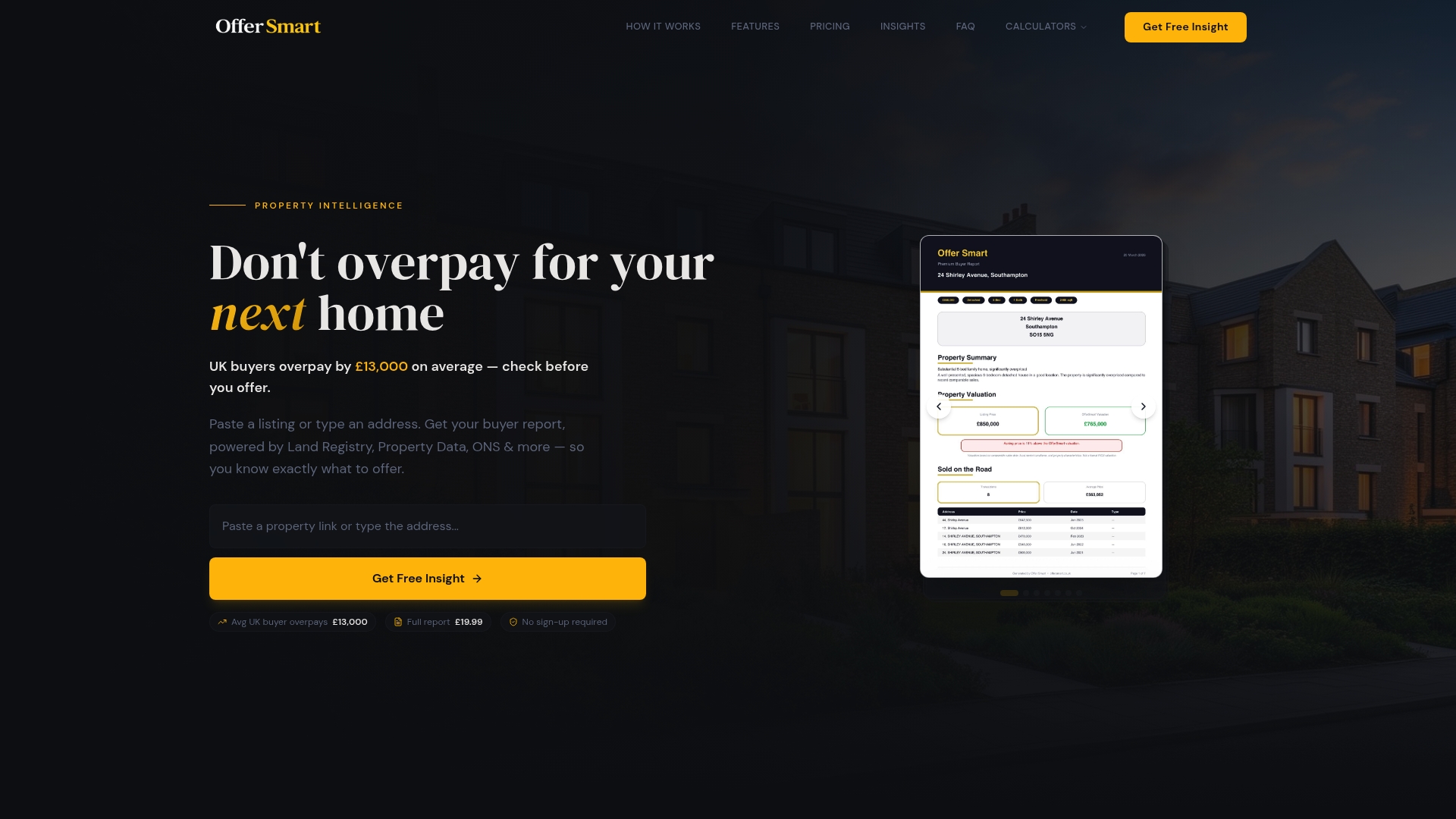
Offersmart gives you a clear financial picture before you commit. The mortgage calculator shows you realistic monthly payments based on your deposit, loan amount, and term, so you know exactly what you can afford before you fall in love with a property. Beyond the mortgage, Offersmart analyses comparable local sales, flood risk, crime data, and estimated running costs, replacing guesswork with data you can act on. Use the full suite of homebuying calculators to plan your budget, assess your offer, and move forward with confidence rather than anxiety.
FAQ
How common is stress when buying a house for the first time?
Extremely common. 48% of UK homeowners name moving house as the most stressful life event they have experienced, making it more stressful than starting a new job or having a child.
When should I instruct a conveyancing solicitor?
Instruct your solicitor before your offer is accepted if possible. Delaying instruction after offer acceptance is a key stress multiplier that stalls chains and extends the overall timeline.
How long does conveyancing take in the UK?
Freehold conveyancing typically takes 8 to 12 weeks. Leasehold purchases add two to four weeks. Local authority searches and slow chains are the most common causes of delay.
What is the quickest way to reduce homebuying anxiety right now?
Identify which stage of the process you are in, confirm who is responsible for the next action, and set a scheduled update point with your solicitor or broker. Replacing open-ended waiting with a defined next touchpoint removes the most acute source of uncertainty.
Should I use a mortgage broker as a first-time buyer?
A mortgage broker is one of the most effective stress-reduction tools available to first-time buyers. They establish your borrowing limits, manage lender communication, and provide proactive updates that demonstrably lower buyer anxiety throughout the process.