

Most buyers assume property negotiation is simply about offering less and seeing what sticks. It is not. A property negotiation strategy is a structured, pre-planned approach to securing the best possible deal across price, terms, and conditions. It combines market data, psychological awareness, and preparation to put you in control before you ever make an offer. For UK home buyers and investors, understanding what a property negotiation strategy actually involves can mean the difference between overpaying by tens of thousands of pounds and walking away with a deal that genuinely works in your favour.
Table of Contents
- Key takeaways
- Understanding property negotiation strategy fundamentals
- Using local market data to inform your offer
- Effective negotiation tactics beyond price
- Practical steps for conducting property negotiations
- Common pitfalls in property negotiations
- My honest take on what makes negotiations work
- How Offersmart helps you negotiate with confidence
- FAQ
Key takeaways
| Point | Details |
|---|---|
| Preparation beats instinct | Define your objectives, walk-away point, and BATNA before any negotiation begins. |
| Data drives credibility | Use comparable sales from the past 3 to 6 months to anchor your offer objectively. |
| Price is one lever | Flexible terms like closing dates and seller credits often carry more weight than price alone. |
| Emotional detachment wins | Setting a clear walk-away point protects you from overpaying due to fear of missing out. |
| Inspections create leverage | Prioritise structural and safety issues during inspections to negotiate credits or repairs effectively. |
Understanding property negotiation strategy fundamentals
A property negotiation strategy is more than a number you plan to offer. It is the full framework you bring into every stage of a transaction, from the initial offer through to exchange of contracts.
At its core, the strategy rests on a few foundational principles:
- Define your objectives clearly. Know exactly what you want from the deal before any dialogue begins. Price matters, but so do completion timelines, fixtures included, and survey outcomes.
- Establish your BATNA. Your Best Alternative to a Negotiated Agreement is the option you fall back on if the deal falls through. Knowing your BATNA provides the confidence to negotiate without desperation and prevents you from agreeing to unfavourable terms.
- Use price anchoring. The first number stated in any negotiation sets the psychological reference point. A well-researched opening offer, grounded in comparable sales, establishes your credibility immediately.
- Understand seller motivations. A seller under time pressure values speed over price. A seller with emotional attachment to the home values a buyer who shows respect for the property. Rapport is not a soft skill here. It is a negotiation tool.
- Plan your concessions. Every concession you make should be deliberate and reciprocal. Successful negotiators combine deposits, contingencies, possession terms, and credits strategically to shape deals rather than reacting on the spot.
Equally important is emotional detachment. Maintaining emotional detachment and defining a walk-away point before you start prevents poor decision-making caused by fear of missing out. If you fall in love with a property before negotiating, you have already lost your most powerful card.
Pro Tip: Write down your walk-away price and keep it somewhere visible during the negotiation process. Committing it to paper makes it far harder to justify crossing that line in the heat of the moment.
Using local market data to inform your offer
Data is what separates a credible offer from a guess. Sellers and their agents spot emotional pricing immediately, and it weakens your position before the conversation has properly begun.
Effective negotiation preparation involves analysing comparable sales from the past 3 to 6 months to establish an objective baseline. In the UK, this means looking at Land Registry sold prices, Rightmove data, and local agent insights to understand what properties on the same street or in the same postcode have genuinely sold for, not just listed at.
When interpreting comparable sales, you need to adjust for several factors:
- Property condition. A recently refurbished three-bedroom semi is not directly comparable to one that needs a new roof and full rewiring.
- Time on market. Properties that sold quickly signal strong demand. Properties that lingered suggest the original asking price was misjudged.
- Market direction. Whether the local market is rising, flat, or cooling affects whether you negotiate closer to or below recent sold prices.
- Specific location within a postcode. Two roads 200 metres apart can show meaningful price differences based on school catchment areas, noise, or access.
The table below illustrates how comparable data should inform your offer range:
| Factor | Impact on offer |
|---|---|
| Recent sold prices in same road | Strongest comparable. Use as primary anchor. |
| Properties in same postcode, sold 3 to 6 months ago | Strong secondary data point. Adjust for differences. |
| Properties sold over 12 months ago | Use with caution. Market movement may skew comparisons. |
| Properties listed but unsold | Signals maximum market tolerance, not confirmed value. |
Tools like Offersmart give you direct access to UK comparable sales data by simply entering a property address, removing the guesswork from this stage entirely.
Effective negotiation tactics beyond price
Price gets most of the attention, but experienced negotiators know that non-price terms can be more valuable to sellers than small price movements. This is where real leverage sits.

Consider the following comparison of negotiation approaches:
| Tactic | What it involves | When to use it |
|---|---|---|
| Flexible completion date | Offer a timeline that suits the seller's circumstances | When the seller has a dependent onward purchase |
| Seller credit | Request a credit towards repairs or costs at completion | After a survey reveals defects |
| Inspection-based renegotiation | Revisit price after a full survey using a tiered priorities list | Almost always, after instructing a surveyor |
| Escalation clause | Agree to beat competing offers by a set increment up to a ceiling price | In competitive markets with multiple bidders |
The tiered priority framework for inspection-based renegotiation is particularly effective. When your survey comes back, resist the temptation to list every single item as a reason to reduce the price. Instead, focus on structural problems, significant damp, or electrical issues. These are the items that are genuinely costly to remedy and the ones sellers find hardest to dispute. Cosmetic issues are conceding ground; critical structural issues are your priority.
On timing, balanced UK property markets favour concessions and interest rate buydowns over speed and escalation clauses. Understanding which type of market you are in shapes which tactics you lead with.
Pro Tip: Present the seller with two or three offer packages rather than a single number. For example, one package at a lower price with a quick completion, and another at a higher price with you covering legal costs. This reframes the conversation from "accept or reject" to "which option works best for you?"
Practical steps for conducting property negotiations
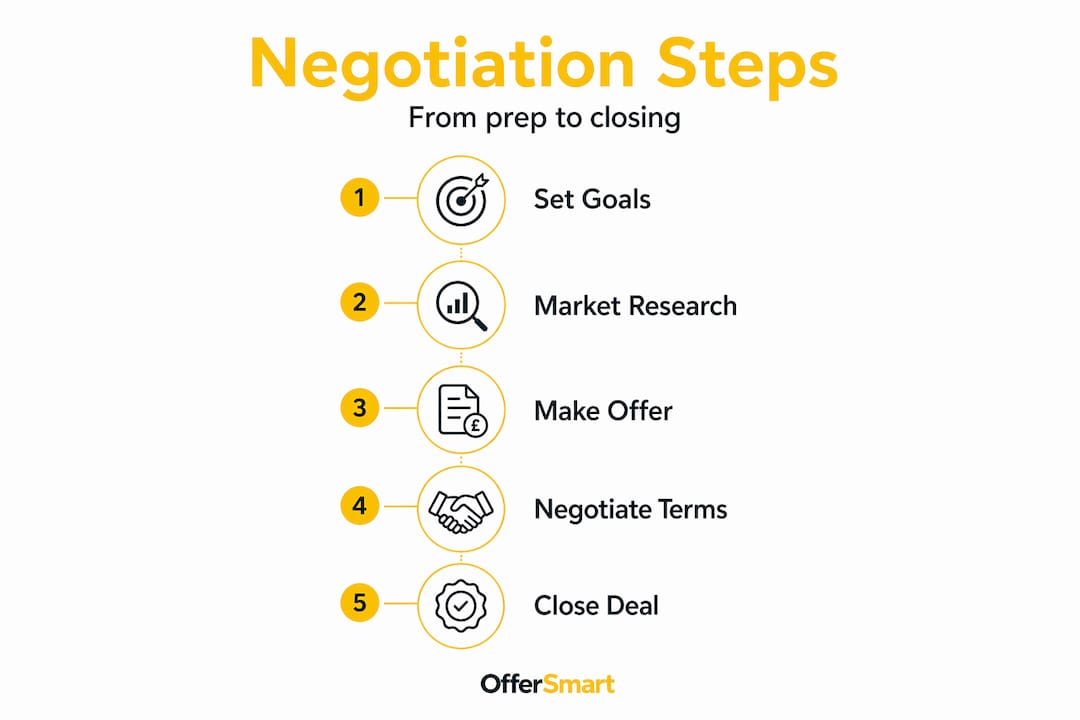
Knowing the theory matters, but the real test is how you execute it. Here is a practical sequence to follow:
-
Set your parameters before any contact. Decide on your target price, your realistic offer, your walk-away point, and your BATNA. Preparation before negotiation shapes your confidence and leads to better outcomes.
-
Make a credible opening offer. Ground your first offer in comparable sales data. Too low and you damage rapport; too close to asking price and you leave no room to manoeuvre. A well-researched offer 5 to 10 per cent below asking price, with a clear data rationale, is a strong opening in most UK markets.
-
Listen actively and ask open questions. When the seller or their agent responds, your job is to gather information. "What is most important to the seller about the timeline?" often reveals more negotiating room than any counter-offer.
-
Respond to counteroffers with deliberate, measured concessions. Never concede immediately or in large jumps. Slow, small concessions signal that you are at or near your limit. Each concession should be framed as something you are giving up, not simply closing the gap.
-
Use silence strategically. Silence after making an offer is a powerful tool. Pausing after a counteroffer forces the other party to fill the silence, often with useful information or an unexpected concession.
-
Document every agreed point in writing. Even informal verbal agreements should be followed with a written summary by email. This protects you and creates a clear record if the deal becomes contentious.
-
Know when to walk away. If the terms cross your pre-agreed walk-away point, leave the negotiation calmly. It is not failure. It is the strategy working as intended.
Common pitfalls in property negotiations
Even well-prepared buyers make mistakes that cost them money or the deal itself. These are the errors worth watching for:
- Focusing only on price. Buyers who fixate on the headline number often miss opportunities in terms, credits, and conditions that could be worth thousands of pounds.
- Skipping the data research. Without comparable sales, your offer has no credibility. Sellers and their agents will treat it as uninformed, weakening your position.
- Emotional attachment to a specific property. Top-performing agents save clients an average of £11,000 or more per transaction through strategic price anchoring and inspection renegotiation. That figure drops sharply when the buyer is too emotionally invested to hold their position.
- Making unreasonable survey demands. Requesting a reduction for every minor defect erodes goodwill rapidly and can cause sellers to walk away from otherwise sound deals.
- Neglecting your BATNA. Buyers who have not identified alternative properties negotiate from a position of scarcity. This almost always results in conceding too much.
- Aggressive communication. Negotiation built on trust and understanding of the other party's motivations consistently outperforms combative approaches.
Pro Tip: Before any negotiation, write down your three most attractive alternative properties. This is not pessimism. It is what gives you the calm confidence to negotiate without desperation.
My honest take on what makes negotiations work
I have seen plenty of buyers walk into negotiations with a number in mind and nothing else. What consistently strikes me is how often the deal is won or lost before any offer is even made.
The buyers who get the best outcomes are not the most aggressive or the most charming. They are the most prepared. They know the street-level comparable sales. They know their absolute ceiling. They understand why the seller is selling, and they make the seller feel understood rather than pressured. Negotiation is a balance of data analysis and human connection, and you genuinely need both.
What I have found, time and again, is that emotional control is the skill that makes everything else possible. You cannot anchor effectively if you are desperate. You cannot walk away if you have already decided you must have this particular property. Your BATNA is not a fallback plan. It is the thing that gives you permission to negotiate honestly.
My advice is to treat negotiation as a skill you develop deliberately, not something you wing on the day. Study the market. Know your numbers. Build rapport. And then trust the preparation you have done.
— Rhys
How Offersmart helps you negotiate with confidence
Before you make an offer on any UK property, you need two things: an accurate picture of market value and a clear understanding of what you can genuinely afford. Offersmart gives you both.

Enter any UK property address and Offersmart instantly analyses recent local sales, comparable properties on the same road, flood and crime risk, and estimated running costs. For investors, it calculates rental yield and long-term ROI. Use the mortgage calculator to define your financial ceiling before you negotiate, so you know exactly where your walk-away point sits. Explore the full suite of Offersmart calculators to prepare for stamp duty, running costs, and offer pricing. No guesswork. No overpaying. Just clarity before one of the biggest financial decisions of your life.
FAQ
What is a property negotiation strategy?
A property negotiation strategy is a structured plan for securing the best possible deal on a property, covering price, terms, and conditions. It combines market research, objective-setting, and communication tactics to put the buyer in a stronger position throughout the transaction.
How do I research comparable sales in the UK?
Use Land Registry sold prices, property listing sites, and tools like Offersmart to find properties sold within 3 to 6 months in the same road or postcode. Adjust for condition, size, and location differences to establish a credible offer range.
What is BATNA in property negotiation?
BATNA stands for Best Alternative to a Negotiated Agreement. In property terms, it means knowing which other properties you would buy if this deal falls through. A clear BATNA removes desperation from your negotiating position and gives you genuine walk-away power.
Should I always negotiate below the asking price?
Not necessarily. In competitive markets, offering at or slightly above asking price with favourable terms can be more effective. The goal is not to offer less but to offer the right amount based on data, with terms that work in your favour.
What non-price terms can I negotiate on a property?
You can negotiate on completion dates, fixtures and fittings included in the sale, survey-based repair credits, and seller contributions to legal costs. These terms often matter more to sellers than marginal price differences, giving you useful leverage without a prolonged price dispute.