

Local data is defined as the collection of statistics, trends, and insights specific to a neighbourhood, street, or postcode area. For first-time buyers in the UK, it is the single most reliable tool for judging whether an asking price is fair. 55% of first-time buyers name finding the right property as their hardest challenge, spending a median of 12 weeks searching. That difficulty shrinks considerably when you know how to read the local market. Understanding why local data helps first buyers is not just about saving money. It is about making a decision you can stand behind for years.
Why local data helps first buyers avoid overpaying
Two identical two-bedroom flats can differ by up to £50,000 in price based purely on postcode and local factors. That gap is not random. It reflects school catchment areas, proximity to transport links, crime rates, green space, and the quality of nearby amenities. A flat in a postcode served by an Outstanding-rated Ofsted school will consistently command a premium over an equivalent flat two streets away in a different catchment.
This is why the asking price alone tells you very little. The Office for National Statistics publishes postcode-level house price data updated monthly. Local authority planning portals record recent sales on specific roads. Cross-referencing these sources against a listing gives you a factual basis for your offer, not just a gut feeling.

Understanding how house prices are determined at a local level also protects you from paying a premium that the market does not support. Mortgage lenders rely on local comparable sales, known as comps, when underwriting. If you offer above what local comps justify, your lender's valuation may fall short and the deal can collapse. Knowing local data before you offer prevents that outcome.
| Local factor | Typical price influence |
|---|---|
| Outstanding Ofsted school catchment | Significant premium over neighbouring postcodes |
| Direct rail link under 30 minutes to city centre | Higher demand and faster sale times |
| High owner-occupation rate | Greater community stability and stronger resale values |
| Flood risk zone designation | Reduced buyer pool and lower comparable prices |
| Limited broadband availability | Growing negative impact on desirability |
The table above illustrates that property value is not fixed by bricks and mortar alone. Location factors are immutable. You can renovate a kitchen, but you cannot move a school catchment boundary.
How do local market insights help buyers negotiate?
Micro-markets vary significantly at the street and sector level, and tracking the right signals reveals where negotiation leverage exists. Real estate operates at a granular level that national headlines never capture. A city-wide average price rise means nothing if the specific road you are targeting has seen three price reductions in the past month.
The key indicators to track before making an offer are:
- Days on market. A property sitting unsold for 60 or more days signals a motivated seller. The longer a listing remains active, the more negotiating room typically exists.
- Price reductions. A listing that has already been reduced once shows the seller has accepted the original price was too high. A second reduction is a strong signal of urgency.
- Inventory levels. When several similar properties are available locally, buyers hold more power. Scarcity drives competition; surplus creates opportunity.
- Comparable sales on the same road. Recent sales within 200 metres carry the most weight with lenders and valuers. They are the clearest benchmark for a realistic offer.
Market analysts recommend shifting focus to forgiving markets where price reductions and extended days on market indicate genuine negotiation opportunities. This approach is particularly relevant for first-time buyers with tighter budgets who cannot afford to overpay and then wait years to recover the difference.
Local market knowledge reduces buyer stress by replacing uncertainty with clear expectations about pricing, neighbourhood conditions, and realistic timelines. Confidence in your data translates directly into confidence in your offer.
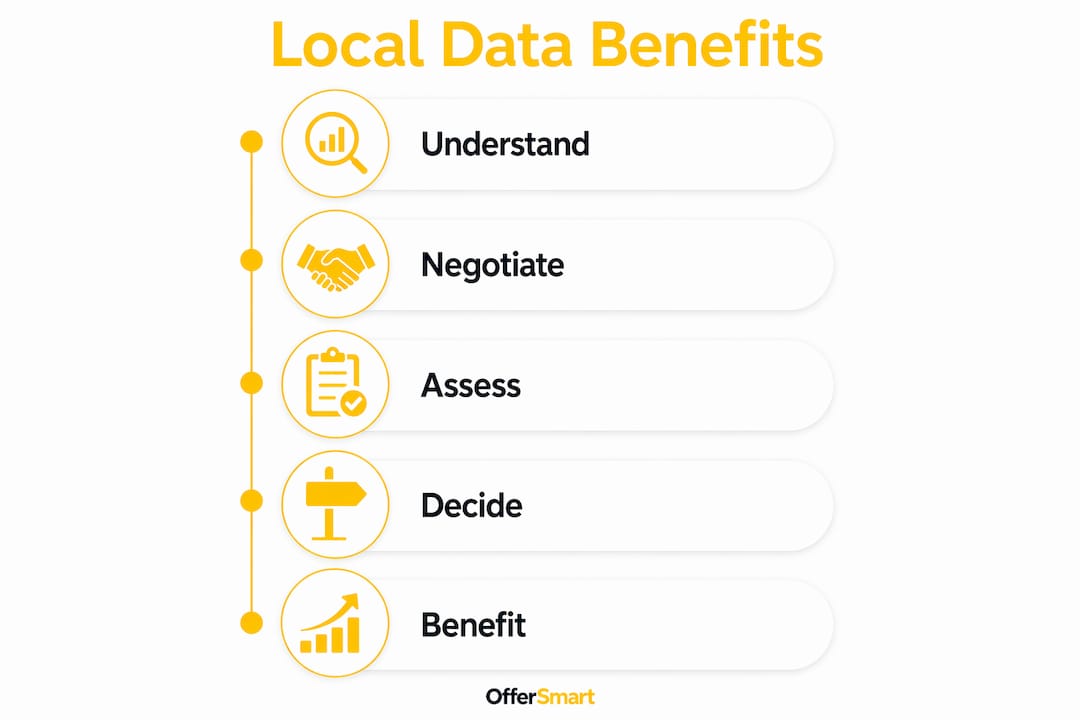
Pro Tip: Before submitting an offer, compile a short evidence pack: three to five recent comparable sales on or near the target road, the property's days on market, and any price reduction history. Present this to the estate agent. It signals you are a serious, prepared buyer and strengthens your negotiating position considerably.
What does local data reveal about neighbourhood quality?
Owner-occupation rates correlate positively with community stability. High private rental rates, by contrast, correspond to greater turnover and more absentee landlords. This matters for first-time buyers because a neighbourhood with predominantly owner-occupiers tends to be better maintained, quieter, and more consistent in its character over time. ONS census data breaks this down at ward and postcode level, making it straightforward to check before you commit.
School quality is one of the most powerful drivers of neighbourhood desirability. Ofsted inspection results are publicly available and directly influence both demand and price. A school rated Outstanding attracts families willing to pay a premium to live within its catchment. That demand sustains property values even during broader market downturns.
Broadband availability is now a primary factor for many buyers, influencing desirability and property value. Ofcom's Connected Nations data lets you check full-fibre availability at a specific postcode before you view. For buyers who work from home, a property without reliable gigabit broadband is a practical problem, not a minor inconvenience.
Beyond connectivity, nearby amenities affect property value in ways that compound over time. Access to parks, restaurants, and independent shops signals an area with active investment and community engagement. Crime data from Police.uk, flood risk maps from the Environment Agency, and noise exposure data from local authority environmental health departments complete the picture.
| Neighbourhood indicator | Where to find it | What it tells you |
|---|---|---|
| Owner-occupation rate | ONS census data | Community stability and turnover risk |
| School Ofsted rating | Ofsted public register | Catchment desirability and price premium |
| Broadband speed | Ofcom Connected Nations | Practical liveability for remote workers |
| Crime rate by category | Police.uk open data | Safety profile and insurance implications |
| Flood risk designation | Environment Agency maps | Long-term insurability and resale risk |
How should first-time buyers use local data in their search?
Integrating local data into your search from the outset saves time and prevents you from falling in love with a property in an area that does not suit your needs. A structured approach works best.
- Start at district level. Use ONS house price statistics and local authority data to identify districts that fit your budget. Narrow from region to district before you look at individual streets.
- Shortlist by postcode. Once you have a district, compare postcodes within it. Check school catchments, transport links, and crime data. Two postcodes in the same district can have meaningfully different profiles.
- Research specific roads. Pull recent sales data for the exact road you are considering. Land Registry records are publicly available and show sold prices going back years. This is your baseline for offer pricing.
- Prepare questions for the estate agent. Hyper-local queries make up 71%–87% of property research, yet digital searches cannot answer everything. Modern estate agents increasingly function as neighbourhood consultants. Ask about commute patterns, noise at different times of day, and planned local development.
- Combine data with a physical visit. Walk the street at different times. Visit on a weekday morning and a Saturday evening. Data tells you what has happened. Your own observation tells you what living there will feel like.
- Use a property insight tool. Offersmart analyses a property and its surrounding area instantly, comparing recent local sales including properties on the same road. It surfaces crime risk, flood risk, school proximity, and lifestyle factors in a single report, saving hours of manual research.
Well-prepared buyers who research local school Ofsted results, recent road-level sales, and planning history demonstrate greater negotiating leverage with agents. Agents value buyers who arrive with data. It builds credibility and shortens the negotiation process. Learning how to use data to make a property offer is one of the most practical skills a first-time buyer can develop before entering the market.
Key takeaways
Local data is the most reliable foundation a first-time buyer has for assessing true property value, negotiating with confidence, and choosing a neighbourhood that suits their long-term needs.
| Point | Details |
|---|---|
| Postcodes drive price gaps | Identical properties can differ by up to £50,000 based on local factors like schools and transport. |
| Track negotiation signals | Days on market and price reductions reveal motivated sellers and realistic price ceilings. |
| Neighbourhood quality is measurable | ONS data, Ofsted results, and Ofcom broadband checks give a factual picture before you commit. |
| Prepared buyers negotiate better | Arriving with local comps and market data builds credibility and strengthens your offer position. |
| Combine data with observation | Local statistics set the baseline; a physical visit confirms what living there will actually be like. |
Local data changed how I think about first-time buying
I have spoken with enough first-time buyers to know that the biggest mistake is not overpaying on price. The biggest mistake is fixating on the property itself while ignoring the neighbourhood entirely. A buyer will spend weeks agonising over whether to choose the flat with the bigger kitchen or the one with the extra storage. They spend almost no time checking whether the road has had three burglaries in the past month or whether the nearest Outstanding school is actually within the catchment boundary.
The property is fixable. The location is not. You can repaint walls and replace worktops. You cannot change the flood risk designation or move the catchment boundary.
What I find genuinely useful about approaching this with local data is that it shifts the conversation. Instead of asking "do I like this flat?", you start asking "does this postcode justify this price?". That is a question you can actually answer with evidence. And when you walk into a negotiation with evidence, the dynamic changes. Estate agents respond differently to a buyer who says "comparable sales on this road over the past six months average £285,000" than to one who says "I think it feels a bit overpriced."
Agents value buyers who arrive prepared with local data. That preparation improves credibility and strengthens your negotiating position significantly. The buyers who get the best outcomes are not the ones with the biggest budgets. They are the ones who did the research.
— Rhys
Offersmart gives first-time buyers a local data advantage
First-time buyers who want a clear picture of what a property is genuinely worth now have a direct route to that answer. Offersmart analyses any UK property instantly, pulling together comparable sales on the same road, crime risk, flood risk, school proximity, broadband availability, and lifestyle factors into a single report.
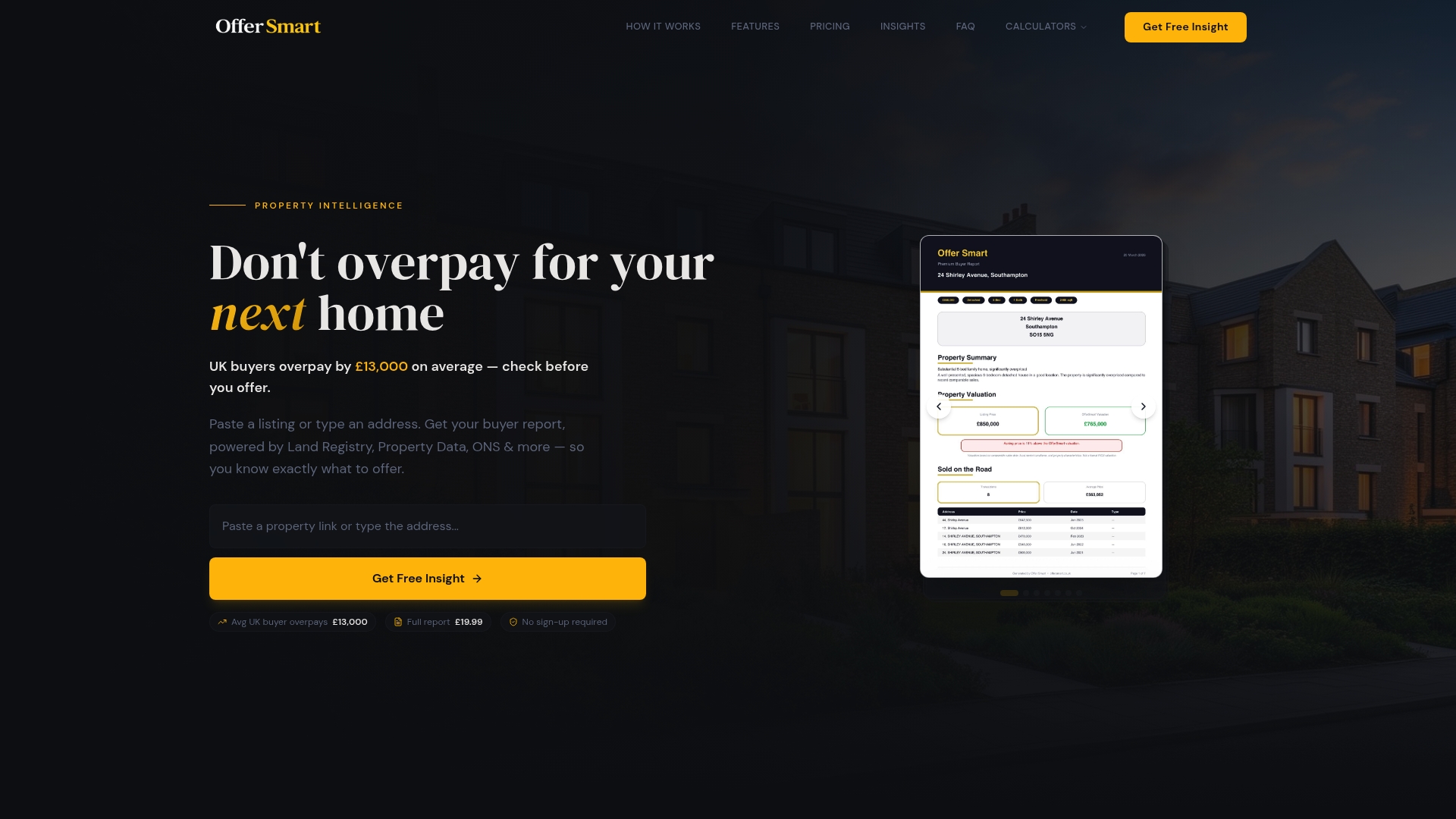
You do not need to spend hours cross-referencing ONS data, Police.uk, and Land Registry records manually. Paste a listing link or enter an address, and Offersmart tells you what you should realistically offer. The built-in mortgage calculator and running cost estimates give you a full financial picture before you commit. For first-time buyers who want confidence without the complexity, Offersmart is built precisely for that purpose.
FAQ
Why does local data matter more than national house price trends?
National averages mask significant variation at postcode and street level. Two identical properties in the same city can differ by up to £50,000 based on local factors like school catchments and transport links.
What is a micro-market in UK property?
A micro-market is a localised segment of the property market, sometimes as small as a single street or postcode sector, where prices and demand conditions differ from the surrounding area.
How do days on market help first-time buyers negotiate?
A property that has been listed for 60 or more days without selling signals a motivated seller. Longer listing times and prior price reductions indicate greater room to negotiate below the asking price.
Where can first-time buyers find reliable local property data in the UK?
The ONS publishes monthly postcode-level house price data. Land Registry records show sold prices on specific roads. Ofsted, Police.uk, the Environment Agency, and Ofcom provide school, crime, flood, and broadband data respectively.
Does local data help with mortgage applications?
Yes. Mortgage lenders use local comparable sales to validate property valuations during underwriting. Buyers who understand local comps can anticipate whether their offer will be supported by the lender's independent valuation.