

A confident first property offer is defined by a defensible price backed by comparable sales data, combined with terms that give sellers certainty. For first-time buyers in the UK, the difference between an accepted offer and a missed opportunity rarely comes down to who bid highest. It comes down to who prepared best. This guide shows you how to assess market conditions, build a compelling offer package, and make your first property offer confidently using a clear, repeatable system rather than guesswork or gut feeling.
How to make your first property offer confidently
Before you write a single number on an offer form, you need to understand what the local market is actually doing. UK property markets vary enormously by region, street, and property type. In a seller's market, properties sell above asking price within days. In a buyer's market, you have room to negotiate. Reading these signals correctly is the foundation of every confident offer.
The two most reliable indicators are the sale-to-list price ratio and days on market. If homes in your target area are consistently selling at or above asking price within two weeks, you are in a competitive market and your opening offer needs to reflect that. If properties are sitting for six weeks or more with price reductions, you have negotiating room.

Comparable sales, known as "comps," are the backbone of defensible offer pricing. Select three to five recently sold properties within half a mile that match your target home in size, type, age, and condition. Sold prices, not asking prices, are what matter. You can access these through the Land Registry, Rightmove's sold prices section, or tools like Offersmart, which compares recent local sales including properties on the same road.
Pro Tip: Set three price points before you view any property: your target offer, your stretch ceiling, and your absolute walk-away number. Experienced buyers use this three-tier framework to prevent emotional overbidding in the heat of the moment.
| Market signal | What it means | Your response |
|---|---|---|
| Selling above asking within 7 days | Strong seller's market | Open at or near asking; consider escalation clause |
| Selling at asking within 3-4 weeks | Balanced market | Offer 2-3% below asking with strong terms |
| Price reductions after 6+ weeks | Buyer's market | Offer 5-10% below asking with full contingencies |
Understanding what a realistic offer looks like in your specific area removes the anxiety of guessing. Data replaces emotion, and that is where confidence comes from.
What makes a winning offer package beyond price?
Sellers do not simply accept the highest number. The best offers are viewed as a package of certainty, where terms like flexible closing dates and strong financing proof often outweigh raw price. Understanding this changes how you approach every offer you make.
Earnest money deposit is the sum you pay upfront to demonstrate commitment. In the UK context, this is typically the reservation deposit or exchange deposit. Earnest money is generally 1-3% of the sale price, with 3% or more signalling stronger buyer commitment in competitive markets. A higher deposit tells the seller you are serious and financially prepared.
Financing readiness is arguably the single most powerful signal you can send. A mortgage Agreement in Principle (AIP) from a lender shows you have been assessed and are ready to proceed. An underwritten pre-approval, where a lender has verified your income and credit in detail, is even stronger. Sellers and their agents notice the difference.
Contingencies protect you legally and financially, but they need to be structured carefully:
- Survey contingency: Gives you the right to renegotiate or withdraw if a structural survey reveals significant problems. Inspection contingency periods typically run 7-10 days, which is a reasonable window to arrange a RICS survey.
- Mortgage contingency: Protects you if your lender withdraws the offer before exchange. Never waive this without independent legal advice.
- Appraisal contingency: Covers you if the lender's valuation comes in below your agreed purchase price.
Pro Tip: Tailored offer terms addressing the seller's situation can create a compelling package that outshines offers with higher price tags. Ask your estate agent what matters most to the seller: a fast exchange, a specific completion date, or leaving certain fixtures behind.
| Term | Buyer benefit | Seller benefit |
|---|---|---|
| Higher deposit (3%+) | Signals commitment | Reduces risk of buyer withdrawing |
| Flexible completion date | Reduces pressure | Aligns with seller's moving plans |
| Appraisal gap guarantee | Strengthens offer in competition | Removes valuation risk for seller |
| Pre-approved mortgage | Speeds up process | Confirms buyer can proceed |
An appraisal gap guarantee, where you commit to covering any shortfall between your offer price and the lender's valuation up to a set amount, is particularly powerful. Appraisal gap guarantees offer sellers greater security and are often more influential than a nominal price increase. This is an advanced tactic, but worth knowing before you enter a competitive bidding situation.
Step-by-step guide to submitting your first offer
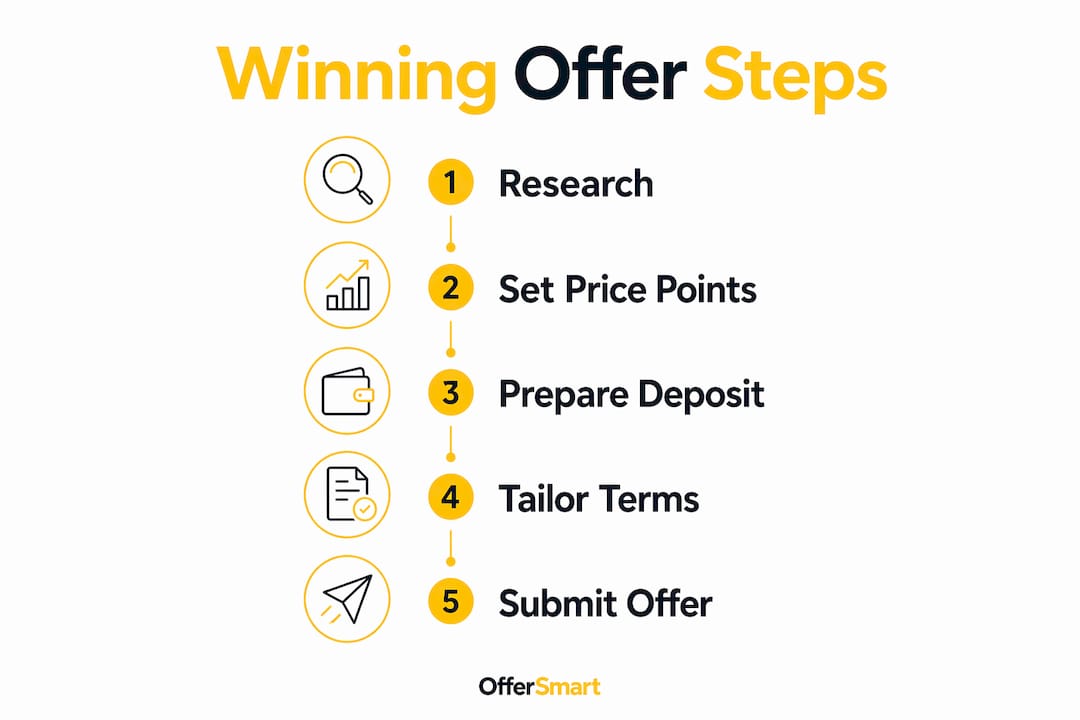
A clear process removes anxiety. Follow these nine steps and you will know exactly where you stand at every point.
-
Gather comparable sales. Pull three to five sold prices from the Land Registry or Offersmart for similar properties within half a mile. Focus on sales from the past three to six months.
-
Calculate your price range. Set your target offer, your stretch ceiling, and your walk-away number. Write them down before you view the property. Do not revise them upward based on emotion during the viewing.
-
Obtain mortgage pre-approval. Secure an Agreement in Principle before submitting any offer. If you are a cash buyer, prepare a proof of funds letter from your solicitor or bank. You can use Offersmart's mortgage affordability calculator to model different scenarios before approaching lenders.
-
Decide on your deposit amount. Consider offering above the minimum 1% reservation deposit if the market is competitive. A stronger deposit signals commitment and can tip a seller's decision in your favour.
-
Select your contingencies. Include a survey contingency and a mortgage contingency as standard. Only consider waiving or shortening them if you have had a pre-inspection carried out and you understand the risks fully. Read the property surveys guide for first-time buyers before making this decision.
-
Agree on a completion timeline. Ask your estate agent what timeline suits the seller. Matching their preferred completion date costs you nothing but can make your offer significantly more attractive.
-
Write a concise offer letter. State your offer price, your financing position, your proposed deposit, your preferred completion date, and any conditions. Keep it factual and professional. Avoid lengthy personal appeals, which can feel unprofessional in the UK market.
-
Use your agent for intelligence. Smart buyers communicate through their agents with the seller's agent to understand seller priorities and competing offer levels before submitting. This is not underhand. It is standard practice.
-
Submit promptly and prepare to negotiate. Once you are ready, submit without delay. Sellers notice hesitation. Prepare a counter-offer position in advance so you can respond quickly if needed.
Pro Tip: Keep all communication through your estate agent and respond to any counter-offer within 24 hours. Speed signals seriousness and can close a deal before a competing buyer re-enters.
How to avoid costly mistakes on your first property bid
The most common reason first-time buyers overpay or lose deals is emotional decision-making. Basing offers on recent comparable sales reduces the risk of overpaying emotionally and keeps your thinking grounded in evidence rather than attachment.
Here are the mistakes that cost buyers most:
- Bidding beyond your ceiling. Once you set a walk-away number, treat it as fixed. In markets with 4-8 competing offers, buyers often need to offer 3-7% above list price. Knowing this in advance means you can decide rationally whether a property is worth competing for, rather than discovering your limit mid-negotiation.
- Waiving the survey contingency without preparation. Skipping a survey to appear more attractive is a high-risk move. Keeping the inspection contingency is standard advice from experienced conveyancers. If you want to compete without a full contingency, commission a pre-inspection before submitting your offer.
- Misreading comparable sales. Using asking prices instead of sold prices, or comparing a terraced house to a semi-detached, produces a distorted picture. Comps must match on type, size, condition, and proximity.
- Ignoring the seller's motivation. A seller who needs a fast exchange will favour a buyer with no chain and strong financing over a higher offer from someone still selling their own home. Understanding motivation is free intelligence.
- Leaving earnest money signals too weak. A minimal deposit on a competitive property tells the seller you are not fully committed. Increasing deposits after contingencies clear is one way to balance seriousness with financial protection.
Pro Tip: Write your walk-away number on a piece of paper before every viewing and put it in your pocket. When the bidding gets emotional, take it out and read it. It sounds simple because it is.
Key takeaways
A confident first property offer combines a data-backed price range, strong financing proof, and terms tailored to the seller's priorities.
| Point | Details |
|---|---|
| Use comparable sold prices | Base your offer on Land Registry sold data, not asking prices, to set a defensible range. |
| Build a three-tier price framework | Set a target, a stretch ceiling, and a walk-away number before viewing any property. |
| Strengthen your offer package | A higher deposit, pre-approved mortgage, and flexible completion date often outweigh a higher price. |
| Keep contingencies in place | Survey and mortgage contingencies protect you; only waive them with full knowledge of the risks. |
| Use your agent for market intelligence | Ask what the seller needs before submitting, then tailor your terms to match their priorities. |
What I have learned from watching first-time buyers make offers
Most first-time buyers I have worked with arrive at the offer stage believing price is everything. They spend weeks agonising over whether to offer £5,000 more or less, while completely overlooking the terms that actually close deals. I have seen a buyer with a lower offer win over a higher bidder simply because they matched the seller's completion date and came with a clean mortgage pre-approval. The seller did not want more money. They wanted certainty.
The emotional trap is real. I have watched buyers who set a firm ceiling abandon it the moment they fell in love with a kitchen. The discipline of a written walk-away number is not a gimmick. It is the only reliable protection against a decision you will regret when the mortgage statement arrives.
My honest view is that the buyers who succeed are the ones who treat the offer as a negotiation, not a lottery. They gather data, they understand the seller, and they build a package. They also respond quickly, communicate clearly, and do not overthink every counter-offer. Preparation replaces anxiety. That is the whole system.
If you are preparing your first bid, read the step-by-step guide to preparing a winning offer before you submit anything. The process matters as much as the number.
— Rhys
How Offersmart helps you offer with confidence
Knowing your number before you walk into a negotiation is the single biggest advantage you can give yourself as a first-time buyer. Offersmart analyses recent comparable sales on the same road, calculates a realistic offer range, and gives you a full picture of the area including flood risk, crime data, and school proximity. You stop guessing and start deciding.

Use Offersmart's offer and mortgage calculators to model your affordability, stress-test your offer price, and arrive at every negotiation with a number you can defend. The tool is built specifically for UK buyers and takes minutes to use. Enter a property address or paste a listing link and get a clear, data-backed buyer report before you submit a single offer.
FAQ
What is a good opening offer on a UK property?
A good opening offer is typically 5-10% below asking price in a buyer's market, or at asking price in a balanced market. Base your figure on recent comparable sold prices from the Land Registry rather than the asking price alone.
How much deposit do I need when making an offer?
An earnest money or reservation deposit of 1-3% of the purchase price is standard, with 3% or more signalling stronger commitment in competitive markets. The full exchange deposit in the UK is usually 10% of the purchase price.
Should I waive the survey contingency to win a bidding war?
Waiving the survey contingency is not advisable without a pre-inspection already completed. Keeping the survey contingency protects you from costly structural surprises and is standard practice recommended by RICS-accredited surveyors.
How do I know if I am overpaying for a property?
Compare your offer price against recent sold prices for similar properties within half a mile using Land Registry data or Offersmart. If your offer is significantly above the average sold price for comparable homes, you risk overpaying.
What makes an offer more attractive beyond the price?
Sellers prioritise deal certainty. A pre-approved mortgage, a higher deposit, a flexible completion date, and a clean chain position all make your offer more attractive regardless of whether your price is the highest on the table.