

A realistic property offer is an evidence-based bid that reflects recent local sold prices, your financial capacity, and the condition of the property you want to buy. Getting this right matters more than most first-time buyers realise. One third of homes currently for sale have already had a price reduction, which tells you that asking prices are frequently aspirational rather than accurate. To calculate a realistic property offer, you need three things working together: comparable sold price data from Land Registry, a clear picture of your mortgage and deposit limits, and an honest assessment of the property's condition. Get all three right, and you bid with confidence rather than guesswork.
What data should you gather before calculating your property offer?
The most reliable starting point is recent sold price data, not listing prices. Land Registry records every completed sale in England and Wales, and buyers now check comparable sold prices within minutes of viewing a property. Focus on sales completed within the last 6–12 months on the same road or within a quarter-mile radius, matching property type, bedroom count, and approximate floor area.
Before you make any offer, gather the following:
- Land Registry sold prices for comparable properties nearby (same type, size, and condition)
- Mortgage Agreement in Principle (AIP) confirming your borrowing limit from a lender
- Property survey report identifying defects and repair costs
- EPC rating for the property, which affects running costs and resale value
- Leasehold details if applicable, including years remaining on the lease and service charges
A property valuation calculator can help you cross-reference these data points quickly. Offersmart, for example, analyses recent local sales including properties on the same road, giving you a clear real estate offer estimate before you commit to a figure.
| Data source | What it tells you |
|---|---|
| Land Registry sold prices | True market value based on completed transactions |
| Mortgage AIP | Your confirmed borrowing ceiling |
| Survey report | Repair costs that justify price adjustments |
| EPC rating | Running costs and energy efficiency context |
| Leasehold documents | Hidden costs and lease risk |
Pro Tip: Request the EPC and leasehold documents from the estate agent before your second viewing. Both affect your offer calculation and can take time to obtain.
How do you analyse comparable sales to build a base offer?
Comparable sales analysis is the foundation of any credible home purchase offer. The process involves identifying properties that closely match the one you want to buy, then adjusting for differences to arrive at a justified base price.
Follow these steps:
-
Find three to five genuine comparables. Match on property type (terraced, semi-detached, detached), number of bedrooms, approximate square footage, and street or postcode sector. Avoid using flats as comparables for houses, or vice versa.
-
Use sold prices, not asking prices. Asking prices leave room for negotiation and often reflect seller ambition rather than market reality. Sold prices reflect what buyers actually paid.
-
Adjust for condition and features. A comparable that sold with a new kitchen and loft conversion warrants a downward adjustment if your target property has neither. Leasehold details, EPC rating, and outdoor space can all shift value significantly beyond the basic bedroom count.
-
Account for market direction. If prices in the area have softened over the past six months, weight your comparables accordingly. A sale from 12 months ago in a cooling market may overstate current value.
-
Note recent price reductions. A property that has sat on the market for 90 days with two price cuts signals seller flexibility. That context belongs in your offer calculation, not just your negotiation tactics.
The result of this process is a base offer figure grounded in evidence. Using Land Registry data to build this foundation removes the emotional pressure that causes buyers to overbid.
Pro Tip: If a comparable sold more than six months ago, apply a modest adjustment for market movement. Check whether local prices have risen or fallen since that sale completed.

How should your financial position shape your offer?
Your maximum offer is not simply your maximum mortgage plus your deposit. It is the figure left after you account for every cost involved in buying and moving into the property. Many first-time buyers underestimate these additional costs and find themselves stretched after completion.
Build your budget ceiling by subtracting the following from your total available funds:
- Stamp Duty Land Tax (SDLT): first-time buyers pay no SDLT on the first £425,000 of a property's value, but this threshold applies only to properties priced at £625,000 or below
- Solicitor and conveyancing fees: typically £1,000–£2,500
- Survey costs: a full structural survey costs more than a basic valuation report, but the detail justifies the price
- Removal costs and immediate repairs: budget realistically, not optimistically
- Mortgage arrangement fees: some lenders charge these upfront
Beyond the numbers, your buyer strength matters. Sellers often prefer a lower offer from a ready buyer over a higher bid from someone with chain delays. Being chain-free, having your AIP in place, and having a solicitor already instructed all make your offer more attractive at the same price point.
Proof of funds and solicitor readiness frequently sway seller decisions when two offers are close in value. Present your buyer position clearly when you submit your offer. State your chain status, your AIP lender, and your solicitor's name. This costs nothing and can make the difference between acceptance and rejection.
Pro Tip: Set your maximum offer before you view the property, not after. Emotional attachment to a home you have walked around makes it harder to hold your financial limit.
What adjustments should you make for condition, seller situation, and market context?
Once you have a base offer from comparable sales and a ceiling from your finances, you need to adjust for three variables: the property's physical condition, the seller's situation, and the current state of the local market.
Adjusting for property condition
A thorough survey provides evidence of repair costs that you can use to justify a lower offer. Surveyors use a traffic-light system to categorise defects. Only Condition 3 issues (the most urgent) typically justify a substantive price reduction, and only when supported by contractor quotes. A damp patch flagged as Condition 2 is not grounds for a £10,000 reduction without evidence.
Reading seller motivation
Seller motivation signals include:
- Time on market: a property listed for more than 60 days with no sale suggests the asking price is too high or there is a specific issue putting buyers off
- Price reductions: multiple reductions indicate a motivated seller open to negotiation
- Chain status: a seller who has already found their next property and needs to move quickly may accept a lower offer to secure the transaction
- Vacant property: an empty home costs the seller money every month, increasing their motivation to accept
Responding to market conditions
UK houses currently sell around 5% below asking price on average, making an initial offer in the 5–10% below asking range a reasonable starting point in a neutral market. Hot markets, where properties receive multiple offers within days of listing, require offers at or above asking price. Cold markets allow more room to negotiate. Check how quickly similar properties are selling locally before you decide where to pitch your opening bid.
| Market condition | Suggested opening offer range |
|---|---|
| Hot (multiple offers, fast sales) | At or above asking price |
| Neutral (average time on market) | 3–5% below asking price |
| Cold (slow sales, price reductions common) | 5–10% below asking price |
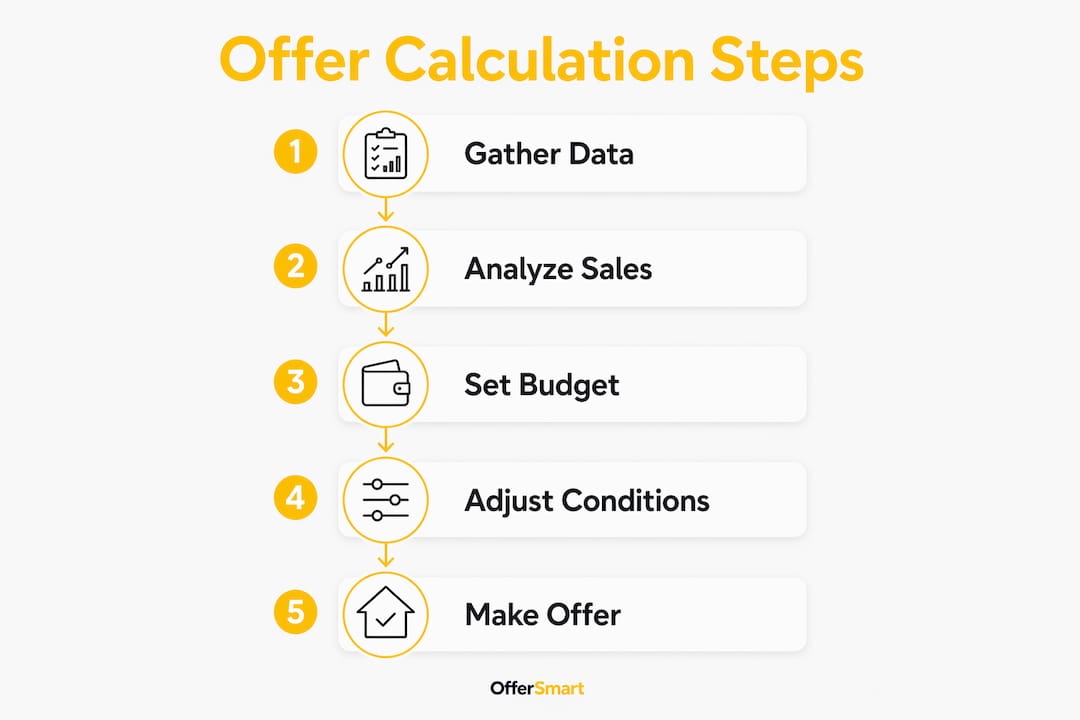
A disciplined approach to your maximum limit protects you from buyer's remorse. Emotional bidding leads to overpaying. Set your ceiling, state it clearly to yourself, and do not move above it without a clear financial reason.
Pro Tip: If a survey reveals Condition 3 defects, get two contractor quotes before renegotiating. One quote looks opportunistic. Two quotes look like evidence.
Key takeaways
Calculating a realistic property offer requires combining Land Registry sold prices, a clear financial ceiling, and evidence-based adjustments for property condition and market context.
| Point | Details |
|---|---|
| Use sold prices, not asking prices | Land Registry data reflects what buyers actually paid, not what sellers hoped to achieve. |
| Set your budget ceiling before viewing | Subtract all purchase costs from your total funds to find your true maximum offer. |
| Survey findings justify reductions | Only Condition 3 defects supported by contractor quotes warrant substantive price adjustments. |
| Buyer strength influences acceptance | Chain-free status, mortgage AIP, and a solicitor instructed can make a lower offer more attractive. |
| Market context sets your opening range | In a neutral UK market, starting 3–5% below asking price is a reasonable and evidence-based position. |
Why first-time buyers get their offers wrong more often than they think
The most common mistake I see first-time buyers make is treating the asking price as the reference point for their offer. It is not. The asking price is the seller's opening position, and in a market where 56% of buyers identify an overpriced home as the biggest dealbreaker, anchoring your bid to that figure puts you at an immediate disadvantage.
The second mistake is ignoring repair costs entirely. Buyers fall in love with a property, dismiss the survey findings as minor, and then spend the first two years of ownership fixing problems they could have negotiated into the purchase price. A Condition 3 defect is not a reason to walk away. It is a reason to get quotes and renegotiate.
The third mistake is underestimating buyer strength. I have seen first-time buyers lose properties to lower offers simply because the competing buyer was chain-free with a solicitor already instructed. Sellers value certainty. Understanding seller motivation and chain status is as critical as the price itself, particularly when you are competing against experienced buyers.
My practical advice: prepare your winning offer strategy before you find the property you want to buy. Know your ceiling, have your AIP ready, and instruct a solicitor early. When the right property appears, you can move quickly and confidently. Speed and preparation are buyer advantages that cost nothing.
— Rhys
How Offersmart helps you determine your property offer price
Pulling together Land Registry data, comparable sales, survey findings, and mortgage limits is time-consuming when you do it manually. Offersmart brings all of this into one place.

Enter a property address or paste a listing link, and Offersmart instantly analyses recent local sales, including properties on the same road, to show you what you should realistically offer. It also covers flood risk, crime data, school proximity, and a 5-year value forecast, giving you a complete picture before you commit. The built-in property offer calculators let you cross-reference your offer against real market data, while the mortgage calculator aligns your borrowing capacity with your offer ceiling. No spreadsheets. No guesswork. Just clear, data-backed numbers you can act on.
FAQ
What is a realistic property offer in the UK?
A realistic property offer is a bid grounded in recent comparable sold prices, adjusted for the property's condition and the buyer's financial limits. It reflects true market value rather than the seller's asking price.
How far below asking price should I offer?
UK houses currently sell around 5% below asking price on average in a neutral market, making an opening offer of 3–5% below asking a reasonable starting point. Hot markets may require offers at or above asking price.
Does a survey affect how much I should offer?
A survey can justify a lower offer when it identifies Condition 3 defects supported by contractor quotes. Minor issues categorised as Condition 1 or 2 do not typically warrant a price reduction.
Does being a first-time buyer affect my offer strength?
Being a first-time buyer with no chain, a mortgage AIP, and a solicitor instructed is a strong position. Sellers often prefer a ready first-time buyer over a higher offer from someone with chain complications.
Should I use a property valuation calculator when making an offer?
A property valuation calculator helps you cross-reference your offer against recent local sold prices quickly. Offersmart's calculators incorporate market data and buyer finances to give you a clear, evidence-based offer figure.