

Making a data-driven offer on your first home means using quantifiable market evidence to craft a price that is affordable, competitive, and legally protected. The term "data-driven offer" is not formal industry vocabulary. Estate agents and conveyancers call this a comparable sales analysis, or simply "comps-based pricing." Both phrases describe the same discipline: replacing gut feeling with verifiable numbers. A defensible offer price draws on comparable sales from the last 3–6 months, your confirmed mortgage affordability, and a clear set of contingencies that protect your deposit if something goes wrong. Get these three elements right and you move from hopeful bidder to informed buyer.
What data and tools do you need before making your first home offer?
The foundation of any data-driven home buying decision is comparable sales data. A "comp" is a recently sold property that closely matches yours in size, condition, location, and type. Pull comps from the last 3–6 months on the same road or within half a mile. The Land Registry's Price Paid Data is the most authoritative free source for this in England and Wales.

Beyond comps, you need to understand local supply. Market heat at a local level is more telling than city-wide averages. Months of supply measures how long it would take to sell every listed property at the current rate of sales. Under three months signals a seller's market. Over six months gives buyers real negotiating room.
Mortgage pre-approval is non-negotiable before you submit any offer. It sets a hard financial ceiling and tells the seller you are a credible buyer. Use an affordability calculator to model different deposit sizes and interest rate scenarios before you commit to a price range. Offersmart's built-in mortgage calculator lets you run these numbers against real local data rather than national averages.
Here is a summary of the core data inputs you need before making your offer:
| Data input | What it tells you | Where to find it |
|---|---|---|
| Comparable sales (comps) | True market value of the property | Land Registry Price Paid Data |
| Months of supply | Whether the market favours buyer or seller | Local estate agent reports |
| Mortgage pre-approval | Your maximum affordable offer | Your lender or broker |
| Estimated repair costs | Adjustment to offer price | Survey report, local tradespeople |
| Closing cost estimates | Total cash needed at completion | Solicitor, Offersmart calculators |
How do market trends and property data shape your offer price?
Months of supply is the single most useful market signal for setting your offer price. Under three months of supply means competition is fierce and offering at or above asking price is often necessary. Over six months means properties are sitting, and you can open below asking with a reasoned justification.

Days on market (DOM) is equally telling. A property listed for more than 60 days in a normal market is sending a signal. Either the price is too high, there is a structural issue, or the seller has already had offers fall through. Each of these scenarios gives you a legitimate basis for a lower offer or a request for seller concessions.
Recent price reductions are another negotiation signal. If a listing has been cut once or twice, the seller has already acknowledged the original price was wrong. Factoring in repair reserves and carrying costs when comps show price drops or high DOM gives you a quantified reason to offer less, rather than a vague feeling that "something is off."
Property condition adjustments work as follows:
- Structural issues: Deduct the full estimated repair cost from your offer, plus a contingency of 10–15% for unforeseen complications.
- Cosmetic work: Treat this as a negotiation point rather than a price reduction. Sellers often prefer a credit at completion over a lower headline price.
- Energy efficiency: A low EPC rating means higher running costs. Model the annual difference and factor it into your five-year cost of ownership.
- Active comparable listings: Check what similar properties are currently listed at. If your target property is priced above active comps, that gap is your opening argument.
Pro Tip: Build a simple scoring sheet before you view any property. Score commute time, broadband speed, repair risk, and flood risk on a consistent scale. Repeatable scoring rubrics remove the bias that creeps in when you fall in love with a kitchen.
How should you structure your offer with deposits, contingencies, and timelines?
A well-structured offer does two things at once. It protects you from financial loss if the deal falls apart, and it signals to the seller that you are organised and serious.
Earnest money and good-faith deposits
In the UK, the equivalent of an earnest money deposit is the exchange deposit, typically 10% of the purchase price paid at exchange of contracts. Before exchange, you may also pay a reservation fee if buying through a developer. Earnest money deposits typically range from 1%–3% of the purchase price in markets where they apply. The key principle is the same in any market: your deposit signals commitment. Make sure your solicitor specifies the exact conditions under which it is refundable.
Contingencies every first-time buyer needs
Contingencies are contractual conditions that must be met for the sale to proceed. Waiving them to appear more attractive is one of the most common and costly mistakes first-time buyers make.
- Survey contingency: Inspection contingencies are regarded as indispensable for first-time buyers. A full structural survey protects you from unknown defects that could cost tens of thousands of pounds.
- Mortgage contingency: If your lender withdraws the offer, this clause lets you exit without losing your deposit.
- Appraisal contingency: If the lender's valuation comes in below the agreed price, this gives you the right to renegotiate or withdraw.
Closing timelines
The typical home buying process spans 3–6 months, with 30–45 days from accepted offer to completion once a mortgage is confirmed. That timeline is your anchor. Propose a completion date that aligns with your lender's processing time. Sellers value certainty, and a realistic timeline is more attractive than an optimistic one that later slips.
Pro Tip: Set a walk-away price before you submit your offer. Write it down. When a negotiation gets emotional, that number is your anchor. Buyers who skip this step routinely overpay by several thousand pounds.
How do you execute and negotiate your offer using data?
Every offer must be submitted in writing. A verbal agreement is not legally binding in England and Wales. Your written offer should cover the agreed price, proposed completion date, deposit amount, and all contingencies. Your solicitor will formalise this in the Memorandum of Sale.
When you present your offer price, attach a brief written justification. List the three or four comps you used, note the DOM for the subject property, and reference any survey findings or repair estimates. Sellers and their agents respond better to a reasoned position than a bare number. It also makes counter-offers easier to evaluate objectively.
Here is a step-by-step process for submitting a data-backed offer:
- Confirm your mortgage pre-approval and set your maximum price before viewing the property.
- Pull three to five comps from the last six months within half a mile. Calculate the average price per square foot.
- Assess DOM and price history for the specific listing. Note any reductions.
- Estimate repair and running costs from your survey report and EPC rating.
- Calculate your offer price by adjusting the comp average for condition, location variance, and repair reserve.
- Draft your written offer with all contingencies, deposit terms, and a proposed completion date.
- Submit through your solicitor or estate agent and request written acknowledgement.
Pre-marketing demand signals such as the number of viewings, saved listings, and tour requests are increasingly available through property portals. High early demand means you have less time to deliberate. Low demand gives you room to negotiate. Use these signals to calibrate your urgency, not your price.
Escalation clauses are worth considering in competitive markets. An escalation clause states that you will beat any competing offer by a fixed amount, up to a defined ceiling. They are not standard practice in the UK, but they are legally permissible and can be included in a written offer. Set the ceiling at your pre-agreed walk-away price.
Common mistakes that undermine a data-driven first home offer
Most first-time buyers do not lose money on their offer because they lacked information. They lose it because they ignored the information they had.
- Relying on the list price alone. The asking price is a marketing figure, not a valuation. Always anchor to comps, not to what the seller wants.
- Ignoring repair reserves. A survey that flags £8,000 of remedial work changes your offer price. Failing to adjust for it means you absorb that cost silently.
- Waiving contingencies under pressure. Removing your survey or mortgage contingency to win a bidding war transfers all the risk to you. The savings rarely justify it.
- Submitting without mortgage pre-approval. Sellers and agents deprioritise unconfirmed buyers. Pre-approval is your credibility document.
- Using city-wide data instead of local data. A rising national average tells you nothing about a specific postcode. Local supply and demand metrics at street level are what actually drive your negotiating position.
Check the UK property purchase checklist before you submit any offer to confirm you have covered every preparatory step.
Key takeaways
A data-driven first home offer requires comparable sales analysis, confirmed mortgage affordability, and clearly defined contingencies to protect your deposit and avoid overpaying.
| Point | Details |
|---|---|
| Use comps from the last 3–6 months | Recent comparable sales set a defensible price range grounded in actual market evidence. |
| Read months of supply at local level | Under three months favours sellers; over six months gives buyers real negotiating leverage. |
| Never waive your survey contingency | An inspection clause protects you from unknown repair costs that can run to tens of thousands. |
| Set a walk-away price before negotiating | A pre-agreed ceiling stops emotional bidding and keeps your offer within your affordability limits. |
| Attach a written justification to your offer | Citing comps, DOM, and repair estimates makes your offer harder to dismiss and easier to negotiate. |
Why data changes everything about buying your first home
I have watched buyers lose money in two very different ways. The first is overpaying because they fell in love with a property and ignored what the comps were telling them. The second is losing a property they genuinely wanted because they submitted a vague, unsupported offer that a better-prepared buyer easily beat.
The data-driven approach solves both problems. When you have a scoring rubric, a comp-adjusted price, and a written justification ready before you even view a property, you stop reacting and start deciding. That shift in posture changes how you negotiate. You are no longer hoping the seller accepts your number. You are presenting a reasoned case that is difficult to argue with.
The honest challenge is that this method requires discipline early in the process, when everything feels exciting and urgent. New buyers often skip the prep work because they are eager to move fast. The irony is that buyers who do the data work upfront move faster at the offer stage, not slower. They already know their ceiling, their comps, and their contingencies. The offer takes an hour to write, not a week of anxious deliberation.
One thing I would add: data does not replace your instincts about lifestyle fit. If the numbers say a property is fairly priced but the area does not work for your commute or your family, no amount of favourable comps should override that. Use data to confirm a decision, not to force one.
— Rhys
How Offersmart helps you build a confident, informed offer
Knowing what to offer is only half the challenge. Knowing what you can afford, what the local market is doing, and what the property is genuinely worth requires tools that go beyond a spreadsheet.
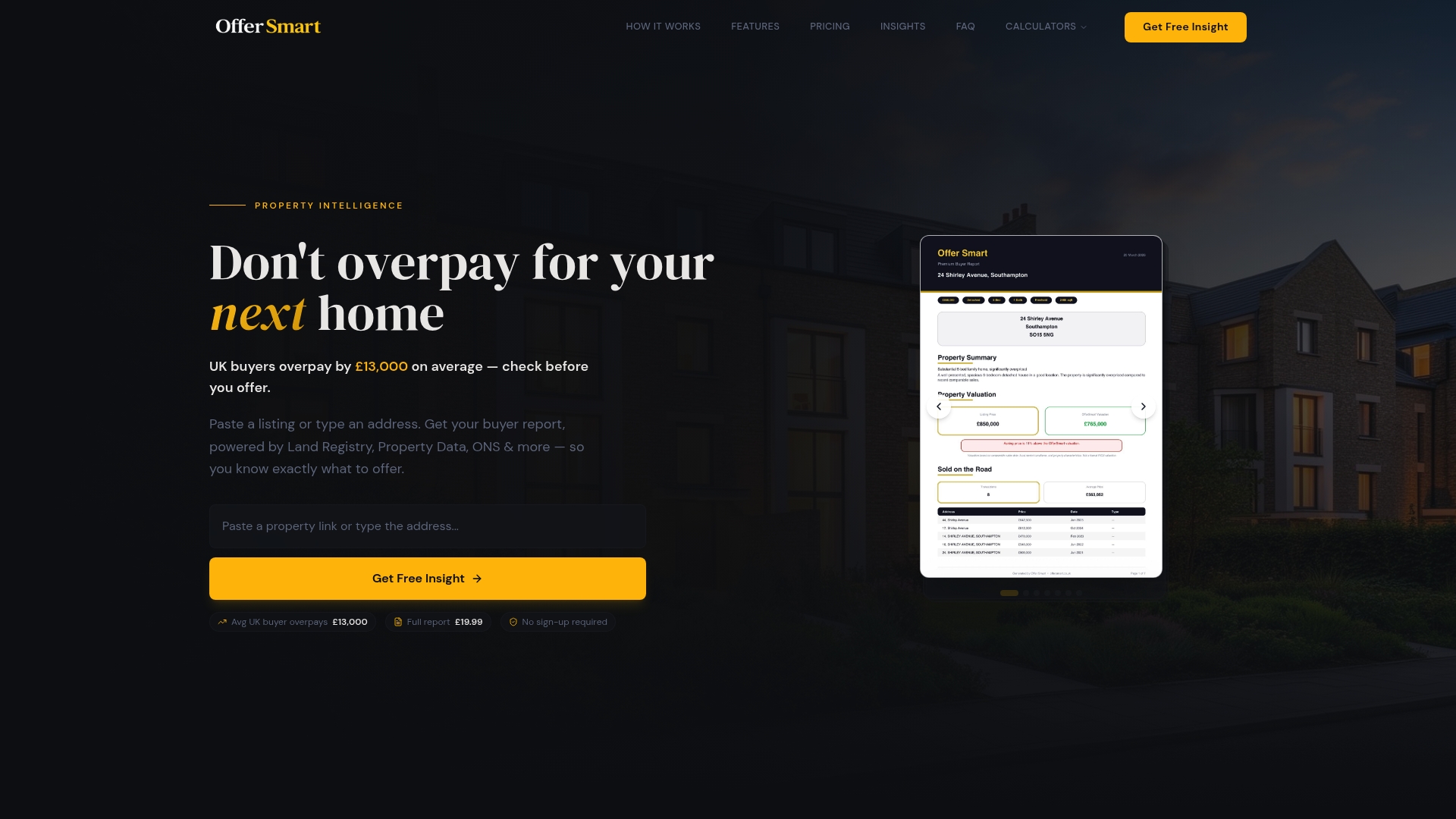
Offersmart is built for exactly this. Enter a property address or paste a listing link, and Offersmart analyses recent local sales, including properties on the same road, to show you a realistic offer range. It layers in flood risk, crime data, school proximity, and EPC-linked running cost estimates so you see the full picture before you commit. The financial calculators cover mortgage affordability, estimated running costs, and a five-year value forecast. For first-time buyers who want to make a confident first offer without paying for a solicitor's opinion on every property they consider, Offersmart gives you the data to act with clarity.
FAQ
What is a data-driven offer on a home?
A data-driven offer is a purchase price derived from comparable sales, local supply metrics, and confirmed mortgage affordability rather than the asking price alone. It is the standard approach professional buyers use to avoid overpaying.
How many comparable sales should I use?
Use three to five comparable sales from the last 3–6 months within half a mile of the property. Comps from recent sales create a defensible price range that you can present to the seller.
Do I need mortgage pre-approval before making an offer?
Yes. Pre-approval confirms your maximum affordable price and signals credibility to the seller. Submitting an offer without it puts you at a significant disadvantage in any competitive situation.
What contingencies should a first-time buyer always include?
A survey contingency, a mortgage contingency, and an appraisal contingency are the three most critical. Inspection contingencies are regarded as indispensable for protecting buyers from unknown structural defects.
How long does it take from offer to completion in the UK?
The typical timeline from accepted offer to completion is 30–45 days once a mortgage is confirmed, though the full buying process from initial search to completion usually spans 3–6 months.