

Most people assume buyer negotiation begins and ends with the offer price. Make a low offer, settle somewhere in the middle, job done. But what is a buyer negotiation in practice? It is a structured, multi-stage process that continues well beyond the moment a seller says yes. In UK property transactions, it runs through solicitor enquiries, survey results, and right up to the exchange of contracts. Understanding this broader picture is what separates buyers who secure genuinely good deals from those who overpay or lose out on terms that matter just as much as the headline figure.
Table of Contents
- Key takeaways
- What is a buyer negotiation: process and stages
- Buyer negotiation in UK home buying
- What else buyers can negotiate
- BATNA and knowing when to walk away
- Practical steps to prepare and negotiate
- My honest take on buyer negotiation
- How Offersmart helps you negotiate with confidence
- FAQ
Key takeaways
| Point | Details |
|---|---|
| Negotiation spans the whole purchase | Buyer negotiation continues through conveyancing, not just at the initial offer stage. |
| Non-price terms carry real value | Closing dates, repair credits, and included fixtures can be worth more than a price reduction. |
| BATNA defines your walk-away point | Knowing your best alternative gives you clarity and prevents costly, emotional decisions. |
| Timing is everything in UK property | The most effective negotiation window is before exchange of contracts, not after. |
| Solicitor enquiries are negotiation tools | Formal written enquiries backed by evidence are how buyers negotiate in UK conveyancing. |
What is a buyer negotiation: process and stages
Buyer negotiation, or purchase negotiation as it is formally known in commercial contexts, is a structured discussion between a buyer and seller aimed at reaching mutually acceptable terms. According to Harvard Business School Online, this process involves four core stages: preparation, bargaining, closing, and learning. Each stage has a distinct purpose, and skipping any one of them tends to produce weaker outcomes.
Preparation is where most buyers underinvest. This means researching comparable sales, understanding the seller's position, and clarifying your own financial limits before a single word is exchanged. Bargaining is the back-and-forth exchange of offers and concessions. The critical point here is that concessions are not a sign of weakness. They are how both parties move toward agreement.
Closing is the stage where final terms are locked in, and learning is the often-forgotten fourth step: reflecting on what worked, what did not, and why. The importance of buyer negotiation lies not just in reaching agreement, but in reaching an agreement that genuinely works for you. A deal that leaves you overstretched or uncertain is not a success, regardless of whether contracts were exchanged.
The core stages of a typical buyer negotiation include:
- Preparation: Researching market value, the seller's motivation, and your own financial position
- Bargaining: Exchanging offers, justifying positions with evidence, and making or requesting concessions
- Closing: Agreeing final terms covering price, conditions, and timeline
- Learning: Reviewing the process to sharpen your approach for future transactions
Understanding these steps in buyer negotiation helps you approach the process with purpose rather than guesswork.
Buyer negotiation in UK home buying
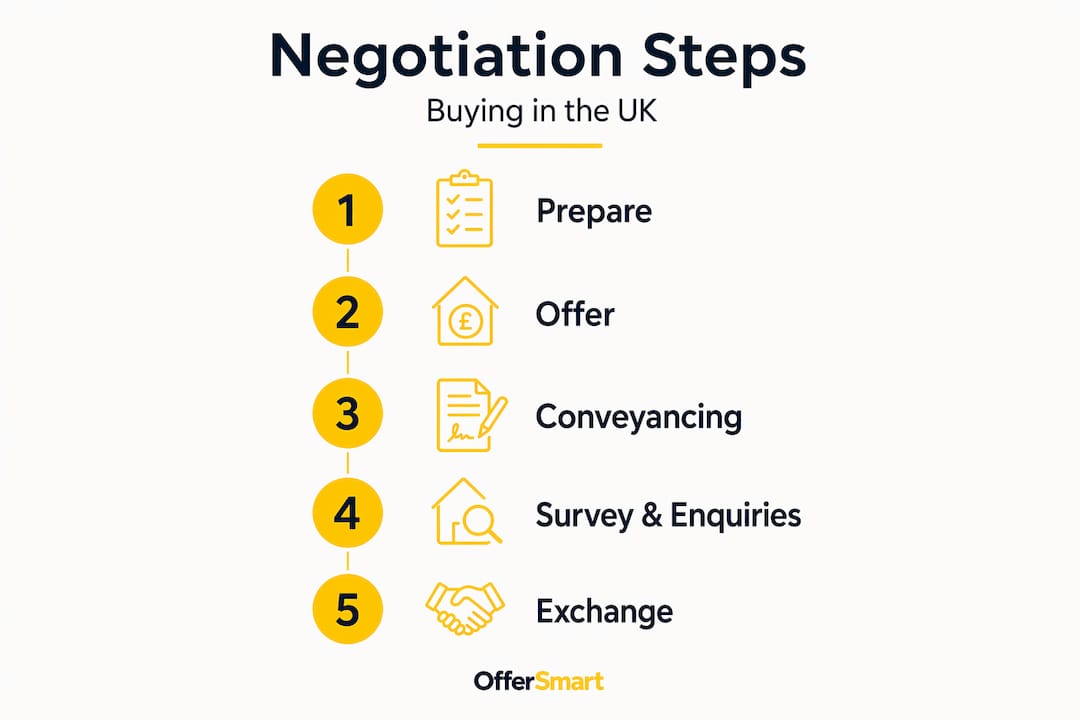
UK property transactions have a specific legal structure that shapes how and when negotiation happens. This is where many buyers get caught off guard. They assume negotiation is over once the seller accepts their offer. In reality, that is when a second, equally important phase begins.

After offer acceptance, both parties instruct solicitors and enter the conveyancing process. Your solicitor raises formal written enquiries with the seller's solicitor, requesting documents, clarifications, and evidence relating to the property. These solicitor enquiries are not just administrative tasks. They are detailed, evidence-based negotiation moves designed to protect your interests and satisfy your mortgage lender's requirements.
If a survey reveals damp, structural movement, or a roof in poor condition, your solicitor can use that report as the basis for a formal request. You may ask the seller to carry out remedial work before completion, reduce the agreed price to reflect the defect, or provide a credit on completion. This is buyer negotiation in its most technical form. It is methodical and documented, not verbal and improvised.
The timing of this matters enormously. Exchange of contracts is the legal point at which the transaction becomes binding for both parties. Before exchange, either side can still withdraw without legal penalty. After exchange, you are committed. That means your real negotiation window, where you still hold genuine leverage, is the period between offer acceptance and exchange.
Pro Tip: If your survey or search results raise concerns, raise them formally with your solicitor before exchange. Raising issues after exchange is legally complex and rarely productive.
Key moments when renegotiation commonly occurs during UK conveyancing:
- When a homebuyer survey or building survey identifies material defects
- When local authority searches reveal planning issues or road adoption disputes
- When solicitor enquiries uncover missing documents such as building regulations certificates
- When the property proves to be leasehold with unfavourable lease terms
What else buyers can negotiate
Price is the most visible part of any property deal, but it is rarely the only thing worth negotiating. Trade-offs beyond price can be just as valuable depending on your priorities and the seller's situation.
Consider what the seller actually needs. A seller who has already purchased their next home wants speed above all else. Offering a shorter completion timeline or demonstrating your readiness with a mortgage agreement in principle may carry more weight than a slightly higher offer from a buyer who is still procuring finance. You gain by securing the property. The seller gains by reducing uncertainty.
The table below shows the key elements open to negotiation and how each one can serve your interests:
| Negotiable element | How it benefits the buyer |
|---|---|
| Sale price | Directly reduces purchase cost and mortgage borrowing |
| Completion date | Aligns with your move-out date or chain requirements |
| Repair credits | Avoids upfront costs for known defects before moving in |
| Included fixtures and fittings | Reduces what you spend on furnishing the property |
| Survey-related price reduction | Reflects genuine market value after defects are identified |
| Lease terms (leasehold) | Improves long-term security and resaleability |
A good negotiator creates value for both sides rather than simply pushing for the lowest price. When you negotiate in a way that acknowledges the seller's priorities, you are more likely to reach an agreement that holds together all the way to completion.
Pro Tip: In a competitive market where price reductions are unlikely, focus your negotiation on completion timing or asking the seller to include specific fixtures. These terms cost the seller little but can save you significant time and money.
BATNA and knowing when to walk away
One of the most powerful concepts in any negotiation framework is BATNA: best alternative to a negotiated agreement. It was developed by Harvard researchers and remains one of the clearest thinking tools available to buyers. Your BATNA is simply the best option you have if this particular negotiation fails. Knowing your BATNA is described as one of the most powerful tools in negotiation because it removes the emotional pressure to reach agreement at any cost.
If your BATNA is strong, meaning you have other properties you would be happy to buy, you negotiate from a position of genuine confidence. If your BATNA is weak, you are more likely to make concessions you will later regret. This is why preparation matters so much before bargaining begins.
There is also a common and damaging mistake that many buyers make:
Equating a successful negotiation with reaching an agreement. Strong negotiation means meeting your objectives. Sometimes that means walking away.
When you feel pressured to accept unfavourable terms because you fear losing the property, your BATNA is doing its job poorly. Signs that it may be time to walk away include:
- The seller refuses all evidence-based requests following survey findings
- The price cannot be reconciled with comparable local sales
- Enquiries reveal legal issues the seller is unwilling or unable to resolve
- The deal structure creates financial exposure beyond your risk tolerance
Knowing your walk-away point before you begin bargaining means you will never be manoeuvred into a decision you cannot genuinely afford.
Practical steps to prepare and negotiate
Approaching a UK property purchase with a clear plan transforms buyer negotiation from something reactive into something you control. These are the steps that consistently produce better outcomes:
- Get your finances confirmed early. A mortgage agreement in principle signals to sellers and estate agents that you are a credible buyer. It also gives you a firm ceiling for your negotiation, so you are never tempted to stretch beyond what you can service.
- Research comparable sales before making any offer. Use recent sold prices on the same road or in the immediate area to justify your opening figure. Unsupported offers are easy for sellers to dismiss. Evidence-backed ones are much harder to decline.
- Instruct a solicitor before you need one. Having a solicitor already in place means enquiries begin quickly after offer acceptance, shortening the pre-exchange window and demonstrating seriousness to the seller.
- Commission a full building survey, not just a valuation. A homebuyer report or full structural survey gives your solicitor the documented evidence needed to raise formal enquiries. Verbal concerns carry no weight in conveyancing.
- Respond to enquiries promptly and in writing. Delayed responses extend the pre-exchange period unnecessarily and reduce your leverage as both parties grow impatient to proceed.
- Keep communication focused and professional. Work through your solicitor and estate agent rather than negotiating directly with the seller. This protects you legally and avoids emotional exchanges that derail progress.
- Set a realistic target outcome before each negotiation stage. Decide in advance what you will accept on price, timing, and repairs. Clarity prevents you from making concessions in the moment that you later regret.
Following these steps in buyer negotiation systematically reduces the chance of overpaying or losing a deal you could have secured with better preparation.
My honest take on buyer negotiation
In my experience, the buyers who struggle most in UK property negotiations are those who spend all their energy arguing over price and none of it preparing for what comes next. I have seen buyers chip a few thousand pounds off the asking price, feel pleased with themselves, and then accept every single condition in the contract without question because they had no idea solicitor enquiries were a negotiation opportunity.
The truth is that what happens between offer acceptance and exchange is where many of the best outcomes are actually won. A survey that reveals a defective roof gives you documented evidence to renegotiate. But you need a solicitor who knows how to use it, and you need to understand that this is a normal part of the process, not an awkward confrontation.
I also think buyers undervalue timing as a negotiation lever. Offering a faster completion to a motivated seller, or agreeing to be flexible on the moving date to reduce their chain stress, can unlock co-operation that a price reduction never would. The sellers who feel understood are the ones who remain committed to a deal when things get complicated.
My advice is straightforward: treat the whole purchase process as a negotiation, not just the opening offer. Know your walk-away number before you start. And use your solicitor properly, because in UK conveyancing, they are your most effective negotiation tool.
— Rhys
How Offersmart helps you negotiate with confidence
Before you can negotiate well, you need to know what the property is actually worth. That is where Offersmart makes a genuine difference.

Offersmart analyses recent comparable sales on the same road, area crime and flood risk, lease terms, and estimated running costs to give you a clear picture of true market value before you make a single offer. You will know immediately whether the asking price is realistic, how much room there is to negotiate, and what factors might affect the property's long-term value. For anyone preparing to navigate the UK property purchase process, Offersmart replaces guesswork with data so your negotiation starts from a position of knowledge, not hope. Enter a property address or paste a listing link to get started.
FAQ
What is buyer negotiation in property?
Buyer negotiation is the structured process by which a buyer works to agree acceptable terms with a seller, covering price, timing, repairs, and other conditions. In UK property transactions, it spans from the initial offer through to the exchange of contracts.
When does buyer negotiation happen in a UK property purchase?
Negotiation happens at two main points: when making the initial offer, and again during the conveyancing process when surveys, searches, and solicitor enquiries may reveal issues that justify renegotiation before contracts are exchanged.
What can buyers negotiate besides price?
Buyers can negotiate completion dates, repair credits, included fixtures and fittings, and, in leasehold transactions, certain lease terms. Non-price terms often deliver more practical value than a small price reduction.
What is BATNA and why does it matter for buyers?
BATNA stands for best alternative to a negotiated agreement. It defines the strongest option you have if the current deal falls through, giving you the confidence to hold firm or walk away rather than accepting unfavourable terms under pressure.
How do solicitor enquiries relate to buyer negotiation?
Solicitor enquiries are formal, written requests for documents and clarifications raised during conveyancing. They are one of the primary tools through which buyers negotiate in the UK, particularly when survey findings or search results reveal issues that need to be addressed before exchange.